
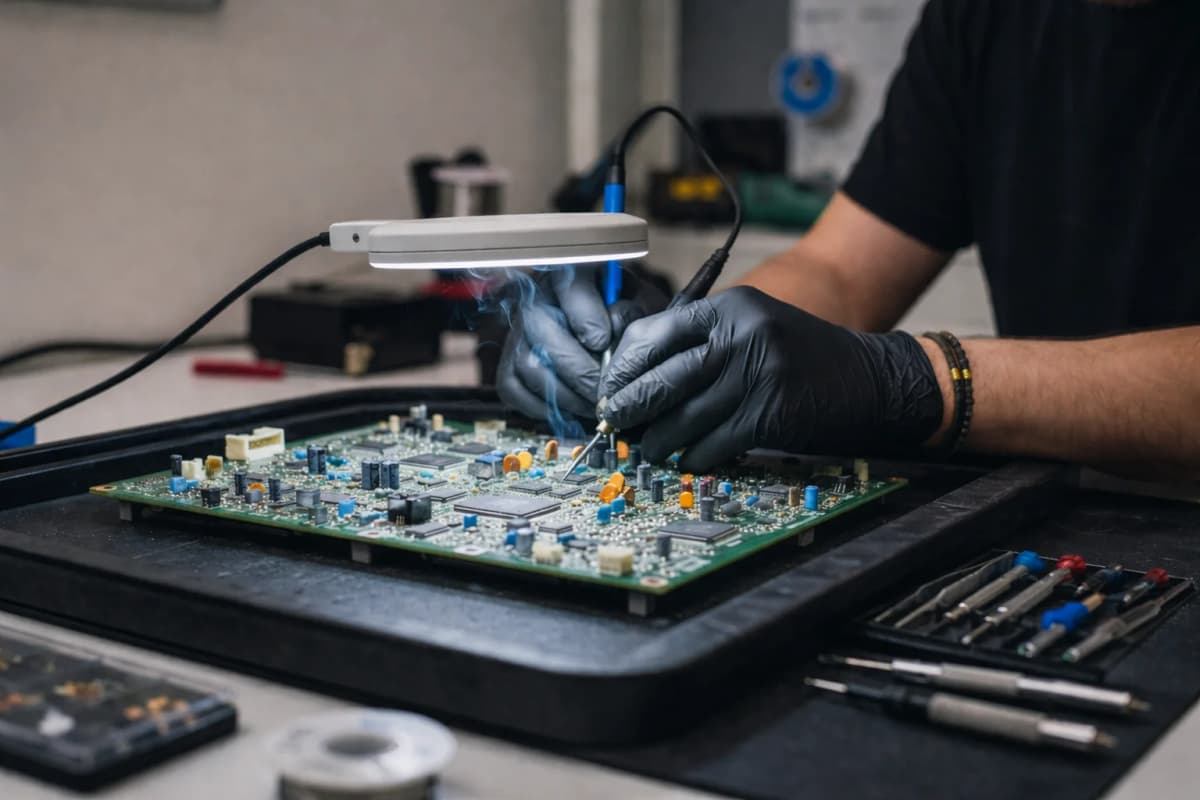
Getrag DPS TCM — workshop diagnostics, repair, and plug-and-play return
Problem with Getrag DPS TCM? Diagnostics, refurbishment, and bench testing, module returned paired to your vehicle. Request your personalized quote.
Please note: at Incarline, “repairing” a control unit means cloning. We transfer your original data — coding, immobiliser pairing and adaptations — onto a healthy unit with an identical reference. We do not carry out component-level repairs on your original unit.
The Getrag DPS transmission ECU (often referred to as DPS6 in some applications) controls a 6-speed dry dual-clutch gearbox via electric actuators dedicated to gear selection and clutch management. When it fails, typical symptoms include limp mode activation, jerking at start-up, loss of gears, or inability to engage forward/reverse, with communication faults on the CAN network. Commonly found on models like Ford Fiesta Mk7, Ford Focus Mk3, or Ford B-Max, this TCM stores adaptation parameters (clutch points, learnings) in non-volatile memory. An appropriate workshop treatment combines data reading (EEPROM/flash), checking power stages that supply the actuators, refurbishing sensitive components, and bench testing, to return a module ready to function without immobilizer relearning.
Find your exact reference
Search by hardware reference, software reference or control unit name. Click a result to configure and order without leaving the page.
Identify your exact reference
Before any intervention on a Getrag DPS TCM, precise identification of the reference helps ensure reliable diagnostics and software pairing. The external marking generally indicates the family (Getrag DPS / DPS6) and internal identifiers used for programming and adaptations. Here's how to proceed simply:
- Cut the vehicle's power and access the TCM, usually positioned above or near the Getrag DPS gearbox.
- Note the manufacturer label: mention “Getrag”/“DPS” or “DPS6”, part number, and barcode; take a clear photo.
- Record the vehicle's VIN and, if possible, read the information via the diagnostic tool (ECU ID, software version) to confirm consistency.
- Transmit these elements when requesting a quote so the workshop can validate the compatibility of operations (reading/cloning, potential reprogramming).
Your available options
Paired used unit
A used Getrag DPS TCM can be prepared and paired for your vehicle when the original data can be retrieved, avoiding a dealership visit.
Repair by cloning
Your own Getrag DPS TCM is opened, component-diagnosed, refurbished, and bench-tested to retain your adaptations and remain plug-and-play.
Reprogramming/Cloning
When the electronic part is sound, software cloning (copying relevant EEPROM/flash areas) or targeted reprogramming can resolve data corruptions.
What to expect technically
Upon receipt at Incarline, the Getrag DPS TCM is handled on an ESD workstation and referenced with your symptoms. A detailed visual inspection searches for heat marks, solder cracks, oxidation, and worn capacitors; a microscope check focuses on critical areas of actuator drivers and BGA pads. Memory reading (EEPROM and flash) is performed to save clutch and selection adaptations, often essential on this dry dual-clutch family. When software inconsistencies are detected, table reordering or selective reflashing is considered before any part replacement.
On the power side, the Getrag DPS controls electromechanical actuators via switching stages (H-bridges, dedicated drivers) and measures current using shunt resistors; these areas are tested under stabilized power to verify consumption, response to commands, and potential short circuits. Components typically targeted in case of failure include power transistors, shunt resistors, regulators, capacitors, and, more rarely, corrupted memory sectors. If necessary, controlled desoldering is performed, followed by replacement and BGA/SMT resoldering compliant with thermal profiles, then cleaning and AOI inspection.
The test bench simulates CAN communication with the engine ECU and reproduces gear engagement scenarios to validate selection and deselection, clutch responses, and thermal behavior. Key functions specific to the Getrag DPS — storage of clutch “kiss” points in non-volatile memory, separate management of the two shafts via dedicated actuators — are verified to ensure the module responds correctly to commands and retains its adaptations.
Once the checks are passed, the TCM is closed and sealed. The repaired module remains paired to your original vehicle (VIN and learning data retained), avoiding any immobilizer relearning upon reinstallation; depending on the gearbox and clutch condition, a hot adaptation cycle via the diagnostic tool may still optimize smoothness. A usual workshop lead time is communicated in the quote, and a workshop warranty applies to the performed service.
Frequently encountered symptoms on Getrag DPS/DPS6:
- Limp mode activation, gearbox warning message, and locking in a gear or neutral.
- Marked jerking at start-up, slipping, or intermittent loss of reverse gear.
- Sporadic communication loss with other ECUs on the CAN network.
Vehicles commonly equipped with the Getrag DPS TCM (depending on engines and markets):
- Ford Fiesta Mk7 (dry dual-clutch PowerShift gearbox).
- Ford Focus Mk3.
- Ford B-Max.
- Some Ford EcoSport.
In summary, a serious refurbishment of a Getrag DPS TCM combines data backup/validation, component-level cloning, BGA resoldering when required, and dynamic tests simulating real use — the goal being a plug-and-play return with adaptations retained.
Frequently asked questions
How do I know if my Getrag DPS ECU is faulty?
Which vehicles are equipped with the Getrag DPS ECU?
Can a Getrag DPS be cloned without visiting the dealership?
What is the difference between a repair and a paired used unit for a Getrag DPS?
Does the Getrag DPS ECU require learning after cloning?
Where is the Getrag DPS module located in the vehicle?
What internal elements most often fail on a Getrag DPS?
What data does the Getrag DPS manage in non-volatile memory?
Your reference isn’t listed?
Contact us — we can source your control unit or handle your repair on a quote basis.
Contact us