
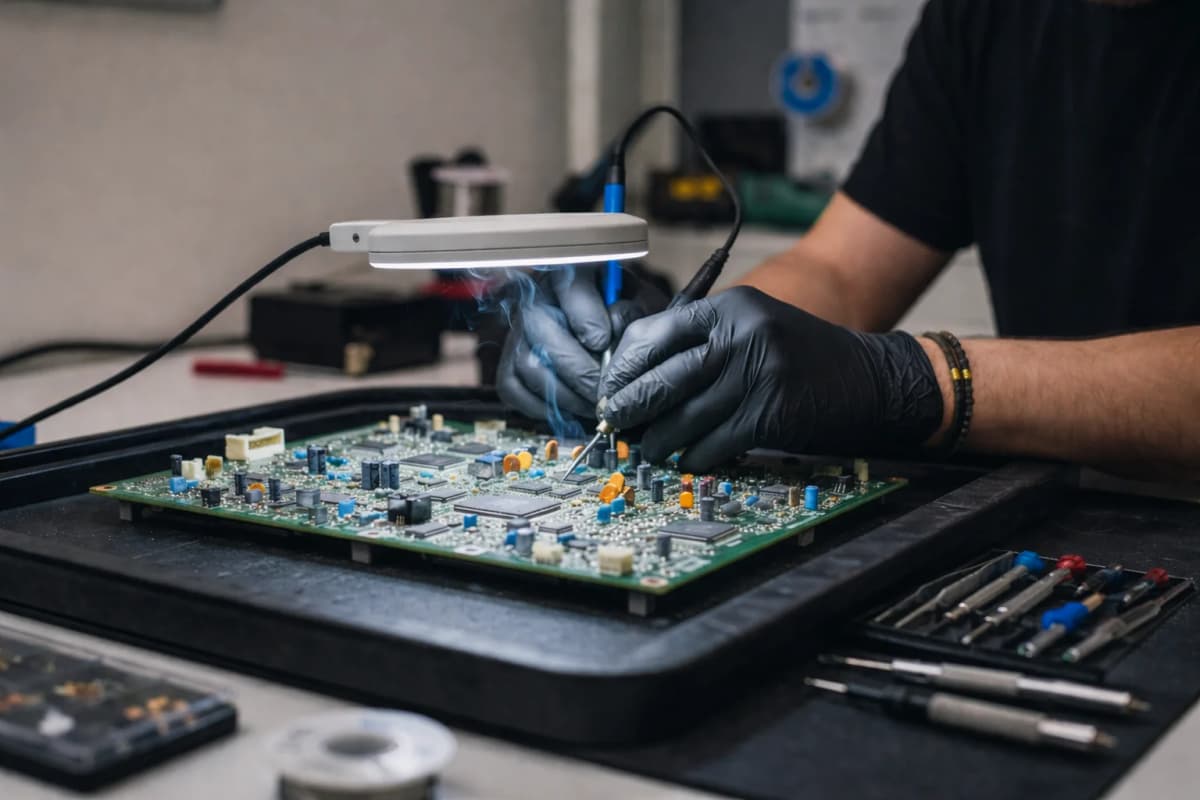
Bosch ME7: ECU engine diagnostic, faults and solutions
Engine light, limp mode or starting issues on Bosch ME7? Diagnostic, cloning or paired replacement possible. Request your personalized quote.
Note: on a Bosch ME7, our intervention is a cloning, not an electronic repair. Your data — coding, pairing, learned adaptations — are transferred to a healthy unit of the same reference. We do not work on your board's components.
Have you just run diagnostics and the vehicle is in limp mode, starts poorly or refuses to start? On the Bosch ME7 family (petrol ECM), typical symptoms include an illuminated engine light, unstable idle, acceleration cuts, and intermittent communication losses. The ME7 controls the motorized throttle, ignition, and injection based on the mass air flow sensor and various sensors; when the ECU has an internal fault, alerts related to internal control, throttle management, or sensor power supply often reappear after clearing. Conversely, a true sensor failure isolates a single subsystem and is confirmed by substitution. The ME7 core typically relies on a 16-bit microcontroller, external flash memory for the program, and a serial EEPROM for immobilizer and VIN identification. If doubt persists, bench testing and memory analysis can determine between electronic and peripheral failure.
Find your exact reference
Search by hardware reference, software reference or control unit name. Click a result to configure and order without leaving the page.
A typical case
A mechanic receives a Volkswagen Golf IV 1.8T with an engine light, lack of power, and fluctuating idle. The diagnostics show faults related to throttle management and internal monitoring, reappearing immediately after clearing. The throttle is cleaned, its learning reset, the mass air flow sensor substituted, without lasting improvement; communication on the K-line remains sometimes unstable while other ECUs communicate correctly. By removing the Bosch ME7 and bench testing it, the EEPROM reading confirms coherent content but recurrent anomalies on the program side. The chosen solution is a Bosch ME7 cloning to a healthy donor unit (copying EEPROM and identification areas), reinstallation on the vehicle, then throttle adaptation. The engine regains a sharp response, boost pressure is again regulated via the turbo solenoid, and the client leaves with a paired ECU without going through the manufacturer network. The same scenario occurs on Audi A3 8L 1.8T or Seat Leon 1M 1.8T, where electronic throttle control and immobilizer stored in the ME7 make the diagnosis particularly sensitive to ECU integrity.
Why this ECU has this fragility
The Bosch ME7 is a widely used generation of petrol management, marked by "e-gas" (motorized throttle) and a torque strategy. It commonly uses a K-line (ISO/KWP) for diagnostics and, depending on setups, CAN for inter-system exchange. In many vehicles, the ME7 combines a 16-bit microcontroller with parallel flash (program and maps) and a 95xxx series EEPROM dedicated to immobilizer and VIN pairing. Problems often appear after voltage drops, battery bridging, polarity reversals, or short circuits on actuators (coils, solenoids), which can alter internal power supply or corrupt program areas. In this family, an internal fault can result in intermittent communication loss, ECU coherence faults, inability to complete throttle learning, or a systematic return to limp mode despite replaced sensors.
Conversely, a sensor failure on a ME7 vehicle leaves distinctive clues. A truly faulty mass air flow sensor imposes emergency load calculations and degrades turbo regulation without preventing throttle adaptation; a malfunctioning pedal or throttle position sensor alters real-time read values and reacts to substitution with a tested part; an intake air leak disrupts mixture correction but disappears when sealing is restored. When the Bosch ME7 ECU itself fails, the K-line often becomes unstable only with the ECM, internal control faults reappear immediately, actuator outputs are inconsistently controlled, or immobilization is linked to EEPROM immobilizer data. Distinction is made by combining power supply and ground measurements at the ECU, oscilloscope checks on the diag line, cross-testing sensors, and, if necessary, memory reading to verify checksum and software integrity.
What changes when you send it to us
Upon receiving a Bosch ME7, it is opened, inspected, powered on a bench, and interrogated via K-line or CAN depending on version; flash and EEPROM memories are read to check immobilizer, VIN, and program integrity, then power stages and regulators are verified before functional testing on a simulator. Depending on the diagnosis, Incarline can clone your Bosch ME7 data to a strictly identical reference healthy unit, or provide you with a pre-paired used unit: we do not perform component-by-component repair. As an alternative to full replacement at the manufacturer, virginization or immo-off may be considered when the platform allows and according to the vehicle's legal context, with final validation by starting and throttle adaptation on site.
Frequently asked questions
How to know if my Bosch ME7 ECU is faulty?
Which vehicles are equipped with the Bosch ME7 ECU?
Can a Bosch ME7 be cloned without going to the dealer?
What is the difference between a repair and a paired used unit for a Bosch ME7?
What fault codes are commonly encountered on Bosch ME7?
Is the problem with the sensor or the Bosch ME7 ECU?
What to do in case of Bosch ME7 failure after a battery voltage drop?
Your reference isn’t listed?
Contact us — we can source your control unit or handle your repair on a quote basis.
Contact us