
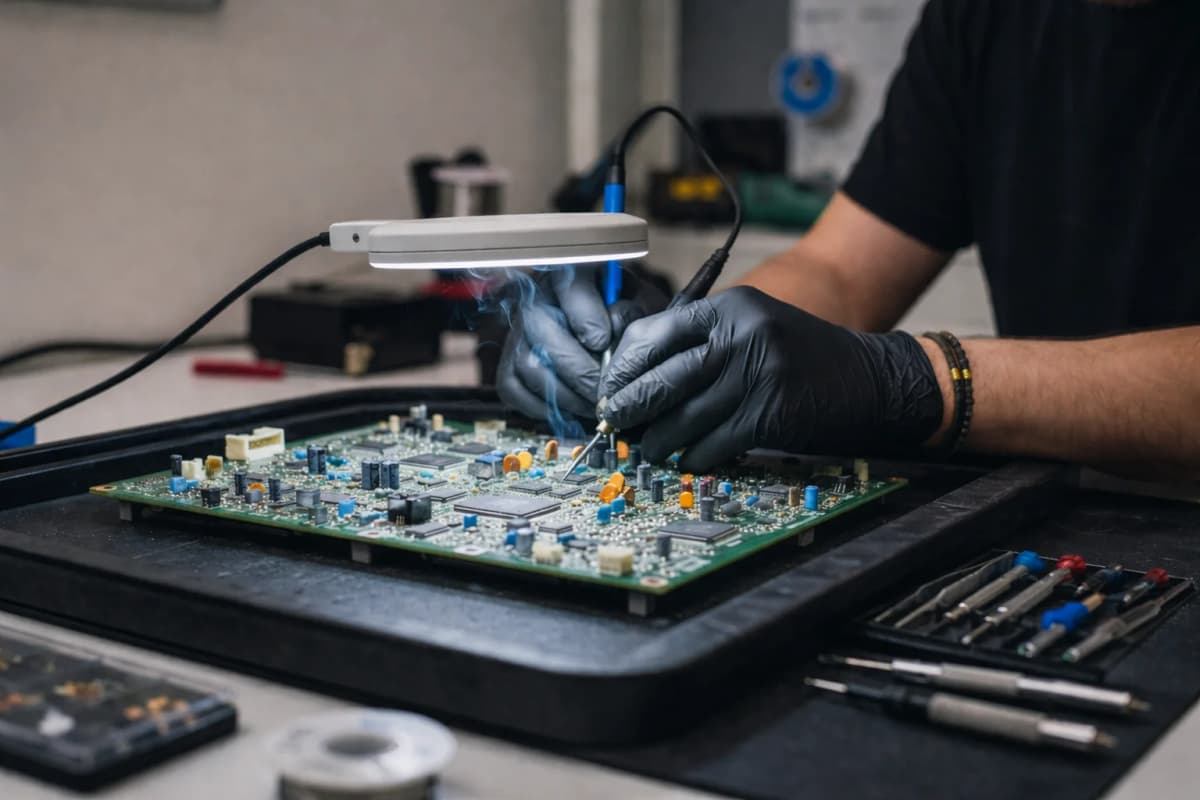
Temic DQ TCM: DSG remapping, maps and pairing
Optimize your Temic DQ TCM: adapted shift laws, torque, and clutch. Remapping in workshop or remote file. Request your personalized quote.
The Temic DQ transmission ECU is used in dual-clutch transmissions of the VAG group and controls the mechatronics (hydraulic pressure, clutches, shift laws). When the engine is upgraded to stage 1/2, the TCM may limit torque or retain unsuitable strategies. A targeted optimization of the Temic DQ allows adjusting clutch maps, accepted torque thresholds, and shift timings, while respecting the mechanics. Access is done according to the reference via OBD (CAN), in bench or boot-mode. Professional market solutions (for example, certain Alientech suites, CMD, or software like PCMflash) are used when the protocol of the targeted version is supported. Incarline offers remapping in the workshop or the provision of a modified file remotely, with backup of the original file and power supply precautions during writing.
Find your exact reference
Search by hardware reference, software reference or control unit name. Click a result to configure and order without leaving the page.
Technical sheet of this family
The Temic DQ family includes transmission ECUs (TCM) dedicated to dual-clutch gearboxes of the VAG group. The electronics are integrated into the mechatronic unit: a 32-bit microcontroller manages in real-time the hydraulic pressure, solenoid control, and coordination of the two clutches, while a flash memory stores the software and calibration areas, complemented by an EEPROM or data area for adaptations (coding, pairing, learned thresholds). Vehicle communication is done on the CAN network with frequent exchanges of requested/offered torque with the engine ECU, ABS/ESP, and the column module. This architecture, characteristic of Temic DQ TCMs, requires strict coherence between engine maps and gearbox strategy.
In remapping, access to the Temic DQ varies according to the revision: reading/writing via the OBD port is possible on certain versions; otherwise, a "bench" mode (direct connection to the ECU out of the vehicle) or a special start in boot-mode is used. In the professional field, recognized hardware and software support these TCMs when a protocol is available, notably Alientech solutions (including KESSv3 for supported variants), CMD, and software suites like PCMflash. Low-level methods such as boot/BDM may be required on specific generations but are not systematic. Typically modified areas on Temic DQ concern authorized torque maps (torque monitoring), clutch pressures, ramps and shift times, kickdown thresholds, lock-up management, and certain ancillary behaviors (creep, gear holding). Conversely, everything related to injection, timing, or boost pressure remains in the engine ECU and is not handled by the TCM.
Vehicles concerned
The Temic DQ is fitted on many VAG group models equipped with dual-clutch gearboxes. The presence and version depend on the engine and vehicle generation.
- Volkswagen Golf TSI/TDI — 2000-2010 and following years depending on generation
- Audi A3 TFSI/TDI — 2000-2010 and following years depending on generation
- Škoda Octavia TSI/TDI — 2000-2010 and following years depending on generation
- SEAT Leon TSI/TDI — 2000-2010 and following years depending on generation
- Volkswagen Passat TSI/TDI — 2000-2010 and following years depending on generation
- Audi Q3 TFSI/TDI — 2010 and following years depending on generation
Points of attention
On a Temic DQ, optimization must respect the balance of torque/traction/gearbox oil cooling. Increasing torque limits without adjusting clutch pressures or ramps can cause slippage and overheating. Similarly, overly aggressive shift laws at low revs can degrade comfort or unnecessarily stress the clutches. Before writing, it is recommended to perform a full backup, stabilize the power supply, check the integrity of the sensors (especially oil temperature), and the state of the mechatronics. In case of replacement, pairing (coding/identifiers) may require cloning or adaptation for the Temic DQ to accept the vehicle and for the immobilizer/network functions to remain operational.
Regarding procedures, prioritize OBD when the protocol is provided by the tool; otherwise, switch to bench/boot-mode with wiring and test points compliant with the treated version's diagrams. Partial writes (calibrations) are often safer than full writes if the platform allows, as they limit the risk of "bricking." Disabling kickdown, adjusting pressures, measured elevation of torque limits, or adapting timings in D/S/manual modes are realistic levers on Temic DQ, to be validated on the road and diagnostics (temperatures, slippage, shift quality). Incarline can perform Temic DQ remapping in the workshop or provide a modified file remotely, and intervene on pairing if a mechatronic replacement requires cloning or data adaptation.
Frequently asked questions
How do I know if my Temic DQ ECU is limiting torque after an engine stage 1?
Which maps of the Temic DQ are actually modifiable in optimization?
Can a Temic DQ be cloned without going to the dealer?
What access protocol should be used to read/write a Temic DQ in remapping?
Which vehicles are equipped with the Temic DQ ECU?
What are the risks during the remapping of a Temic DQ?
Can kickdown be removed or launch adjusted on a Temic DQ?
Does remapping the Temic DQ suffice to remove EGR/DPF/AdBlue?
Your reference isn’t listed?
Contact us — we can source your control unit or handle your repair on a quote basis.
Contact us