
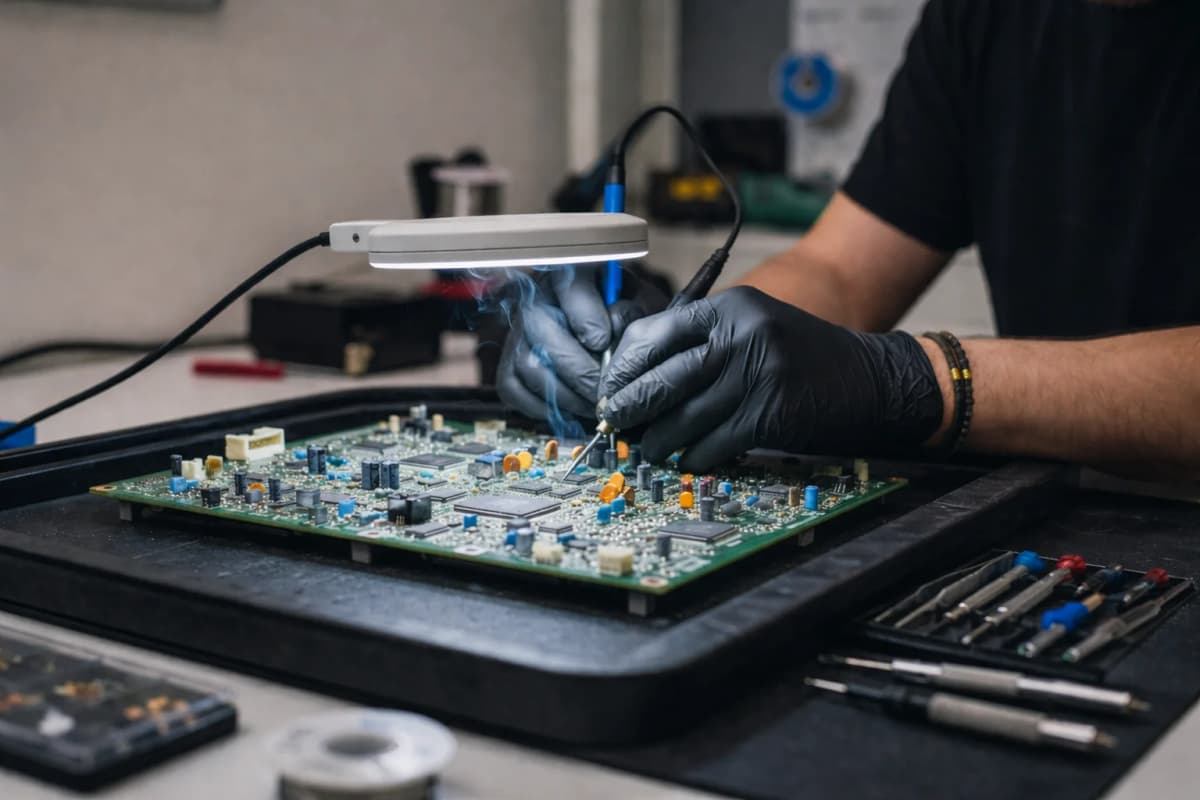
Siemens / Continental GPEC ECU — diagnostics, cloning, repair
Siemens / Continental GPEC ECU failure? Diagnostics, repair, and cloning to retain pairing. Request your personalized quote.
Please note: at Incarline, “repairing” a control unit means cloning. We transfer your original data — coding, immobiliser pairing and adaptations — onto a healthy unit with an identical reference. We do not carry out component-level repairs on your original unit.
The Siemens / Continental GPEC engine ECU (a family of petrol ECUs used on many FCA group engines) can exhibit typical power electronics or memory failures. Incarline handles these units in the workshop with a focus on preserving original data (VIN, immobilizer, codings). After a visual inspection of the board and reading of memory areas, we identify the elements involved (ignition/injector drivers, shunt measurement resistors, power supply capacitors, corrupted EEPROM areas) and proceed with a controlled restoration. The goal is to return a functional unit, still paired with the vehicle, thus avoiding any immobilizer relearning. Depending on the case, a GPEC remapping or cloning may complement the repair to ensure software consistency.
Find your exact reference
Search by hardware reference, software reference or control unit name. Click a result to configure and order without leaving the page.
Identify your exact reference
The Siemens / Continental GPEC family includes several variants (GPEC2, GPEC2A, GPEC3, GPEC4, GPEC4LM). To ensure the reliability of the service, it is essential to indicate the exact reference marked on your unit (manufacturer's label and engraved markings). This determines the test bench pinout, memory reading strategy, and, if necessary, compatibility for cloning.
- Disconnect the vehicle's power supply (battery disconnected) and remove the ECU while observing anti-static precautions.
- Note the title "Siemens / Continental GPEC" and the sub-variant (e.g., GPEC4LM) on the label.
- Record the production reference(s) and the VIN number if present on the label.
- Send clear photos of both sides of the label and the connector to confirm the pinout and hardware version.
The options available to you
Paired used unit
A used unit from the same family can be cloned from your Siemens / Continental GPEC to retain VIN, immobilizer, and codings.
Repair by cloning
The electronic board of your Siemens / Continental GPEC is restored by replacing faulty components, then validated on the bench.
Reprogramming / Cloning
EEPROM/Flash reading, duplication of useful data, and, if required, software reprogramming to ensure compatibility with your vehicle.
What to expect technically
When a Siemens / Continental GPEC arrives at the workshop, the process begins with a detailed visual inspection (signs of overheating on ignition drivers, coil/injector control circuits, oxidation, altered protective varnish). We then proceed to read the memories (serial EEPROM for identifiers and parameters, Flash for software) via access adapted to the GPEC generation. In this family, diagnostic communication typically occurs over CAN with UDS services, allowing for realistic bench testing.
Common failures observed on GPECs involve, depending on the case, power transistors (coil control, EVAP actuators, flaps, etc.), shunt resistors for current measurement, worn power supply capacitors, or corruption of certain memory areas. After identification, components are properly desoldered, replaced with quality equivalents, and resoldered; if the ECU contains a 32-bit microcontroller in a BGA package, reballing and X-ray inspection (or alignment inspection) may be performed when necessary to ensure ball reliability.
Before closure, the board is cleaned, solder joints are checked, and critical areas are re-coated with protective varnish if originally provided. Functional testing is conducted on the CAN bench, simulating key sensors/actuators, verifying internal power supplies, ignition/injection paths, and diagnostic communication. If a software inconsistency is detected, reprogramming may be performed to align the software version with your configuration.
An important point for this family: certain variants of Siemens / Continental GPEC (notably from the GPEC4 generation) control specific air/fuel management components on recent petrol engines; when cloning is performed, it preserves the necessary calibrations for these actuators. In all cases, the repaired or cloned ECU remains paired with your vehicle; no immobilizer relearning is required if your original data is intact and reintegrated.
Typical symptoms of a failing Siemens / Continental GPEC:
- Engine light on and limp mode without obvious mechanical cause.
- Random starting, hot cut-outs, or loss of ignition on multiple cylinders.
- Intermittent lack of diagnostic communication on the CAN network.
- Fault codes related to power stages or internal consistency (non-specific).
Examples of vehicles frequently associated with the Siemens / Continental GPEC family (depending on engine and production year):
- Jeep Grand Cherokee WK2 equipped with FCA group petrol engines.
- Dodge Charger LD in petrol configuration with recent generation GPEC ECU.
- Jeep Cherokee KL using GPEC4 variants for petrol engines.
The timeframe generally depends on the diagnostics and necessary operations; it is confirmed during the quote. The warranty applies according to current conditions. For immediate advice on your Siemens / Continental GPEC, contact Incarline with the exact reference on the unit.
Frequently asked questions
How do I know if my Siemens / Continental GPEC ECU is faulty?
Which vehicles are equipped with the Siemens / Continental GPEC ECU?
Can a Siemens / Continental GPEC be cloned without going to the dealer?
What is the difference between a repair and a paired used unit for a Siemens / Continental GPEC?
Does the Siemens / Continental GPEC use a UDS protocol on CAN for diagnostics?
What data is stored in the EEPROM of a Siemens / Continental GPEC?
Does the Siemens / Continental GPEC manage specific systems like MultiAir, and does this change the procedure?
Your reference isn’t listed?
Contact us — we can source your control unit or handle your repair on a quote basis.
Contact us