
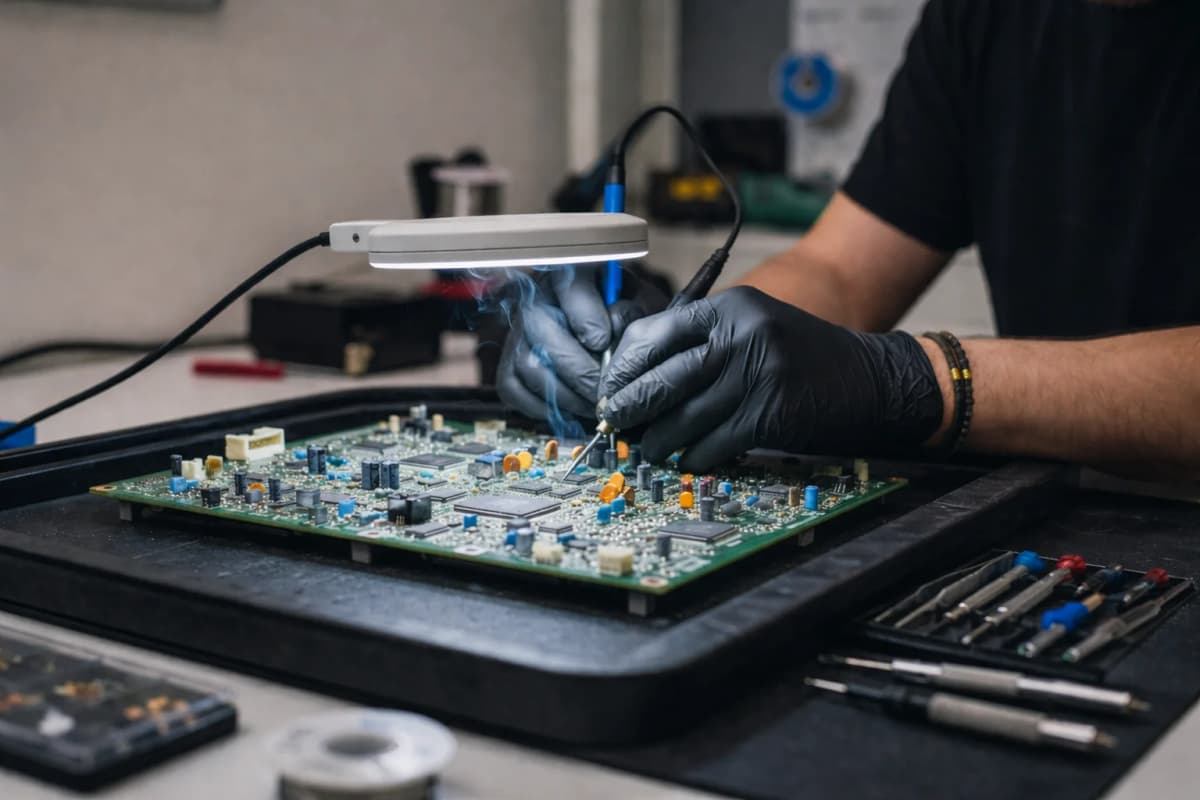
Bosch EDC17: ECU engine diagnostic and repair in workshop
Issue with your Bosch EDC17? Diagnostic and repair in workshop, cloning or paired replacement. ECU returned ready to start. Personalized quote.
Please note: at Incarline, “repairing” a control unit means cloning. We transfer your original data — coding, immobiliser pairing and adaptations — onto a healthy unit with an identical reference. We do not carry out component-level repairs on your original unit.
Designed for common rail diesel injection management, the Bosch EDC17 ECU controls fuel supply, EGR, turbocharging, and post-treatment depending on the version. When a Bosch EDC17 exhibits malfunctions (engine light, limp mode, random or impossible start), the workshop intervention focuses on the electronic cause: internal power supply, actuator drivers, non-volatile memory, and solder integrity. At INCARLINE, the typical process includes a thorough visual inspection, reading of memories (EEPROM/flash) to secure pairing data, identification of faulty components, then micro-repair (clean desoldering, replacement, resurfacing/BGA if necessary) before bench tests and functional validation. The ECU is returned paired to your vehicle, with no immobilizer relearning required. The timeframe depends on the fault and workshop load; an estimate is provided in the quote.
Find your exact reference
Search by hardware reference, software reference or control unit name. Click a result to configure and order without leaving the page.
Technical sheet of this family
The Bosch EDC17 family includes recent generation diesel engine ECUs, built around a 32-bit microcontroller from the typical tri-core range of that era. It features flash memory (internal and/or external depending on the reference) containing the firmware and calibrations, as well as a serial EEPROM dedicated to persistent parameters and pairing data. Diagnostic communication is via the CAN bus, with protocols commonly used on this generation (UDS or KWP depending on variants). The family references are available in multiple suffixes (e.g., EDC17Cxx / EDC17CPxx) to adapt to common rail injection architectures and peripherals (EGR management, turbo geometry, pressure/Temp sensors, post-treatment depending on the engine).
In the workshop, the restoration of a Bosch EDC17 follows a tooled and reproducible process. After controlled opening of the casing, a visual inspection under a magnifying glass/microscope searches for signs of overheating, corrosion, varnish cracks, or cracked components. Power supplies are checked (regulators, filtering, capacitors), as are the power stages (actuator drivers, transistors, shunt resistors). Memories are read securely: in-circuit when possible, or after clean desoldering if communication is disrupted. Common cases include dry capacitors, drifting shunt resistors, or memory area corruption causing a no-boot. Faulty components are replaced identically, BGA package balls can be reworked if a solder fatigue is suspected, then connections are resoldered with seal control. The validation phase combines a controlled start on the bench, a CAN diagnostic session, component activation tests, and data integrity verification (EEPROM/flash). If necessary, a reprogramming is performed to align software and calibrations. In the end, the Bosch EDC17 is returned with its original identifiers and pairing, avoiding any immobilizer procedure upon reassembly.
Vehicles concerned
The Bosch EDC17 is fitted to many diesel engines on the European market. Without listing specific model years, it is found on sedans, estates, and light commercial vehicles from well-known brands, notably on 1.6 TDI to 3.0 TDI engines and 2.0 CDTI depending on the manufacturers. Check the Bosch label and the EDC17 reference on your casing for confirmation.
- Volkswagen Golf — 2.0 TDI — late 2000s and 2010s
- Volkswagen Passat — 2.0 TDI — 2010s
- Audi A4 — 2.0 TDI — late 2000s and 2010s
- Audi A3 — 1.6/2.0 TDI — 2010s
- Skoda Octavia — 2.0 TDI — 2010s
- SEAT Leon — 2.0 TDI — 2010s
- Opel Insignia — 2.0 CDTI — 2010s
Points of attention
Before suspecting a Bosch EDC17 ECU failure, check the vehicle power supply (battery/ground), the wiring, the injection (injector short-circuit, EGR or turbo actuator), and the absence of water ingress in the casing. An interrupted OBD write or overvoltage can also corrupt memory areas. In diagnostics, symptoms like limp mode, difficult/cold start, random cut-offs, or inability to communicate via CAN point to the ECU. In the workshop, the method prioritizes saving pairing data, reading EEPROMs, verifying control stages, and bench testing simulating vehicle signals. The returned ECU remains paired to the original car, avoiding any immobilizer relearning.
Micro-repair operations are conducted in an ESD-protected environment; clean desoldering of components, including BGA packages if necessary, is followed by identical replacement and resurfacing of critical solder joints. Reprogramming may be performed to restore software coherence after cloning. Depending on the diagnosis, Incarline can clone the data from your Bosch EDC17 onto a healthy unit with a strictly identical reference, or supply an already-paired used unit: we do not carry out component-level repairs. The timeframe is communicated in the quote and remains dependent on the diagnosis and workshop load.
Frequently asked questions
How do I know if my Bosch EDC17 ECU is faulty?
Which vehicles are equipped with the Bosch EDC17 ECU?
Can a Bosch EDC17 be cloned without going to the dealer?
What is the difference between a repair and a paired used unit for a Bosch EDC17?
What internal faults are encountered on Bosch EDC17?
Does the Bosch EDC17 use the UDS protocol via CAN for diagnostics?
What tests are performed after cloninging a Bosch EDC17?
Your reference isn’t listed?
Contact us — we can source your control unit or handle your repair on a quote basis.
Contact us