
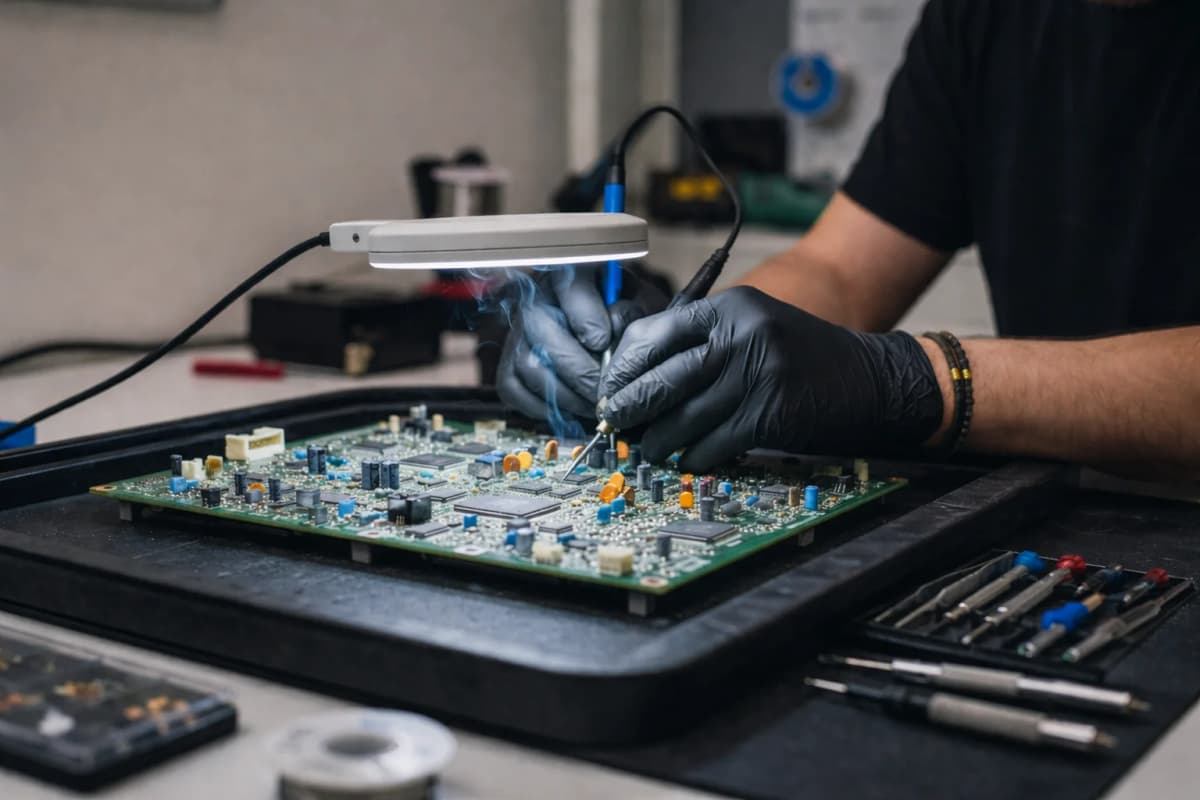
Bosch EDC15: diesel engine ECU diagnostics and remedies
Bosch EDC15 ECU malfunctioning? Symptoms, causes, cloning, and paired replacement explained. Contact INCARLINE for technical advice or a quote.
Please note: at Incarline, “repairing” a control unit means cloning. We transfer your original data — coding, immobiliser pairing and adaptations — onto a healthy unit with an identical reference. We do not carry out component-level repairs on your original unit.
Engine light, limp mode, power loss, or erratic starting after a diagnostic tool check? The Bosch EDC15 is a diesel engine ECU (ECM) widely used in first-generation TDI/HDI. It typically communicates over the K-line (ISO 9141/ISO 14230 KWP2000) and stores immobilizer/codings in a separate 24Cxx series EEPROM from the main flash memory. When real-time measurements seem inconsistent (rail pressure, air flow, EGR control) or multiple sensors simultaneously lose their reference, the 'ECU' path becomes credible. This page helps you read your symptoms, differentiate a sensor fault from a module failure, and understand possible actions: sending for electronic check, Bosch EDC15 cloning to retain the immobilizer, or paired replacement if necessary.
Find your exact reference
Search by hardware reference, software reference or control unit name. Click a result to configure and order without leaving the page.
In brief
The Bosch EDC15 controls diesel injection from this era and is often blamed when the vehicle goes into safety mode, refuses to start, or reports aberrant values. Its communication is mostly via K-Line and its identification data (VIN/immobilizer) reside in a 24Cxx EEPROM, allowing for cloning in case of replacement. If your diagnostic tool readings point to transversal faults rather than targeted ones, the ECU deserves a thorough diagnosis.
Frequently Asked Technical Questions
Why does this ECU fail?
With age, thermal cycles and vibrations eventually weaken internal solder joints and some power/control components of the Bosch EDC15. Moisture ingress or voltage variations can accelerate these drifts. Typical symptoms include random cut-offs, common 5 V reference losses across multiple sensors, or inability to properly control actuators (EGR, variable geometry, solenoids). In this generation, the K-Line topology and internal power electronics make these faults visible to the diagnostic tool through multiple inconsistencies rather than a single isolated sensor.
What signs point to a faulty Bosch EDC15 and on which models is it found?
When the engine goes into limp mode with a clear loss of torque, starting is erratic hot or cold, or multiple measurements (air flow, rail pressure, EGR position) contradict each other without an obvious mechanical cause, the Bosch EDC15 may be at fault. It is notably found on compact and family cars from the VAG group like the Volkswagen Golf IV TDI (1J platform), Audi A3 8L TDI, and Skoda Octavia I TDI (1U). Some sedans and HDi estates of an equivalent generation also use EDC15 variants. The coexistence of transversal faults and a healthy sensor/actuator network strongly points to the ECU.
How to differentiate a sensor/actuator failure from a Bosch EDC15 failure?
Proceed by exclusion. First, check the ECU's power supply and ground, then the stability of the references (5 V) directly at the connector. An unstable reference on multiple lines at once points to the ECU. Next, check the harness continuity between EDC15 and sensors (mass air flow sensor, rail pressure sensor, pedal sensor) and compare real data to a simple mechanical check (high-pressure diesel leak, EGR clogging). If a substituted or disconnected sensor does not change the expected behavior, or if actuators remain silent when command is requested, the ECU's internal logic/driver may be at fault. Finally, the simultaneous presence of K-Line communication faults and plausible engine values is another indicator of a tired EDC15.
Can a Bosch EDC15 be cloned while retaining the immobilizer?
Yes, in this family, the VIN, immobilizer, and codings are generally housed in a 24Cxx EEPROM separate from the flash. Cloning a Bosch EDC15 involves transferring these data (and, if necessary, the parallel flash content) to a donor unit of the same reference. This results in a paired replacement without going through the manufacturer network. In the presence of memory corruption or a silent ECU, a 'bench read' may be necessary. Immo-off is possible on some variants, but retaining original functions via cloning/pairing remains the preferred route on open roads.
Possible Remedies
Depending on the diagnosis, Incarline can clone the data from your Bosch EDC15 onto a healthy unit with a strictly identical reference, or supply an already-paired used unit: we do not carry out component-level repairs.
Frequently asked questions
How to know if my Bosch EDC15 ECU is faulty?
Which vehicles are equipped with the Bosch EDC15 ECU?
Can a Bosch EDC15 be cloned without going to the dealership?
Does the Bosch EDC15 communicate via CAN or K-Line?
What are typical symptoms of a faulty Bosch EDC15 at startup?
What is the difference between a repair and a paired used unit for a Bosch EDC15?
Can a Bosch EDC15 be read/written via the OBD port?
Your reference isn’t listed?
Contact us — we can source your control unit or handle your repair on a quote basis.
Contact us