
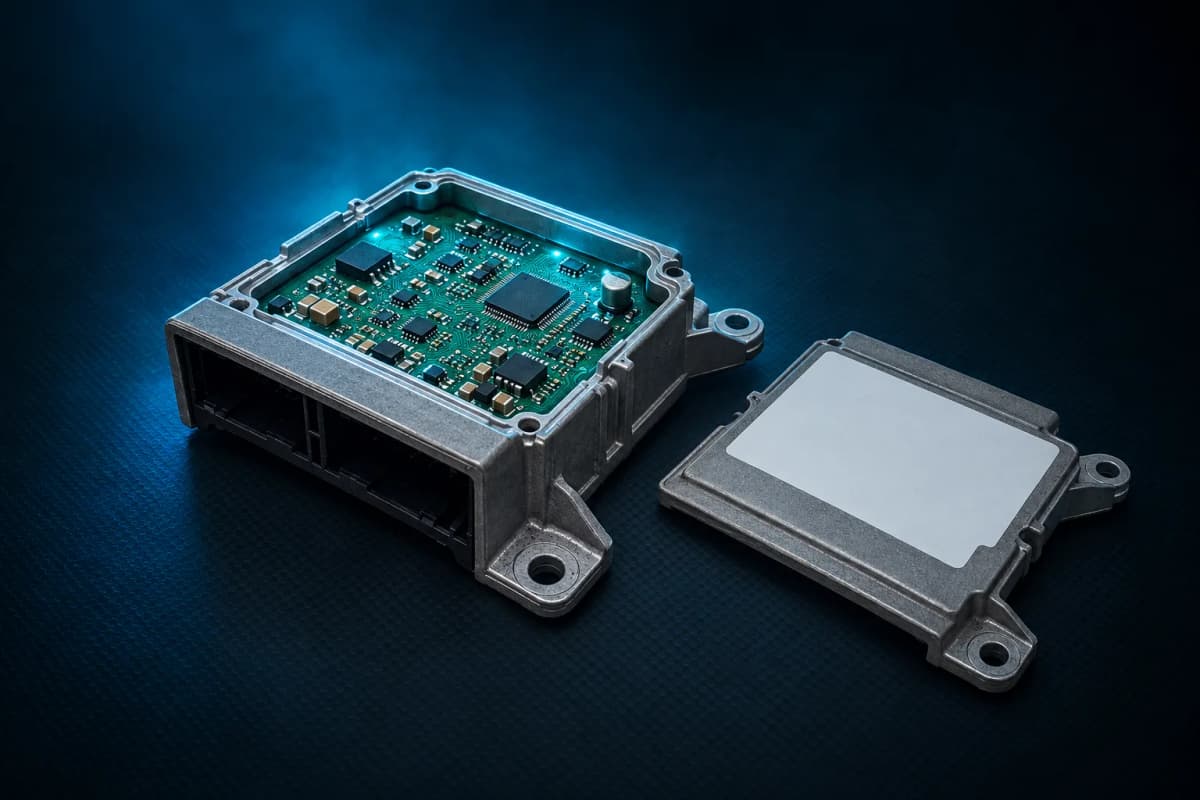
After an impact, the airbag ECU records crash data and locks permanently — no diagnostic tool can erase them. What resetting resolves, and what it does not replace.
After an impact, even without apparent severity, the SRS light remains on the dashboard. Sometimes the vehicle outright refuses to start. It's not a faulty sensor: the airbag ECU has recorded the event and locked itself. As long as it remains in this state, your airbags will not redeploy.
Why an Airbag ECU Locks
The airbag ECU — or SRS module — continuously monitors the vehicle's accelerometers. When it detects a deceleration characteristic of an impact, it triggers the airbags and seatbelt pretensioners, then records what is called crash data: the event log.
This locking is not a defect, it's a safety feature. It prevents a module that has already experienced a deployment from being considered operational without human verification. The downside is that a locked ECU remains so permanently, even if the impact was minor and nothing deployed.
Signs That Don't Lie
- The SRS or airbag light remains permanently on after an impact.
- The vehicle refuses to start, or starts then goes into safety mode.
- The diagnostic returns fault codes related to the airbag module, impossible to erase with a standard tool.
- The light reappeared shortly after a garage visit where it had been "erased".
This last case deserves clarification: a diagnostic tool can erase fault codes, but not crash data. They are recorded in the ECU's memory, and that's precisely why a simple erasure with the tool is never enough.
What Resetting Does — and What It Doesn't
This distinction is the most important of this article, so let's state it plainly.
Resetting erases the crash data and fault codes recorded in the ECU. The module returns to its operational state: it becomes capable again of detecting an impact and triggering what is connected to it.
It does not replace deployed components. If airbags have deployed, if seatbelt pretensioners have triggered, these parts are single-use and must be replaced by an authorized garage. An ECU reset on a vehicle whose airbags have not been replaced gives the illusion of an operational system — the light turns off — when there is nothing left to deploy. This is the situation to avoid at all costs.
Our intervention focuses on the ECU alone. The rest of the safety chain is the responsibility of the workshop that restores the vehicle.
Why Replacement Is Not the Right Answer
A new dealership module costs between €500 and €1,500 depending on the model, plus mandatory programming.
As for used ones, they pose a problem few anticipate: these ECUs almost always come from crashed vehicles. Many still contain the crash data from their original vehicle, not erased and perfectly invisible to the naked eye. You risk installing an already locked module — or worse, believing the problem is solved because the light temporarily turns off.
Starting from your own ECU eliminates this uncertainty: you know exactly what it has experienced, and its history is erased.
Identify Your ECU
The OEM reference is usually printed on the label affixed to the casing. It determines the feasibility of the intervention.
We handle the vast majority of modules on the market: the Bosch 0285010xxx, 0285011xxx, and 0285012xxx series, very common in Peugeot, Citroën, and Dodge; the Continental and former Siemens VDO like the 9675127080 and 9677910680 from the PSA group; the Siemens 5WK43154 and 5WK43349; the Temic, including the 402107B4, 402787B5, 402787B7, and 402792B7 installed in Renault; as well as the TRW.
If in doubt, a photo of the label is enough to clear any ambiguity before ordering.
⚠️ Safety — Battery Disconnection Required
The airbag ECU contains motion sensors. Handling it while the battery is connected — during removal or reinstallation — can be interpreted as an impact and trigger airbag deployment. At close range, a deploying airbag causes serious injuries.
Therefore, disconnect the battery before removing the ECU, allow the circuit to discharge, and only reconnect it once the module is reinstalled and reconnected. This precaution applies to both directions of the operation: reconnection is the most often neglected moment, and it is one of the riskiest.
How It Works
The vehicle does not need to be moved: only the ECU travels. It is generally located under the central console or under a front seat, depending on the model.
Once the order is placed, DHL picks up the package from you at the date and time of your choice, with pickup included in the price. Diagnosis and resetting take 24 to 48 working hours. The module returns to you ready to reinstall, without additional reprogramming, with a one-year warranty. The package is €149 including VAT.
A caveat: this service is for an ECU locked by an impact. If yours is physically destroyed — immersion, severe short circuit — a preliminary diagnosis is necessary before anything else.
In Summary
An SRS light that remains on after an impact almost always signals an ECU locked by crash data, which no diagnostic tool can erase. Resetting your original module costs a fraction of the price of a new one and eliminates the very real risk of a used module carrying the history of another accident.
With one non-negotiable condition: deployed airbags and pretensioners must have been replaced. The ECU controls safety, it does not replace it.
Questions fréquentes
La réinitialisation remplace-t-elle les airbags déployés ?
Non, et c'est le point le plus important. Les coussins et les prétensionneurs de ceinture sont à usage unique : une fois déployés, ils doivent être remplacés par un garage agréé. La réinitialisation porte uniquement sur le calculateur, qui redevient capable de commander le système — encore faut-il qu'il y ait quelque chose à déployer.
Pourquoi ma valise de diagnostic n'efface-t-elle pas le défaut ?
Un outil de diagnostic efface des codes défaut, pas les crash data. Celles-ci sont inscrites dans la mémoire du calculateur et constituent un verrouillage volontaire, conçu pour qu'un module ayant vécu un déploiement ne soit pas réputé opérationnel sans intervention. C'est pour cette raison que le voyant réapparaît systématiquement.
Puis-je monter un calculateur d'occasion à la place ?
C'est risqué. Ces modules proviennent presque toujours de véhicules accidentés et contiennent souvent les crash data de leur véhicule d'origine, non effacées et invisibles à l'œil nu. Vous risquez de monter une pièce déjà verrouillée, ou de croire le problème réglé alors qu'il ne l'est pas.
Faut-il faire remorquer le véhicule ?
Non. Seul le calculateur voyage. Il se trouve généralement sous la console centrale ou sous un siège avant selon les modèles. DHL vient récupérer le colis chez vous à la date et à l'heure que vous choisissez, l'enlèvement étant compris dans le prix.
Comment savoir si mon calculateur est pris en charge ?
La référence OEM figure sur l'étiquette collée sur le boîtier. Nous traitons la grande majorité des modules du marché : Bosch séries 0285010xxx à 0285012xxx, Continental et ex-Siemens VDO, Siemens 5WK43154 et 5WK43349, Temic dont les références Renault, ainsi que TRW. En cas de doute, une photo de l'étiquette suffit à trancher avant commande.
Faut-il reprogrammer le module après remontage ?
Non. C'est votre calculateur d'origine qui vous revient, avec son codage véhicule intact : il se remonte tel quel. Un module neuf, lui, sort vierge d'usine et impose une programmation.
Et si mon calculateur est physiquement endommagé ?
Cette prestation s'adresse à un module verrouillé par un choc, dont l'électronique est intacte. En cas d'immersion ou de court-circuit sévère, un diagnostic préalable est nécessaire : contactez-nous avant de commander.
Réinitialisation calculateur airbag après accident
Our technicians carry out this operation in our workshop.