
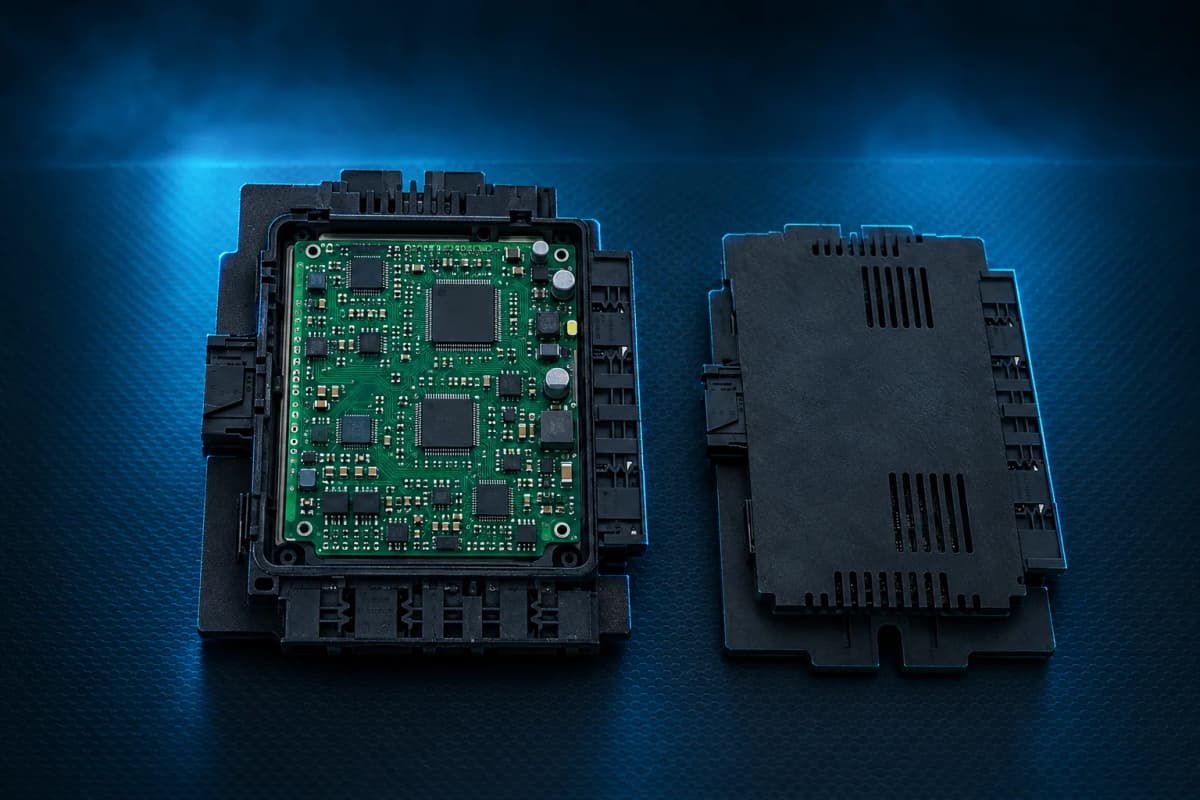
Headlights permanently on, unresponsive central locking, erratic windows: these seemingly unrelated issues point to the FRM module. In most cases, it's not dead — it has entered protection mode after 50 detections.
Your headlights stay on even when the ignition is off. The central locking no longer responds. The windows work every other day, the wipers activate at random. These issues seem to have no connection — and that's precisely what makes them puzzling. On a BMW E Series or a MINI R, they almost always point to a single unit: the FRM.
The FRM, the unit on which the entire cabin depends
FRM stands for Footwell Module, generally in its third generation on the vehicles concerned — hence the name FRM3. It is located behind the glove box, on the passenger side, in most models.
Its scope explains the variety of symptoms: it manages lighting, door central locking, wipers, and cabin electronics. A single module for all these functions, so a single fault can disrupt them all together.
The equipped vehicles are the BMW 1 Series E81, E82, E87, and E88, the 3 Series E90, E91, E92, and E93, the X5 E70, X6 E71 and E72, X3 E83 and X1, as well as the MINI R55, R56, R57, R58, R59, R60, and R61.
The symptoms that indicate the FRM
- Headlights and low beams permanently on, even with the ignition off.
- Door central locking inoperative, both locking and unlocking.
- Wipers, electric windows, and interior lighting behaving erratically.
- Characteristic fault codes: A3C1, A3B4, 497F, CCID-231.
The most telling sign is not an isolated symptom but their combination: several seemingly unrelated functions degrading simultaneously. A damaged wiring harness wouldn't cause this; a central module would.
What really happens inside
Here's the point that few explanations mention, and it changes the way the fault is understood.
The FRM contains a detection counter. Each time it detects an electrical anomaly on the circuits it monitors — a blown bulb, an oxidized terminal, a short circuit in a harness — it increments this counter. After 50 detections, it locks itself permanently for safety.
In other words: in many cases, the module is not dead. It has entered protection mode. And it did so because something upstream was sending it repeated anomalies.
This nuance has an immediate practical consequence, which we will return to below — because it determines the success of the intervention.
Why going to the dealership is disproportionate
The standard response is replacement: a new FRM costs €500 to €700, plus mandatory programming, as the module comes factory blank.
It's a significant expense for a unit that, most of the time, has simply entered protection mode after counting to fifty.
Reset rather than replace
The intervention involves resetting this counter to zero and replacing the actually faulty components with original parts. The module returns plug and play: no reprogramming is necessary after reinstallation, as it's your original module returning with its vehicle coding intact.
The package is €119 including VAT, with DHL pickup and return included, and a one-year warranty. The module is bench-tested before shipment.
The mistake not to make
This is where the detection counter becomes crucial, and this advice might save you from paying twice.
If the FRM has locked, it's because it detected anomalies. Resetting the counter without addressing their origin is like resetting the stopwatch: the upstream electrical fault continues to generate detections, and the module saturates again within a few weeks.
Before sending us the unit, take the time to check and correct what might have triggered it: faulty bulbs, oxidized terminals, short circuits in a harness, loose connectors. This check is not an administrative formality — it determines whether the repair holds over time.
How it works
The vehicle doesn't need to be immobilized with us: only the module travels. It is removed from behind the glove box, on the passenger side, in most models.
Once the order is placed, DHL will pick up the package from you at the date and time you choose. Diagnosis and repair take 24 to 48 business hours after receipt. The return is at our expense, with the module tested and ready to reinstall without a dealership visit.
In summary
Seemingly unrelated cabin faults — headlights, locks, windows, wipers — most often point to the FRM on BMW E Series and MINI R. In the majority of cases, the module has entered protection mode after accumulating fifty anomaly detections, rather than having actually failed.
Restoring it costs significantly less than replacement, on one condition: identifying what caused it to count up to that point.
Questions fréquentes
Faut-il immobiliser le véhicule chez vous ?
Non. Seul le module voyage. Il se démonte derrière la boîte à gants, côté passager, sur la plupart des modèles. DHL vient récupérer le colis chez vous à la date et à l'heure que vous choisissez.
Mon FRM est-il mort ou seulement verrouillé ?
Dans la majorité des cas, il s'est mis en protection. Le module compte les anomalies électriques détectées sur les circuits qu'il surveille et se verrouille au bout de 50 détections. C'est un mécanisme de sécurité, pas une défaillance définitive — c'est justement ce qui permet de le remettre en service.
Faut-il reprogrammer le module après remontage ?
Non. C'est votre module d'origine qui vous revient, avec son codage véhicule intact : il se remonte en plug and play, sans passage en concession. Un FRM neuf, lui, sort vierge d'usine et impose une programmation.
Pourquoi vérifier l'installation électrique avant d'envoyer le module ?
Parce que le compteur de détections s'est rempli pour une raison. Si le défaut amont subsiste — ampoule grillée, cosse oxydée, court-circuit dans un faisceau, connecteur desserré — le compteur du module réparé se resaturera en quelques semaines. Cette vérification décide de la durabilité de l'intervention.
Quels véhicules sont concernés ?
Les BMW Série 1 E81, E82, E87 et E88, les Série 3 E90, E91, E92 et E93, les X5 E70, X6 E71 et E72, X3 E83 et X1, ainsi que les MINI R55, R56, R57, R58, R59, R60 et R61.
Combien de temps prend l'intervention ?
Le diagnostic et la réparation prennent 24 à 48 heures ouvrées après réception, auxquelles s'ajoutent les délais d'acheminement aller et retour. Le module est testé sur banc avant expédition.
Et si les symptômes ne venaient pas du FRM ?
Le signe le plus fiable est la combinaison de pannes sans rapport apparent — éclairage, serrures, vitres, essuie-glaces qui se dégradent ensemble. Si une seule fonction est touchée, la cause est plus probablement locale : ampoule, faisceau ou contacteur. Le diagnostic le confirmera avant toute intervention.
Réparation module FRM BMW / MINI
Our technicians carry out this operation in our workshop.