
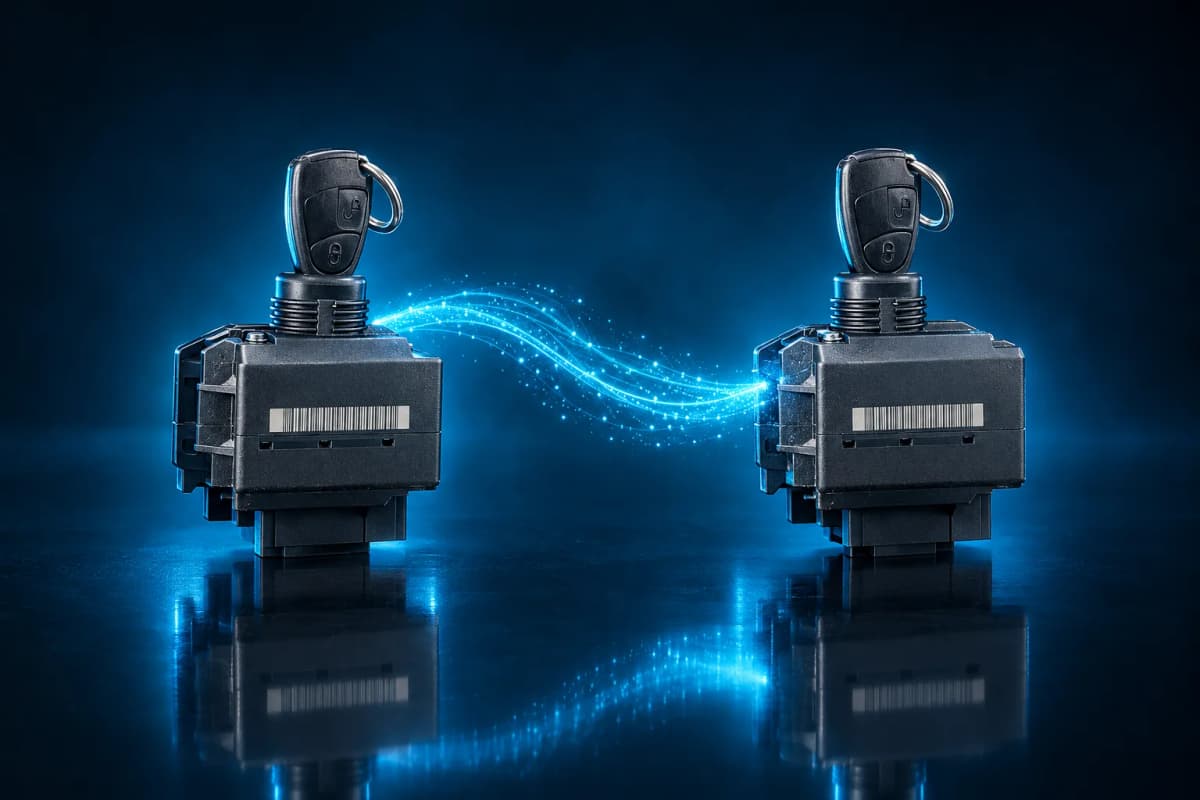
Key no longer turns, "Key not recognized," starts every other time: these symptoms often point to the EZS. How to identify the failure, and why transferring your data to a healthy module avoids pairing at the dealership.
Your Mercedes no longer starts, the key refuses to turn, or the instrument cluster displays "Key not recognized." Before concluding a tired battery or a worn-out starter, there is a module to suspect first: the EZS. It is the part that authorizes — or refuses — the start of your vehicle, and its failures follow a fairly recognizable pattern.
What exactly is the EZS?
EZS is the abbreviation for Elektronisches Zündschloss: the electronic ignition switch. In Mercedes nomenclature, it is also referred to by the code N73. It has been fitted to most Mercedes since 1997 and replaces the traditional mechanical ignition lock.
Its role far exceeds that of a lock. The EZS reads the car key, verifies its identity, authorizes the start, manages the anti-theft system, and constantly communicates with the engine ECU and the SAM. It is paired with your vehicle: it knows your ECU and your keys, and they know it. This relationship is at the heart of the problem, as we will see.
Symptoms indicating the EZS
An EZS failure rarely manifests all at once. It often starts with intermittence — the vehicle starts every other time — before becoming permanent. The most characteristic signs:
- The key turns normally, but the starter does not engage.
- The key no longer turns at all, stuck in position 0 or 1.
- The instrument cluster displays "Key not recognized," "Insert key," or "Start impossible."
- Starting becomes random, then consistently fails.
- The anti-theft light stays on or flashes on the dashboard.
- The battery drains while stationary for no apparent reason — a faulty EZS can remain in active standby.
If a diagnostic has been performed, certain fault codes clearly point to this module: B1031, B1030, P1525, and P1693 concern communication between the EZS and the engine ECU.
On S-Class W221 and CL coupe W216, the symptom takes another form: the Keyless-Go button no longer responds, or the inserted key is no longer recognized. These models use a more sophisticated version of the module, with enhanced encrypted communication.
Internally, the origin is often the same: the microcontroller — a Motorola MC68HC908 in many cases — or the capacitors in the power stage, which degrade over time and heat.
What resembles an EZS failure without being one
Let's say it right away: not all start refusals come from the EZS, and it would be a shame to remove a module in good condition.
A weak battery produces similar symptoms, with a useful difference: it generally affects other functions at the same time — dimming lights, slow window lifts, instrument cluster turning off. A worn car key battery prevents recognition, but the problem disappears with the second key. A worn-out starter produces a characteristic clicking sound, whereas a faulty EZS most often leaves complete silence.
The most telling test remains that of the second key. If the vehicle starts with it, the module is probably not the cause.
Why dealership visits are so expensive
This is where the pairing mentioned earlier becomes crucial. A new EZS leaves the factory blank: it knows neither your engine ECU nor your keys. It must therefore be synchronized at Mercedes according to a proprietary procedure.
The module alone costs €700 to €1,200 for C, E, and CLK series, and €1,200 to €1,800 on S-Class W221. Added to this is the pairing, charged €150 to €500 depending on the center and model complexity. Key recoding is often necessary on top, at €50 to €100 per unit. The total bill commonly ranges between €900 and €2,500.
And second-hand is not an escape: an EZS taken from another vehicle remains coded with that vehicle's ECU and keys. Installing it as is causes a pairing refusal. It's a dead end — unless you tackle the real issue, which is not the part but the data it contains.
Cloning: Keep your data, change the support
This is the approach we favor, for the same reason as with engine ECUs. Starting from a physically healthy module eliminates the risk of a latent defect that a workshop bench would not reveal — a weakened component that would last a few months before failing, once the vehicle is reassembled and back on the road.
The principle: the software data from your original EZS — pairing with the engine ECU, key coding, VIN — are extracted and transferred to a donor module in good condition. Even if your EZS board is damaged, its EEPROM memory is generally readable: that's what counts.
The result, from your point of view, is what matters: your original keys continue to work and no visit to Mercedes is necessary. The cloned module carries your vehicle's identity.
The package is €399 including VAT, pickup and return by DHL included, with a one-year warranty on the operation.
The point to know: a donor module is needed
Cloning is not a repair, it's a transfer. It therefore requires a host part, and on this point, you have two options.
You provide the donor. It must have a manufacturer reference strictly identical to yours — the number in the format A00x xxx xx xx, engraved on the module's label. New from Mercedes or second-hand from a scrapyard, it doesn't matter, as long as it is physically functional. This is the €399 package route.
Before buying anything, send us a photo of your EZS label: we will confirm compatible references for free within 24 hours. This verification avoids the classic mistake — a module that seems identical but whose reference differs by one character. On S-Class W221, this caution is all the more justified as the Keyless-Go system imposes additional constraints.
Or we take care of it. If you prefer not to chase after the part, we can source the donor module for you. In this case, the intervention is done on a quote, the price of the part depending on the model and its availability. A quote request is enough to get the pricing.
How it works
The EZS is removed on site: it is located on the steering column, which involves removing the steering wheel, airbag, and column cover. The vehicle therefore does not need to be towed — only the module travels.
You send us your original EZS, the donor module if you provided it, and a car key. This key is not a formality: it allows us to perform a pairing test on the bench before returning, thus verifying that the car will start on the first try. It returns with the package.
DHL picks up the package from you on the date you choose. Diagnosis, data extraction, cloning, and bench testing take 72 working hours after receipt. The return is at our expense, with the cloned module, your key, and your old EZS.
In summary
A start refusal on Mercedes deserves a look at the EZS before considering heavier work, especially if the symptoms started with intermittence and the instrument cluster mentions a key not recognized.
The dealership's response is replacement, with the pairing and the bill that go with it. Transferring your data to a healthy module avoids both, lets your keys work as before, and relies on a base whose condition is known rather than assumed.
Questions fréquentes
Faut-il faire remorquer le véhicule ?
Non. L'EZS se démonte sur place : il est situé sur la colonne de direction, ce qui implique la dépose du volant, de l'airbag et du carénage de colonne. Seul le module voyage, récupéré par DHL à la date que vous choisissez.
Où trouver un EZS donneur compatible ?
Il doit porter une référence constructeur strictement identique à la vôtre, au format A00x xxx xx xx gravé sur l'étiquette du module — neuf chez Mercedes ou d'occasion en casse, du moment qu'il est physiquement fonctionnel. Envoyez-nous une photo de l'étiquette de votre EZS : nous confirmons gratuitement les références compatibles sous 24 heures. Si vous préférez ne pas chercher la pièce vous-même, nous pouvons la sourcer — l'intervention se fait alors sur devis.
Combien de temps le véhicule reste-t-il immobilisé ?
Le diagnostic, l'extraction des données, le clonage et le test d'appairage sur banc prennent 72 heures ouvrées après réception. À cela s'ajoutent les délais d'acheminement aller et retour.
Mes clés vont-elles continuer à fonctionner ?
Oui. Le codage de vos clés fait partie des données transférées sur le module donneur, avec l'appairage du calculateur moteur et le VIN. Ni recodage, ni rachat de clés, ni passage chez Mercedes.
Peut-on simplement monter un EZS d'occasion sans clonage ?
Non. Un EZS prélevé sur un autre véhicule reste codé avec le calculateur moteur et les clés d'origine de celui-ci : le monter tel quel provoque un refus d'appairage. C'est précisément ce que le transfert de données résout.
Ma Mercedes est-elle concernée ?
La grande majorité des Mercedes produites depuis 1997 sont équipées d'un EZS : Classe A W168 et W169, Classe B W245, Classe C W203, Classe E W211 et W212, CLK W209, CLS W219, ML W163 et W164, Classe R W251, GL X164, Classe G W463, Vito et Viano W639, Sprinter W906, Classe S W221, CL W216 et Maybach 57/62.
Et si le diagnostic montre que l'EZS n'était pas en cause ?
Cela arrive, et nous le disons. Un faisceau abîmé ou une clé défaillante produisent des symptômes très proches. Mieux vaut l'apprendre au diagnostic que de découvrir après remontage que la panne était ailleurs.
Réparation EZS Mercedes par clonage — Classe C, E, S, CLK, Sprinter
Our technicians carry out this operation in our workshop.