
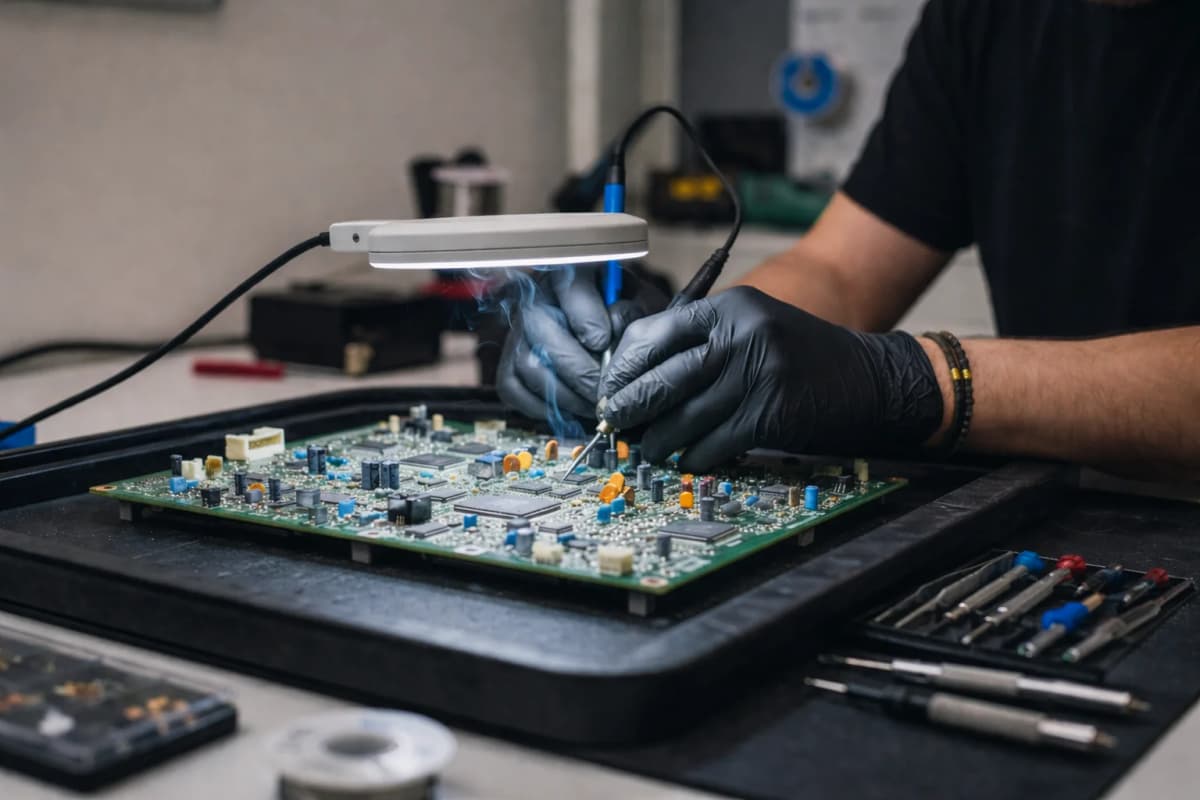
Visteon DCU: diesel engine ECU, faults and solutions
Faults on Visteon DCU ECU (DCU102): symptoms, causes and options. Expert diagnosis and VIN pairing. Request your personalized quote.
Note: at Incarline, the "repair" of a Visteon DCU takes the form of cloning. We transfer your original data — coding, immobilizer pairing, and adaptations — to a healthy unit of identical reference. We do not perform component-by-component refurbishment of your unit.
The Visteon DCU, often referred to as Diesel Control Unit and represented in this family by the reference DCU102, controls common rail injection, turbocharging, and immobilizer. When it weakens, random starts, limp mode activation, hot shutdowns, or cascading sensor faults can occur. These manifestations may stem from internal data corruption, a fatigued injector power stage, an unstable 5 V regulator, or a CAN communication issue. After diagnosis, Incarline can, depending on the case, offer targeted refurbishment of the Visteon DCU, data cloning onto a healthy base, or replacement with a paired used unit.
Find your exact reference
Search by hardware reference, software reference or control unit name. Click a result to configure and order without leaving the page.
Context and role of this family
The Visteon DCU is at the heart of common rail diesel engine management. In this family, the DCU102 illustrates a generation where the engine ECU orchestrates rail pressure via the pump regulator command, synchronizes injection according to crankshaft/camshaft information, controls the EGR and air flap, and ensures CAN exchanges with the vehicle network for torque, ESP, and the instrument cluster. The Visteon DCU stores maps, adaptations, and immobilizer identifiers, and distributes a 5 V reference to many sensors (rail pressure, boost, temperature). Faults encountered on a Visteon DCU typically result in a rail pressure fault at startup, unstable idle, power loss with engine light, and a set of simultaneous sensor faults when the 5 V reference drops. Other common cases involve non-command of one or more injectors due to a weakened power stage, or absence of diagnostic communication due to CAN/diagnostic line disruption. Finally, corruption of the calibration area or microcode can prevent immobilizer authentication and block any start attempt despite an active starter.
Technical specificities
Electronic architecture and memory
The Visteon DCU generally relies on a 32-bit microcontroller dedicated to diesel injection, supported by an internal flash memory for the program and an external memory (often serial EEPROM type) for VIN/immobilizer identifiers, injector codings, and certain adaptations. This separation makes data cloning between Visteon DCUs possible when the basic electronics are healthy, or the reconstruction of a functional set if the flash is readable but the power stage is faulty. The board test points allow, in boot mode, direct reading/writing of useful sectors when the OBD path is inoperative, and facilitate operations like EEPROM backup, repair of corrupted areas, or controlled virginization before pairing.
Communication and power stages
In terms of communication, the Visteon DCU communicates on the engine CAN bus and, depending on the generation, may also expose a separate diagnostic line. Communication layer fault symptoms include lack of OBD dialogue, intermittent frames, or torque inconsistencies with the ABS/ESP ECU. On the power side, injector drivers and actuator outputs (pressure regulator solenoid, turbo actuator, EGR, preheating relay) are sized for inductive loads and may, as they age, present internal short circuits or fatigued solder joints. On a Visteon DCU, a weakened 5 V regulator often produces a series of simultaneous sensor faults and immediate limp mode. An imperfect power/ground at the connector can also trigger hot shutdowns and difficult restarts, sometimes accompanied by faults related to the microcontroller or internal monitoring.
For which uses
A targeted diagnosis on Visteon DCU is necessary when erratic rail pressure is observed at launch, load shutdowns with engine light, absence of command of an isolated injector, or unstable CAN communication, particularly after battery disconnection, polarity inversion, moisture infiltration, or short circuit on a 5 V powered sensor. Depending on the cause, the appropriate solution ranges from cloning with rectification of the faulty stage to data cloning onto a healthy Visteon DCU, or even replacement with a used unit pre-paired to the vehicle's identifiers. Incarline supports these operations by respecting VIN/immobilizer pairing and necessary codings for immediate restart without dealership intervention if the technical context allows.
Frequently asked questions
How do I know if my Visteon DCU ECU (DCU102) is really at fault?
What specific faults are encountered on a Visteon DCU?
Can a Visteon DCU be cloned without dealer intervention?
What symptoms indicate a 5 V reference failure on Visteon DCU?
Does the Visteon DCU manage the immobilizer and VIN?
What to do if my Visteon DCU no longer communicates via OBD?
Can an injector fault originate from the Visteon DCU itself?
When to prefer repair over replacement of Visteon DCU?
Your reference isn’t listed?
Contact us — we can source your control unit or handle your repair on a quote basis.
Contact us