
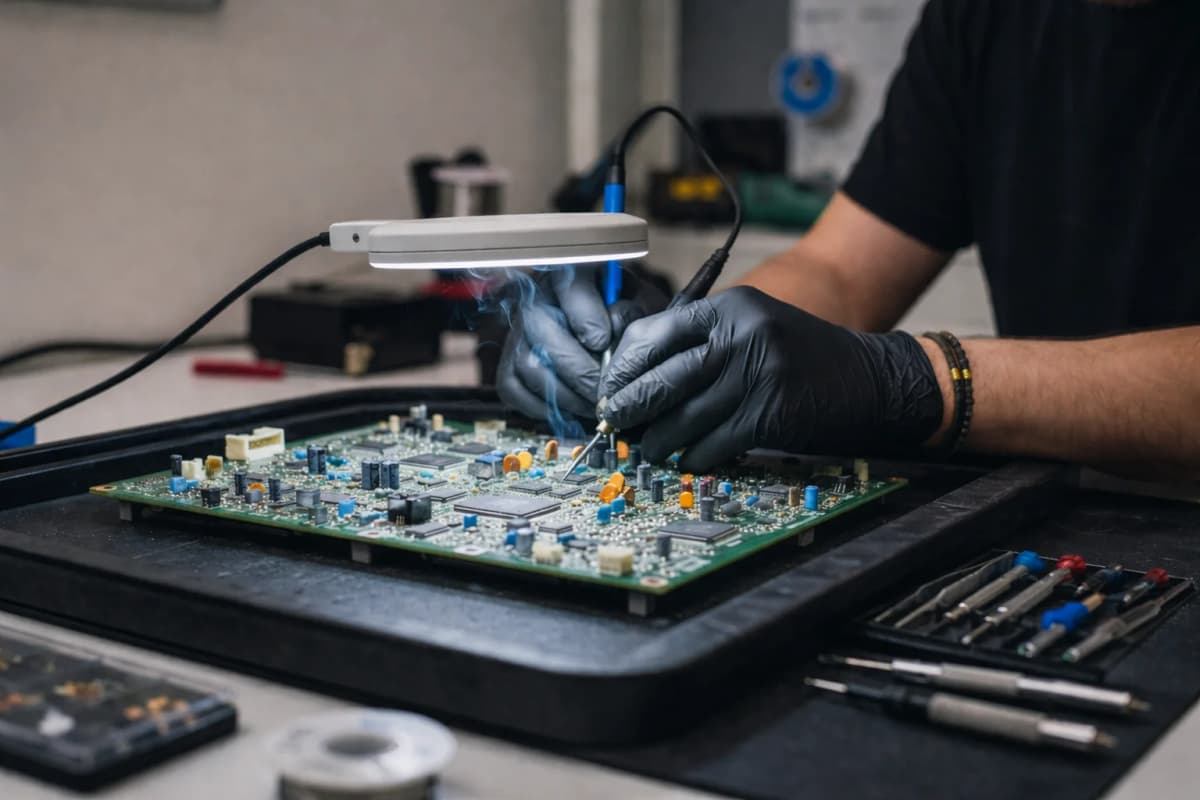
Valeo S Engine ECU: Diagnostics, Faults, and Solutions
Valeo S ECU faults, typical symptoms, and options for cloning or paired replacement. Specialized diagnostics. Request your personalized quote.
Please note: at Incarline, “repairing” a control unit means cloning. We transfer your original data — coding, immobiliser pairing and adaptations — onto a healthy unit with an identical reference. We do not carry out component-level repairs on your original unit.
The Valeo S engine ECU is a petrol ECM whose failures often manifest as erratic OBD communication, ignition or injection cut-offs on one or more cylinders, and unexpected engine stalls when hot. Workshops also encounter loss of control of the main relay or pump, persistent faults related to the motorized throttle despite a healthy throttle body, and brief starts followed by a cut-off as if the immobilizer refused authorization. In this context, the priority is to isolate the cause on the ECU side: internal power supply and grounds, output power stage, K-Line or CAN network, and memory integrity. Incarline can intervene after a preliminary diagnosis to confirm the electronic origin and propose the best outcome depending on the state of the Valeo S.
Find your exact reference
Search by hardware reference, software reference or control unit name. Click a result to configure and order without leaving the page.
Context and Role of This Family
At the heart of petrol injection, the Valeo S orchestrates ignition/injection synchronization from crankshaft/camshaft signals, controls the motorized throttle, and manages correction loops via lambda sensors. When it ages or suffers a voltage surge, very characteristic symptoms are observed: difficult hot starts despite new sensors, sudden power loss followed by limp mode, intermittent ignition coil cut-offs without clear harness faults, and sporadic disappearance of OBD communication. Several workshops also report adaptation calculations resetting to zero after turning off the ignition, indicating unstable memory, as well as injection authorization refusals after one second of starting as if the immobilizer frame was not correctly read. Finally, a weakened Valeo S may no longer properly excite the main relay or fuel pump, leading to an engine that starts and then stalls. Precise identification of these behaviors, coupled with a fault reading oriented towards actuator outputs, internal power supply, or communication, guides the next steps: module refurbishment or resorting to a paired replacement.
Technical Specificities
Specific Power Supply and Output Stages
The Valeo S relies on an internal power supply chain that provides stabilized voltages for the 32-bit microcontroller and its peripherals, with discrete converters and regulators sensitive to overvoltages and polarity reversals. Typical failures include unstable 5 V regulation triggering random cut-offs at mid-range, and fatigue of the output stages dedicated to coils and injectors resulting in persistent misfires on a specific cylinder despite component swapping. The control of the main relay and pump can also be affected by wear of the driving transistors, causing a silent pump when turning on the ignition or a voltage drop under load. On the bench, these faults are often confirmed by an abnormal drop in consumption upon waking and localized heating of power components. When the damage remains contained, targeted repair provides leeway; in case of deeper damage, the pragmatic option remains paired replacement.
Communication, Protocols, and Memory Management
Depending on the variants, the Valeo S communicates via a diagnostic K-Line or a CAN bus, with a wake-up logic that can become erratic after a battery boost or a short circuit on the harness. Partial communication loss materializes as random OBD access or a silent ECU despite 12 V power and ground being present. On the data side, there is a flash + 8-pin serial EEPROM duo for identifiers, immobilizer, and learnings. Corruption of the immobilizer pairing area results in a one-second start then cut-off, while alteration of adaptation areas resets corrections at each ignition off. These situations are managed by off-circuit or bench reading of memories, backup, integrity check, and, if necessary, cloning to a healthy body when the power part or physical communication is irrecoverable. Success relies on recovering the EEPROM and, when possible, the flash map to avoid a reset at the dealership.
For What Uses
Depending on the diagnosis, Incarline can clone the data from your Valeo S onto a healthy unit with a strictly identical reference, or supply an already-paired used unit: we do not carry out component-level repairs.
Frequently asked questions
How do I know if my Valeo S ECU is faulty?
Which vehicles are equipped with the Valeo S ECU?
Can a Valeo S be cloned without going to the dealership?
What typical faults are encountered on a Valeo S?
What is the difference between a repair and a paired used unit for a Valeo S?
What to do in case of Valeo S failure after a jump start or overvoltage?
Can the Valeo S cause hot stalls without an exploitable code?
Your reference isn’t listed?
Contact us — we can source your control unit or handle your repair on a quote basis.
Contact us