
Valeo J Engine ECU: Typical Failures, Diagnosis and Solutions
Recurring faults of a Valeo J ECU (cuts, misfires, 5V, immo). Clear diagnosis and options for restoration. Request your personalized quote.
Please note: at Incarline, “repairing” a control unit means cloning. We transfer your original data — coding, immobiliser pairing and adaptations — onto a healthy unit with an identical reference. We do not carry out component-level repairs on your original unit.
The Valeo J engine ECU is a generation of petrol ECUs commonly found in French brand vehicles using a multiplexed network of either VAN or CAN type depending on the years. When this ECU malfunctions, the symptoms are not just simple 'engine lights': random ignition cuts, stalling when hot, loss of communication with the cabin, and impossible starts without apparent logic. There are also multiple sensor faults that disappear after cooling, pointing to internal instability rather than an isolated sensor. This page gathers the actually observed faults on the Valeo J family, how to distinguish them from a peripheral fault, and which restoration paths to consider. Depending on the diagnosis, Incarline can clone the data from your Valeo J onto a healthy unit with a strictly identical reference, or supply an already-paired used unit: we do not carry out component-level repairs.
Find your exact reference
Search by hardware reference, software reference or control unit name. Click a result to configure and order without leaving the page.
Context and Role of This Family
In the petrol management chain, the Valeo J ECU orchestrates the ignition of coils, the control of multipoint injectors, the operation of the motorized throttle, and the coherence of sensor information (intake absolute pressure, air/water temperature, crankshaft/camshaft position, lambda sensor). It also manages the immobilizer in connection with the cabin electronics. Its failures are often characterized by transient malfunctions sensitive to temperature: a smooth cold start, then cylinder losses after warming up, or a sharp shutdown in traffic followed by an inability to restart while the unit remains hot. On certain small and medium petrol engines of French groups, ignition cuts are found on one or more cylinders without coherence with substituted coils, as well as network coherence faults (multiplexing) when the internal 5V reference of the ECU degrades and contaminates several measurement circuits.
Technical Specificities
Electronic Architecture and Sensitive Areas
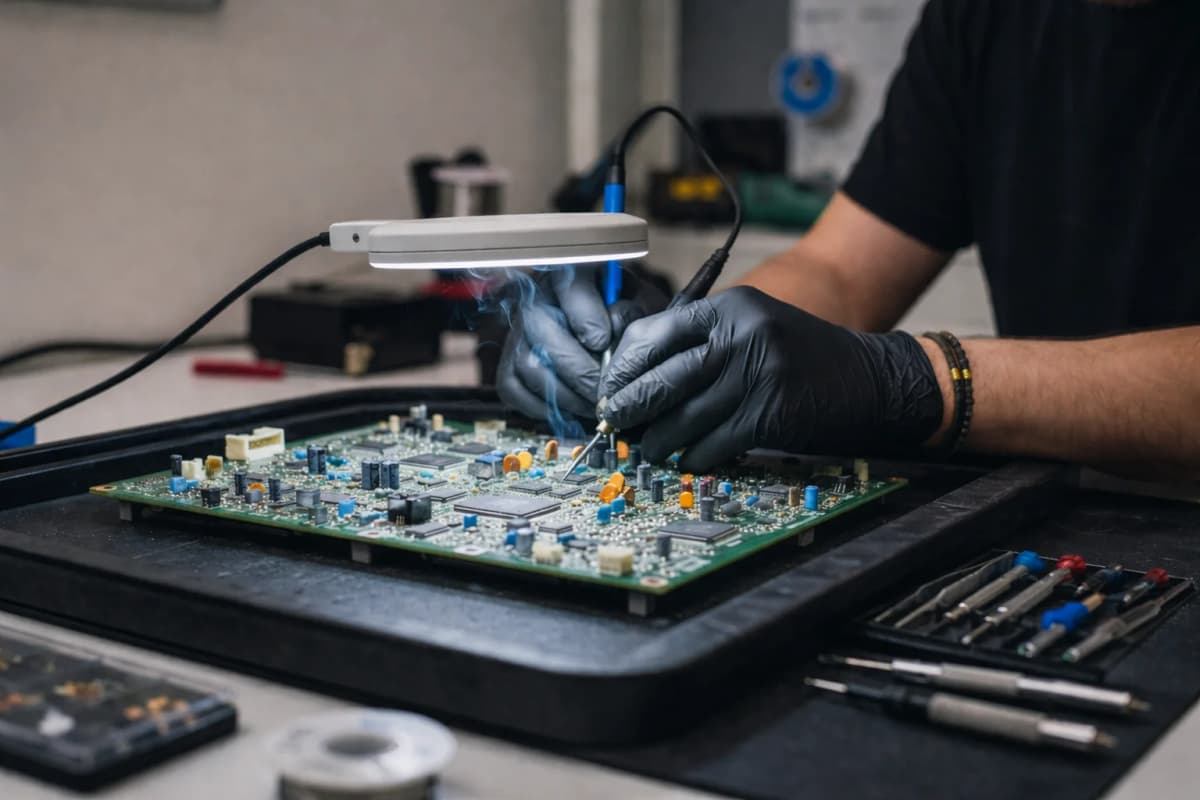
The Valeo J variants use a classic 32-bit microcontroller architecture with parallel flash memory for mapping and a serial EEPROM dedicated notably to immobilizer identifiers and the VIN number. The internal 5V distribution powers sensors and input logics; its drift causes simultaneous sensor faults not linked to each other (throttle position, intake pressure, temperature), a distinctive sign compared to a simple harness failure. The injection and ignition power stages rely on switching transistors integrated into the unit; an external short circuit (faulty coil, overloaded injector) can carbonize one path and leave the others functional, creating permanent targeted misfires. The board is protected by an insulating varnish: serious repair requires its localized removal, checking of heated vias, and re-soldering of micro-cracked joints that appear after repeated thermal cycles.
Communication and BSI/Immobilizer Pairing
Depending on the model years, the Valeo J family communicates on a dedicated K line and/or on a multiplexed network (VAN on earlier generations, CAN on more recent ones) with the cabin and the instrument cluster. Pairing with the cabin module is essential: the ECU stores immobilizer data in EEPROM, and desynchronization results in an impossible start with persistent car key light. When replacing with a second-hand unit, two approaches exist in the trade: full cloning of relevant areas (flash + EEPROM) from the functionally readable original unit, or setting to 'virgin' state followed by learning in the vehicle with the manufacturer's confidential code. INCARLINE can offer either a Valeo J cloning when stable reading is possible, or pairing on vehicle or bench when the original memory is corrupted.
For What Uses
This page is intended for the garage looking to distinguish between a peripheral fault and a truly faulty Valeo J ECU, the mechanic seeking a clean cloning after confirmed diagnosis, and the individual facing unpredictable cuts related to the unit's temperature. If your checks confirm an unstable 5V supply, persistent ignition misfires despite coil/injector exchange, or intermittent network communication loss without harness corrosion trace, intervention on the ECU becomes a priority. Depending on the diagnosis, Incarline can clone the data from your Valeo J onto a healthy unit with a strictly identical reference, or supply an already-paired used unit: we do not carry out component-level repairs.
Frequently asked questions
How to recognize a typical Valeo J ECU fault without confusing it with a faulty coil?
Which vehicles can be equipped with a Valeo J ECU?
What communication faults are characteristic of a struggling Valeo J?
Can a Valeo J be cloned without going through the dealership?
Why are multiple sensor faults observed on a Valeo J when the sensors are good?
What to do if the immobilizer desynchronizes after replacing a Valeo J?
Are hot engine shutdowns frequent with the Valeo J ECU?
Your reference isn’t listed?
Contact us — we can source your control unit or handle your repair on a quote basis.
Contact us