
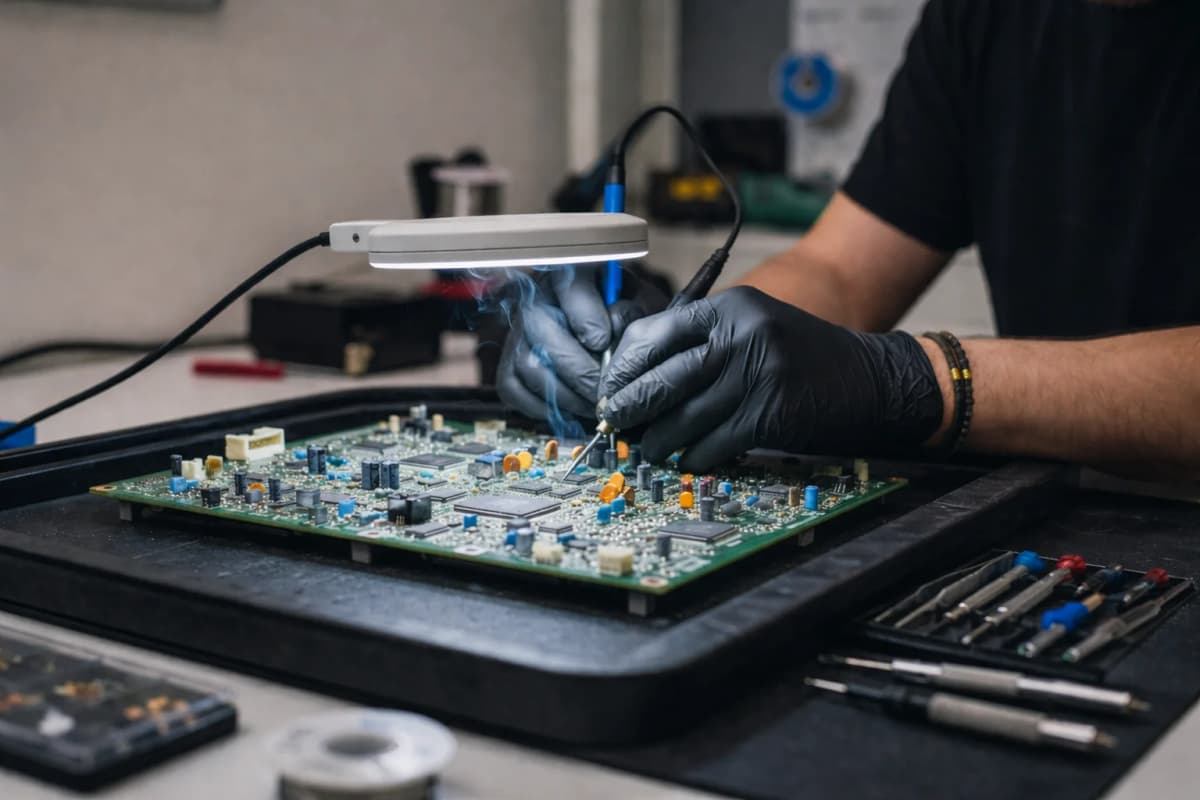
Temic DSG — VAG Mechatronic TCM: faults, symptoms, and solutions
Temic DSG ECU malfunction (pressure, solenoids, mechatronics) on Audi/Volkswagen/Skoda/SEAT? Diagnostics, cloning, or paired replacement. Request your quote.
Please note: at Incarline, “repairing” a control unit means cloning. We transfer your original data — coding, immobiliser pairing and adaptations — onto a healthy unit with an identical reference. We do not carry out component-level repairs on your original unit.
The Temic DSG ECU is the control module for the dual-clutch gearbox of the VAG group, integrated into the mechatronic block that combines hydraulics and electronics. When it malfunctions, typical symptoms include jerking at start-up, clutch slipping, gear loss, flashing gearbox or PRNDS light, and limp mode activation. The most common faults involve hydraulic pressure regulation for the K1/K2 clutches, internal solenoids that stick or leak, an electric pump that no longer maintains pressure, or internal sensors (speed, temperature) that drift. Depending on the diagnosis, Incarline can clone the data from your Temic DSG onto a healthy unit with a strictly identical reference, or supply an already-paired used unit: we do not carry out component-level repairs.
Find your exact reference
Search by hardware reference, software reference or control unit name. Click a result to configure and order without leaving the page.
Context and role of this family
The Temic DSG controls the selection and engagement of gears on wet or dry dual-clutch gearboxes of the Volkswagen-Audi group. Housed at the heart of the mechatronic block, it operates the K1/K2 clutches and planetary gear sets via proportional solenoids and an electric pump maintaining circuit pressure. It continuously measures shaft speeds, actuator positions, and oil temperature, then adjusts clutch pressure to the millisecond to ensure fast and smooth gear changes. When this TCM begins to fail, the symptoms are very typical: hesitant starts, harsh R/D engagements, gears skipping, returning to neutral, dashboard messages, and a limp mode strategy that limits power. On vehicles where the DSG is widespread—such as Volkswagen Golf V/VI DSG, Audi A3 8P, Skoda Octavia II, or Seat Leon 1P—recurring faults are as much due to the Temic DSG control electronics as to the integrated hydraulics, necessitating precise diagnostics before opting for a repair or paired replacement.
Technical specificities
Integrated mechatronics: pressure, solenoids, and pump
The hallmark of the Temic DSG lies in the close integration of electronics and hydraulics. The ECU controls proportional solenoids dedicated to the pressure of the K1/K2 clutches and fork control, while monitoring pressure build-up via internal sensors. An electric pump provides the necessary flow; when it weakens or internal leaks appear, pressure drops, causing jerking, slipping, and safety mode activation. Frequent faults also affect solenoids that seize when hot, altering application times and triggering gear coherence faults. Oil contamination or clutch debris exacerbate these drifts, so the Temic DSG compensates by increasing pressure until adaptation limits are reached, then enters protection mode.
Electronic architecture: 32-bit microcontroller, EEPROM, and CAN
Electronically, the Temic DSG relies on a 32-bit microcontroller and non-volatile memory (serial EEPROM) where immobilization data, VIN, clutch adaptation parameters, and necessary calibrations are stored. Communication with the rest of the vehicle typically occurs via the CAN network, with close exchanges with the engine ECU and instrument cluster. Typical faults include intermittent communication losses due to solder cracks on the board or worn line drivers, as well as partial data corruptions in EEPROM that disrupt K1/K2 learnings. In these situations, reliable data cloning to another Temic DSG or a controlled reset (virginization followed by pairing) restores a sound base.
For which uses
This family is intended for any garage, mechanic, or individual facing a DSG that jerks, slips, returns to neutral, or displays a flashing PRNDS, especially on Audi A3 8P, Volkswagen Golf V/VI, Skoda Octavia II, or Seat Leon 1P. When symptoms point to the electronic part (TCM communication loss, inconsistent clutch adaptations despite clean oil, recurring internal sensor faults), intervention on the Temic DSG ECU—targeted repair or data cloning—is relevant. If analysis instead reveals degraded hydraulics (insufficient pressure, tired pump, mechanically stuck solenoids), replacement with a paired used mechatronic block with data transfer is often the most rational path. INCARLINE can guide the choice after memory reading, adaptation control, and signal verification on the CAN network, then perform the necessary pairing without disrupting the immobilizer.
Frequently asked questions
How do I know if my Temic DSG ECU is faulty?
Which vehicles are equipped with the Temic DSG ECU?
Can a Temic DSG be cloned without going to the dealership?
What is the difference between a repair and a paired used replacement for a Temic DSG?
What to do in case of clutch pressure faults on a Temic DSG?
Can a faulty Temic DSG cause jerking in R/D and a return to neutral?
After replacing a Temic DSG, should K1/K2 learnings be redone?
Can INCARLINE pair a used Temic DSG?
Your reference isn’t listed?
Contact us — we can source your control unit or handle your repair on a quote basis.
Contact us