
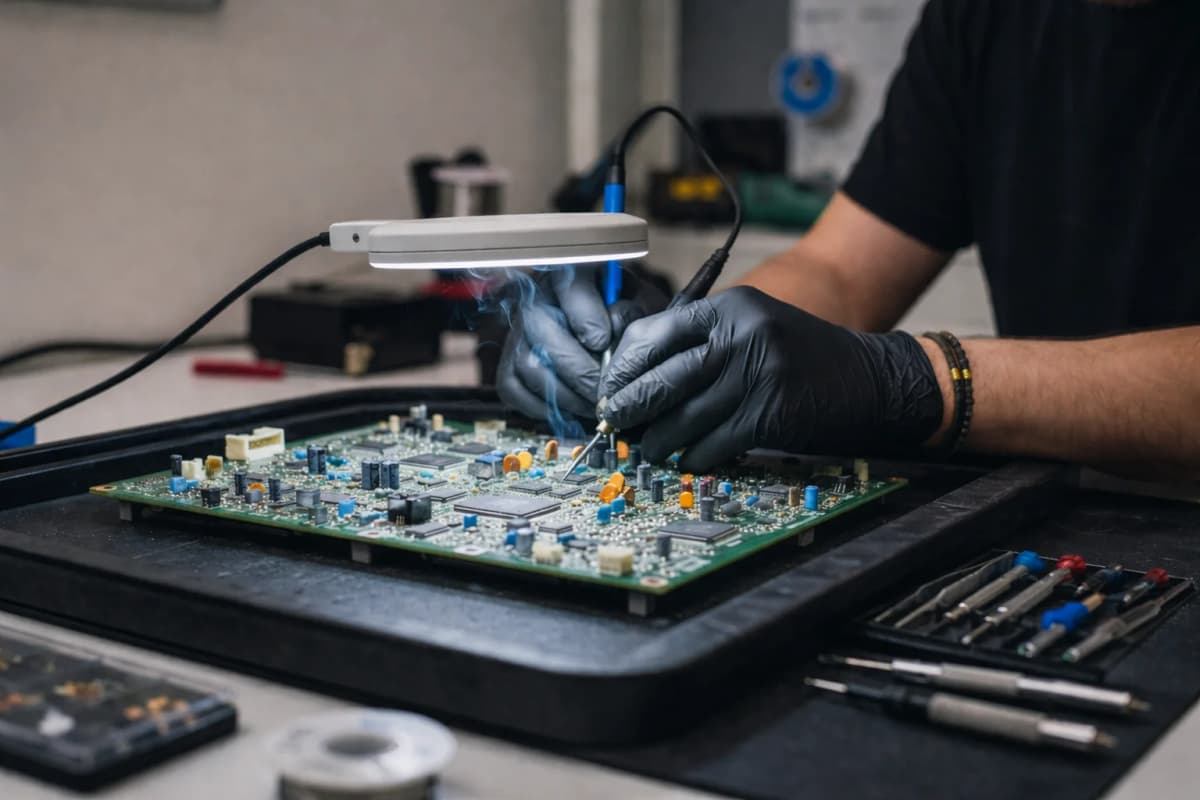
Siemens / Continental SID Engine ECU — Diagnostics and Solutions
Siemens / Continental SID ECU (ECM) failure: symptoms, diagnostics, cloning or paired replacement. Request your personalized quote.
Please note: at Incarline, “repairing” a control unit means cloning. We transfer your original data — coding, immobiliser pairing and adaptations — onto a healthy unit with an identical reference. We do not carry out component-level repairs on your original unit.
Engine light on, limp mode, power loss, or starting issues after a diagnostic scan? With the Siemens / Continental SID range (engine ECM), such failures can originate from an external sensor or the ECU itself. The SID units control common-rail injection, turbocharging, EGR, and DPF via CAN, often using UDS or KWP2000 protocols depending on the generation. Communication breakdowns, frozen or inconsistent values (rail pressure, air flow), or recurring internal faults point towards the ECU. Depending on the diagnosis, Incarline can clone the data from your Siemens / Continental SID onto a healthy unit with a strictly identical reference, or supply an already-paired used unit: we do not carry out component-level repairs.
Find your exact reference
Search by hardware reference, software reference or control unit name. Click a result to configure and order without leaving the page.
In Brief
The Siemens / Continental SID ECUs (ECM) are fitted in many modern diesels. They combine a 32-bit microcontroller, internal Flash memory, and a dedicated serial EEPROM for codings (immobilizer, injectors). When they fail, common symptoms include CAN communication loss, persistent limp mode despite new sensors, or starting followed by stalling due to immobilizer issues. A methodical diagnosis helps differentiate between sensor and ECU failure before considering cloning, repair, or paired replacement.
Frequently Asked Technical Questions
Why does this ECU fail?
For Siemens / Continental SID units, thermal stress, humidity, and voltage fluctuations are typical causes. Under-voltage or over-voltage during assisted starting can disrupt data areas, generating persistent internal faults. Failures in the CAN transceiver or injector power stages can also cause intermittent communication or engine cut-offs. The presence of an external EEPROM on these SID units explains why local coding corruptions (injectors, VIN, immo) result in clear symptoms without other mechanical failures.
How to distinguish a SID failure from a sensor (injector, airflow meter, EGR) failure?
A faulty sensor typically isolates a single subsystem with a plausible value that still changes and intact ECM communication. A failing Siemens / Continental SID more likely produces a set of cross-symptoms: absence or loss of communication with the ECM, frozen or default values (rail, air flow) regardless of the connected sensor, immediate reappearance of faults after clearing, or starting followed by stalling with immobilizer-related messages. If the measured rail pressure remains frozen with ignition on, if tested injectors are correct but the command is erratic across all cylinders, or if the diagnostic tool randomly loses the ECU, the SID ECU hypothesis becomes a priority.
Which vehicles are often affected by a Siemens / Continental SID?
These ECUs are found in various models. For concrete examples, Renault Mégane III in 1.5 dCi use SID series 30x (SID301 / SID305), Peugeot 3008 I and Citroën C4 II in 1.6 e-HDi are commonly associated with SID807 / SID807EVO, and Land Rover Discovery 3 in 2.7 TDV6 employ a SID204. SID803/803A are also seen on Volvo S40/V50 2.0D originating from PSA. The Siemens / Continental SID family thus covers several generations and protocols (KWP2000 or UDS on CAN), explaining slightly different pairing and diagnostic procedures depending on the chassis.
Can a Siemens / Continental SID be cloned or tested on a bench?
Yes, provided the right skills and equipment. Most Siemens / Continental SID units start on a bench with +12 V, grounds, and CAN lines, then identify via KWP2000 or UDS. Cloning involves transferring specific data (EEPROM and, depending on the case, Flash sections containing VIN, immo, and injector codings) to a healthy unit of the same family, to avoid dealership reprogramming. On more recent generations based on a tri-core 32-bit microcontroller, a boot mode is often used for safe read/write operations. Before any cloning, the integrity of the immo areas and calibrations is checked to avoid starting stalls.
Possible Courses of Action
If doubt persists after your tests, sending the Siemens / Continental SID for electronic diagnostics can confirm the failure and recover useful data. Depending on the report, the logical next step is either a repair with coding retention or a replacement with a paired or cloned used unit to restart without recoding the vehicle. For guidance on the most relevant option in your case, contact Incarline.
Frequently asked questions
How do I know if my Siemens / Continental SID ECU is faulty?
Which vehicles are equipped with the Siemens / Continental SID ECU?
Can a Siemens / Continental SID be cloned without going to the dealership?
What is the difference between a repair and a paired used unit for a Siemens / Continental SID?
After a battery drain or jump start, my Siemens / Continental SID no longer communicates: what should I do?
Where are the immobilizer data stored in a Siemens / Continental SID?
Does the Siemens / Continental SID use UDS on CAN or KWP2000?
What symptoms are encountered on SID807, SID204, or SID305 versions?
Your reference isn’t listed?
Contact us — we can source your control unit or handle your repair on a quote basis.
Contact us