
Siemens / Continental PPD: typical failures, diagnosis and solutions
Siemens / Continental PPD failures on 2.0 TDI piezo (P2146–P2149, misfires, limp mode). Diagnosis, repair or paired replacement. Request your personalized quote.
Please note: at Incarline, “repairing” a control unit means cloning. We transfer your original data — coding, immobiliser pairing and adaptations — onto a healthy unit with an identical reference. We do not carry out component-level repairs on your original unit.
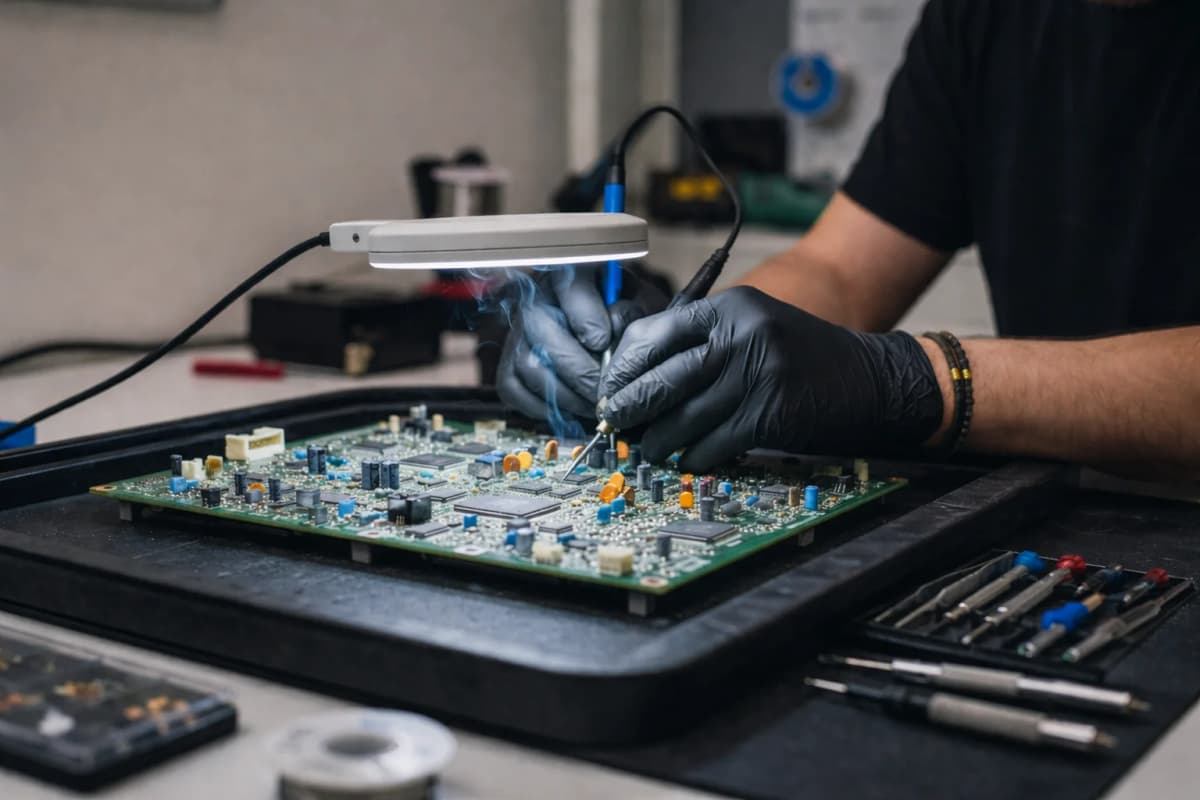
The Siemens / Continental PPD engine ECU is used in many 2.0 TDI piezo injector engines from the VAG group and directly controls the power stages of the Pumpe-Düse units. When a PPD becomes faulty, the symptoms are often clear: misfires on one or two cylinders, random hot starting, limp mode, engine light and codes related to injector group power supply. The most common failures involve the internal drivers of the piezo injectors and, more rarely, solder joints or tracks fatigued by heat in the power supply area. A structured diagnosis allows distinguishing between harness/injectors and the ECU itself. Depending on the diagnosis, Incarline can clone the data from your Siemens / Continental PPD onto a healthy unit with a strictly identical reference, or supply an already-paired used unit: we do not carry out component-level repairs.
Find your exact reference
Search by hardware reference, software reference or control unit name. Click a result to configure and order without leaving the page.
Context and role of this family
Designed around the Volkswagen group's piezo unit injector engines, the Siemens / Continental PPD manages specific currents and voltages necessary for the rapid and precise activation of the Pumpe-Düse elements. Unlike ECUs intended for common rail injection, this ECU concentrates a significant portion of the power electronics for the injectors within the unit itself. In the workshop, it is observed that recurring incidents in this family often manifest as the shutdown of an injector 'group' with the appearance of typical faults, leading to clear misfires, marked power loss, and sometimes a no-start condition. The vehicles where this is most frequently observed include 2.0 TDI piezo models such as Volkswagen Golf V (1K), Audi A3 (8P), Passat (B6), Seat Leon (1P), or Skoda Octavia (1Z), particularly in their high-power versions.
Technical specificities
Piezo power stages and group A/B faults
The Siemens / Continental PPD integrates dedicated drivers for controlling the piezo injectors, organized by groups (often designated A and B) to distribute the power supply. An internal weakness in these stages typically results in group power supply faults and injection cuts on two cylinders, with pronounced vibrations at idle and limp mode under load. The codes retrieved during diagnosis then point towards characteristic errors of injector group power supply circuits such as P2146, P2147, P2148, or P2149, to be interpreted with caution as a damaged harness or a faulty piezo injector can generate the same symptoms. When the PPD's electronics are at fault, targeted repair can restore control and stabilize hot starting, provided the injectors and their wiring are checked in parallel to avoid a relapse.
Memory architecture, pairing, and vehicle communication
Architecturally, a 32-bit microcontroller manages real-time functions and relies on flash memory for maps as well as a serial EEPROM that typically holds immobilizer and identification data (VIN). The Siemens / Continental PPD family communicates on the vehicle's CAN network and interfaces with the cluster/immobilizer to authorize starting, which requires correct pairing of identifiers in case of replacement. In the workshop, a reading of the useful areas (EEPROM/flash) is performed as needed, followed by cloning or virginization and relearning, so that the new unit is accepted without a systematic visit to the dealership. Depending on the context, INCARLINE can offer a pre-paired used replacement or a refurbishment of the original unit, with the priority remaining to secure immobilizer coherence and starting.
For which uses
This family is suitable for 2.0 TDI engines with piezo injectors requiring very short activation times and careful energy control, but it becomes critical when one of the power stages weakens: misfires, losses by pairs of cylinders, and P2146–P2149 faults clearly direct the diagnosis towards a Siemens / Continental PPD. In the presence of these signs, a cross-check of injectors/harness/ECU is necessary; if the ECU is indeed implicated, targeted repair is relevant for localized failures, while a cloned used unit is more suitable if the board is too degraded or has suffered infiltration. In all cases, VIN/immobilizer pairing and data integrity are crucial, and INCARLINE can perform the required cloning or pairing to put the vehicle back into service without unnecessary risk.
Frequently asked questions
How do I know if my Siemens / Continental PPD ECU is faulty?
Which vehicles are equipped with the Siemens / Continental PPD ECU?
Do codes P2146, P2147, P2148, P2149 indicate a PPD failure?
Can a Siemens / Continental PPD be cloned without visiting the dealership?
What is the difference between a repair and a paired used unit for a Siemens / Continental PPD?
Can a Siemens / Continental PPD cause difficult hot starting on 2.0 TDI piezo?
What to do in case of Siemens / Continental PPD failure while driving (limp mode)?
After replacing a used Siemens / Continental PPD, is recoding necessary?
Your reference isn’t listed?
Contact us — we can source your control unit or handle your repair on a quote basis.
Contact us