
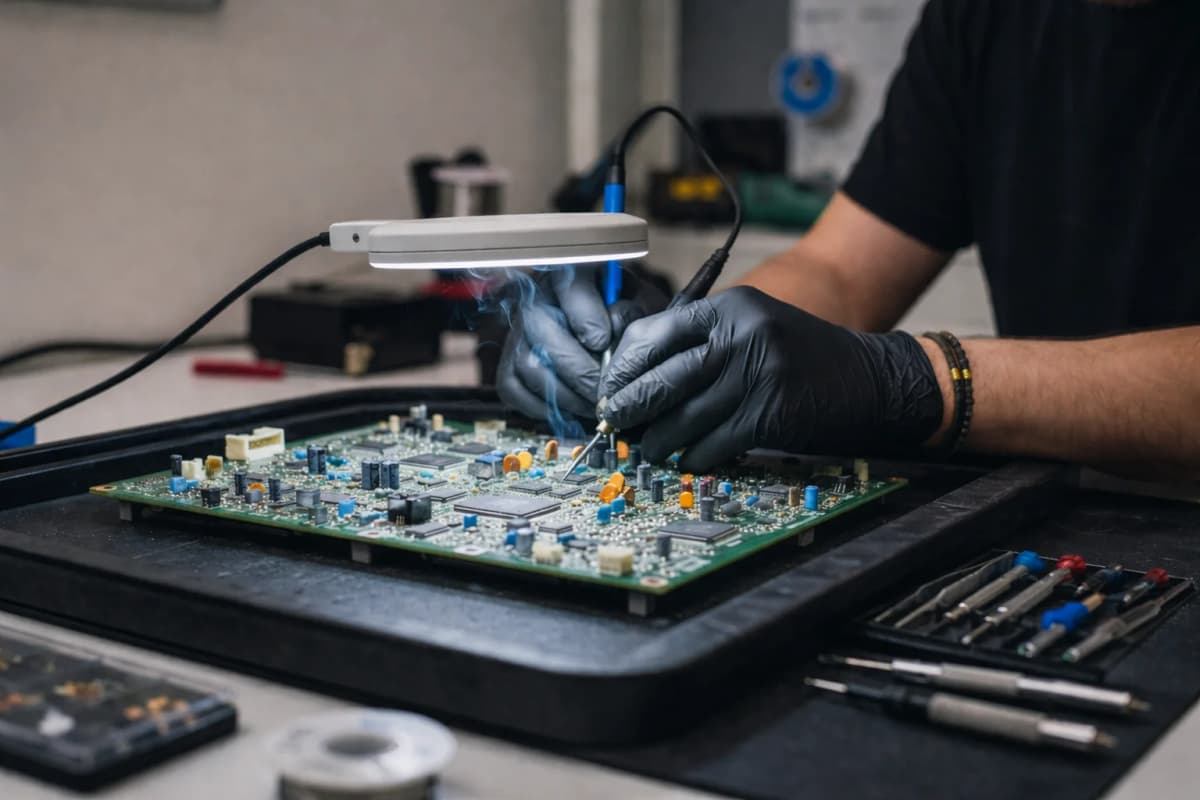
Used Siemens / Continental MSS ECU paired with VIN
Siemens / Continental MSS ECU tested, same HW/SW ref., delivered paired VIN/CAS for BMW M3, M5, M6. Reliable replacement for older ranges. Request your quote.
Please note: at Incarline, “repairing” a control unit means cloning. We transfer your original data — coding, immobiliser pairing and adaptations — onto a healthy unit with an identical reference. We do not carry out component-level repairs on your original unit.
The Siemens / Continental MSS ECUs are notably equipped in high-revving BMW M engines. This family is found on the BMW M3 E90/E92/E93 (MSS60) as well as on the BMW M5 E60/E61 and M6 E63/E64 (MSS65). With age, an MSS can cause random starting, limp mode, power loss, or the inability to communicate correctly in diagnostics. For these older references, repair sometimes becomes uncertain due to the lack of compatible new components. Incarline offers a pragmatic alternative: providing a tested used ECU from an identical vehicle, strictly with the same hardware and software reference, then pairing it with your VIN/immobilizer. Depending on the case, cloning of the immobilizer/EEPROM areas or setting to virgin mode followed by relearning with the CAS/EWS is performed. This approach reduces risks related to obsolete components and simplifies the re-commissioning while retaining the vehicle's original configuration.
Find your exact reference
Search by hardware reference, software reference or control unit name. Click a result to configure and order without leaving the page.
A typical case
A workshop receives a BMW M3 E92 experiencing sharp cuts when hot and sometimes refusing to start after a short stop. The diagnosis reports non-specific internal faults to the ECU and intermittent communication with the engine management. After checking power supplies, grounds, and CAN network, the hypothesis of an end-of-life Siemens / Continental MSS DME is retained. Rather than engaging in uncertain repair on old electronics, we precisely identify the HW/SW reference of the unit in place, then select a strictly identical MSS, taken from a compatible vehicle and bench-tested. The areas containing the ISN/immobilizer, VIN, and configuration are transferred, or the unit is 'virginized' according to the scenario, before synchronization with the CAS module. Upon reassembly, a relearning of the throttle bodies and idle adaptations is performed. The vehicle regains stable operation without random remappings or prolonged immobilization.
Why this ECU has this fragility
The Siemens / Continental MSS family operates in a particularly demanding environment: M engines with individual throttle bodies, high revs, and sustained under-hood temperatures. Thermal cycles and vibrations eventually stress the solder joints and certain tracks, while the tropicalization varnish, effective initially, does not always prevent micro-infiltrations and long-term corrosion. In these generations, the logic relies on a 32-bit microcontroller, with internal flash memory and external EEPROM dedicated to immobilizer identifiers and coding data. Over the years, memory sectors may become corrupted during voltage drops or interventions, and power stages endure the repeated load of motorized throttle actuators specific to these engines.
Additionally, there is an industrial constraint: several components of these MSS are no longer manufactured, or exist in revisions that do not always assemble without heavy requalification. Even when a fault is located, replacing an 'equivalent' regulator or driver does not guarantee lasting performance. Data access is done by boot mode reading or via internal programming points depending on the revisions, and vehicle communication is via CAN (with, depending on the chassis, a coexistence of a K bus for certain functions). These specifics, combined with parts obsolescence, make the option of a paired used Siemens / Continental MSS ECU often more rational than attempting a hypothetical refurbishment.
What changes when you send it to us
Upon receipt, we record the labels and electronic identifiers to lock the exact HW/SW match. The donor Siemens / Continental MSS is bench-tested with CAN line simulation and key input states, then prepared by cloning the VIN/ISN/EEPROM areas or by controlled zeroing followed by alignment with your CAS/EWS. Before shipment, a simulated start sequence validates the coherence of the main sensors and throttle control. Upon installation, only the usual relearnings (throttle, idle, fuel adaptations if necessary) need to be performed. Incarline provides a paired used ECU ready to start and covered by a functional warranty, with the return of your old unit in exchange.
Frequently asked questions
How do I know if my Siemens / Continental MSS ECU is faulty?
Which vehicles are equipped with the Siemens / Continental MSS ECU?
Can a Siemens / Continental MSS be cloned without going to the dealership?
What is the difference between a repair and a paired used Siemens / Continental MSS ECU?
What to do in case of Siemens / Continental MSS ECU failure?
Is it necessary to relearn parameters after installing a paired Siemens / Continental MSS ECU?
Where to find the HW/SW references of a Siemens / Continental MSS ECU?
Does the Siemens / Continental MSS manage the immobilizer and VIN?
Your reference isn’t listed?
Contact us — we can source your control unit or handle your repair on a quote basis.
Contact us