
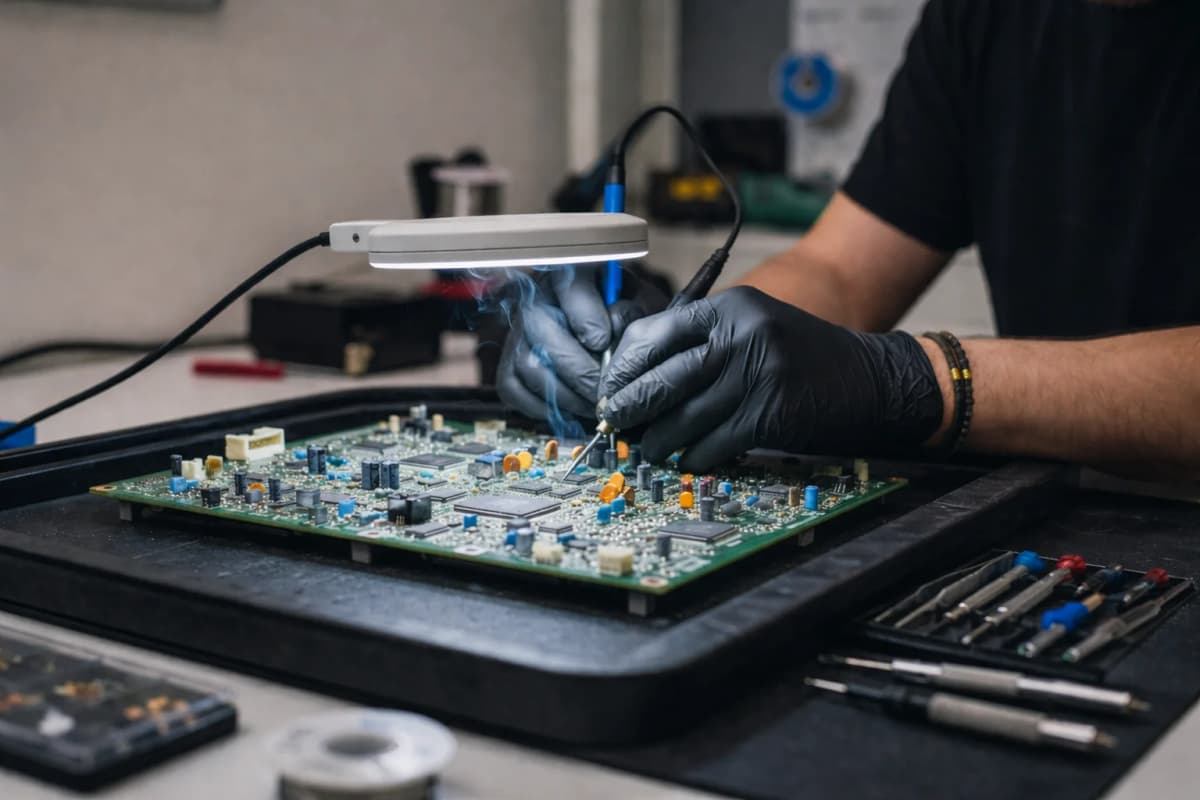
Siemens / Continental EMS ECU — diagnostics and solutions
Engine ECM failure? Symptoms on Siemens / Continental EMS. Accurate diagnostics, cloning or paired replacement as needed. Request your personalized quote.
Please note: at Incarline, “repairing” a control unit means cloning. We transfer your original data — coding, immobiliser pairing and adaptations — onto a healthy unit with an identical reference. We do not carry out component-level repairs on your original unit.
Have you just run diagnostics and the engine goes into limp mode, stalls when hot, or won't start? Siemens / Continental EMS ECUs (multipoint petrol range, references EMS22xx and EMS31xx/3140) are common on Renault and Dacia. When the ECM reports internal faults, sensor power losses, or sporadic communication issues, it's logical to suspect the ECU itself after ruling out peripheral failures. Depending on the diagnosis, Incarline can clone the data from your Siemens / Continental EMS onto a healthy unit with a strictly identical reference, or supply an already-paired used unit: we do not carry out component-level repairs.
Find your exact reference
Search by hardware reference, software reference or control unit name. Click a result to configure and order without leaving the page.
In brief
The Siemens / Continental EMS controls injection and ignition on many petrol engines. Typical symptoms include the engine light being on, random or impossible starting, power loss, and limp mode. When multiple sensors seem to 'fail' simultaneously or OBD communication becomes unstable, the EMS ECU may be at fault. A methodical check of power/ground/5 V, followed by an evaluation on a specialized bench, allows differentiation between sensor failure and ECU failure.
Frequently asked technical questions
Why does this ECU fail?
In the Siemens / Continental EMS family, the combination of heat/vibrations and electrical stresses (repeated starts, weak battery) can wear out internal components. Issues with the 5 V regulator, coil/injector drivers, and sometimes cracked solder joints at the connector are encountered. Moisture infiltration in the engine compartment can also oxidize tracks and disrupt communication. These faults result in internal ECU errors, erratic actuator control, or unstable sensor 5 V.
What signs specifically point to a failing Siemens / Continental EMS?
Beyond the engine light and limp mode, a weak Siemens / Continental EMS often results in occasional starting, an oscillating idle despite a clean throttle, or sudden engine shutdown when hot without a clear sensor code. In some vehicles where these EMS are fitted, like Renault Clio III, Renault Mégane II, or Dacia Logan I, an intact harness but multiple 'out of range' sensors simultaneously, or disappearing and reappearing OBD communication, are sometimes observed. These combinations, especially if power supplies are correct, point more to the ECU than peripherals.
How to differentiate an EMS failure from a sensor (mass air flow, injector, throttle, probe) failure?
Start by rigorously checking ECU power supplies (battery, grounds, + after ignition) and sensor reference voltage: a healthy Siemens / Continental EMS should provide a stable 5 V. If multiple sensors powered by this 5 V show simultaneous faults, it's a strong ECU-side indicator. A cross-test with a known good sensor or a test with an already learned motorized throttle can clear doubts. Finally, if diagnostics report internal processor faults or memory errors not correlated to a specific sensor, and the oscilloscope shows inconsistent ignition/injection commands, the diagnosis narrows to the ECU.
What technical features of the EMS family aid in diagnostics and pairing?
The Siemens / Continental EMS series EMS22xx and EMS31xx/3140 communicate depending on the vehicle via K-Line (KWP2000/ISO 14230) or CAN (ISO 15765), an important point for reading/clearing faults and remapping. The unit integrates a 32-bit microcontroller and flash memory for maps, as well as a dedicated EEPROM memory where the immobilizer and VIN reside. This organization allows, in case of a faulty unit, cloning of useful data to another EMS of the same reference, or 'virginizing' the unit to re-pair it with the vehicle's UCH/BCM. These points are common on models like Dacia Sandero I and the aforementioned Renaults, where immobilizer adaptation is done via the multiplexed network.
Possible recourses
After your basic checks, send the Siemens / Continental EMS for bench diagnostics to confirm the ECU-side failure and secure the next steps. Depending on the diagnosis, Incarline can clone the data from your Siemens / Continental EMS onto a healthy unit with a strictly identical reference, or supply an already-paired used unit: we do not carry out component-level repairs.
Frequently asked questions
How do I know if my Siemens / Continental EMS ECU is faulty?
Which vehicles are equipped with a Siemens / Continental EMS?
Can a Siemens / Continental EMS be cloned without going to the dealer?
What internal failures are common on Siemens / Continental EMS?
What is the difference between a repair and a paired used unit for a Siemens / Continental EMS?
Does the Siemens / Continental EMS use CAN or K-Line for diagnostics?
What to do in case of Siemens / Continental EMS failure after engine washing or water infiltration?
Your reference isn’t listed?
Contact us — we can source your control unit or handle your repair on a quote basis.
Contact us