
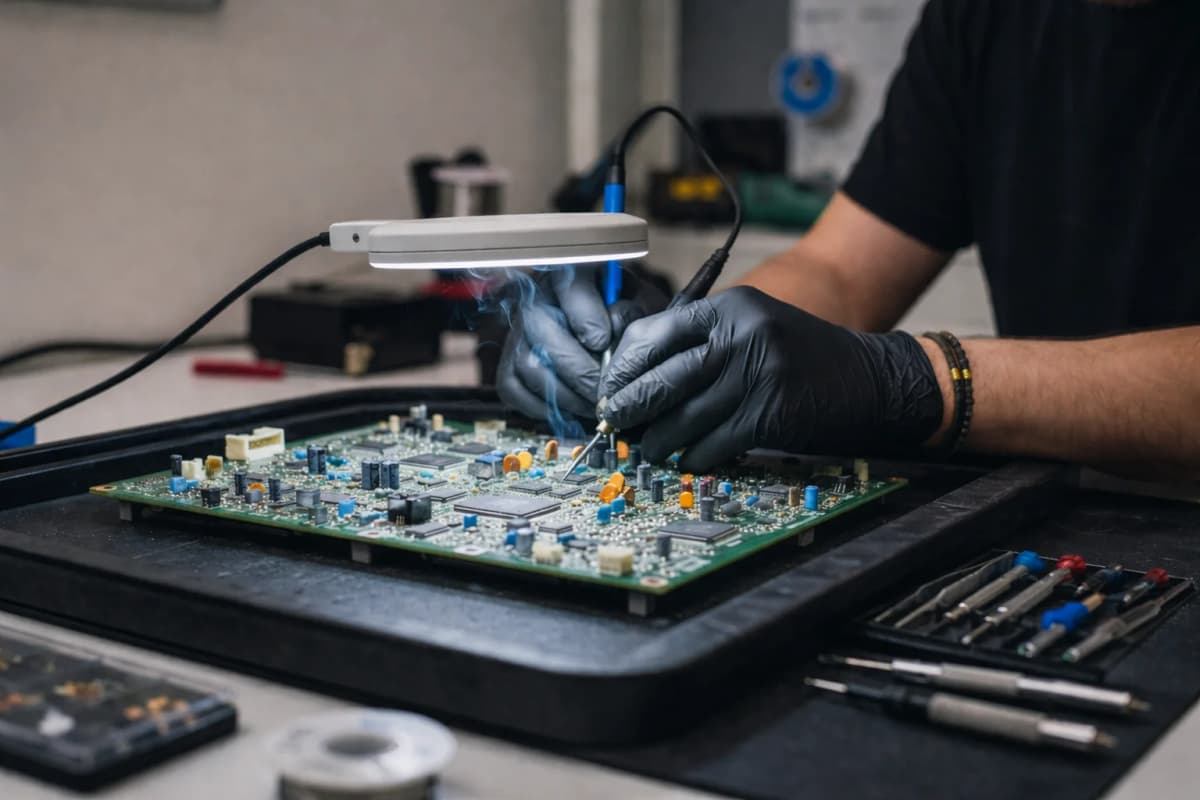
Sagem PL Engine ECU: Typical Failures and Diagnosis
Sagem PL ECU faulty? Symptoms, causes, and options (diagnosis, cloning, pairing). Incarline supports you. Request your personalized quote.
Please note: at Incarline, “repairing” a control unit means cloning. We transfer your original data — coding, immobiliser pairing and adaptations — onto a healthy unit with an identical reference. We do not carry out component-level repairs on your original unit.
The Sagem PL is an engine ECU (ECM) that controls injection and ignition, manages sensor/actuator power supply, and communicates with diagnostics via a serial line or bus. When a Sagem PL fails, symptoms can range from random starting to power loss, including limp mode and an illuminated engine light. Intermittent diagnostic communication losses or lack of control of certain components (fuel pump, coils, injectors) are also observed. Depending on the diagnosis, Incarline can clone the data from your Sagem PL onto a healthy unit with a strictly identical reference, or supply an already-paired used unit: we do not carry out component-level repairs. Possible operations typically include memory reading, Sagem PL cloning, and, in some cases, resetting (virginization) to allow proper pairing with the vehicle's immobilizer.
Find your exact reference
Search by hardware reference, software reference or control unit name. Click a result to configure and order without leaving the page.
Context and Role of This Family
The Sagem PL belongs to a generation of engine ECUs designed to orchestrate all functions related to combustion and idle control, while ensuring internal electrical supervision (sensor power regulation), safety logic (fault detection and fallback strategy), and communication with the rest of the vehicle via the diagnostic port. In practice, this ECU processes signals from crankshaft/camshaft position sensors, temperature, intake pressure, and lambda sensor, then modulates injection and ignition accordingly. Typical failures encountered on a Sagem PL often revolve around the internal power supply chain (5 V sensors), coil/injector control, and non-volatile memory related to the immobilizer. When these elements drift or degrade, the user experiences hot stalling, occasional misfires, an inability to start the engine while the starter turns, or intermittent diagnostic communication loss, complicating fault identification. In this context, off-vehicle testing of the Sagem PL, followed by comparison of memory areas and power/control supplies, allows the fault to be circumscribed before deciding on a Sagem PL cloning or replacement with a paired unit of the same family.
Technical Specificities
Electronic Architecture and Interfaces
Depending on the versions, a Sagem PL relies on a typical 16 or 32-bit microcontroller of that era, with internal flash memory for code/maps and a serial EEPROM dedicated to immobilizer and self-learning parameters. Diagnostic communication is generally via an older generation K-Line ISO interface or, on more recent variants, via the engine CAN bus. These architectural choices explain certain recurring failures: a drop in the internal 5 V reference can simultaneously disrupt several sensors, a weakened K-Line can cause communication cut-off, and EEPROM corruption manifests as a refusal to start with active immobilizer. The boards also include power stages for coils and injectors; when these drivers are worn out, the ECU signals ignition anomalies or cuts control to protect the system, leading to misfires or operation on a reduced number of cylinders.
Typically Encountered Failures and Concrete Indicators
In the field, several failure signatures recur on Sagem PLs. The first concerns the 5 V sensor power supply: unstable regulation leads to inconsistent sensor values and fallback mode, with difficult starting and irregular idle. The second affects actuator control: worn power stages can cause the absence of control of a coil or injector, resulting in an inactive cylinder, especially when hot. The third involves the memory part: if the EEPROM is partially corrupted, the immobilizer remains locked and the engine does not start despite an active starter; Sagem PL cloning or controlled resetting followed by pairing can then restore the situation. Finally, continuity breaks at the connector or internal vias can create intermittent communication loss with the diagnostic tool, making fault reading random. Faced with these symptoms, a test bench with power rail measurements, control output checks under load, and memory area verification allows distinguishing an internal ECU fault from a peripheral problem (relay, ground, external sensor), then arbitrating between Sagem PL repair and replacement with a pre-paired Sagem PL unit to the vehicle's IMMO/VIN.
For What Uses
The Sagem PL is suitable for petrol or similar engines of its generation, where the ECU simultaneously manages injection, ignition, and safety; it is well-suited for cloning when it involves an internal power supply fault, coil/injector driver, or EEPROM, while a severely mechanically damaged or flooded ECU can be replaced by a cloned Sagem PL unit to retain the immobilizer and learned parameters. Incarline can, after inspection, propose the most relevant path between in-depth diagnosis, electronic intervention, and supply of a compatible pre-paired unit, to limit repeated immobilizations related to unsuccessful trials.
Frequently asked questions
How can I tell if my Sagem PL ECU is faulty without relying solely on external sensors?
Can a Sagem PL be cloned to avoid reprogramming the immobilizer to the vehicle?
What symptoms indicate a corrupted EEPROM on a Sagem PL?
Why does diagnostic communication cut intermittently on Sagem PL?
What internal failures of the Sagem PL lead to persistent ignition misfires?
Repair or paired used Sagem PL: how to choose?
Does the Sagem PL manage the immobilizer and what precautions should be taken during replacement?
Your reference isn’t listed?
Contact us — we can source your control unit or handle your repair on a quote basis.
Contact us