
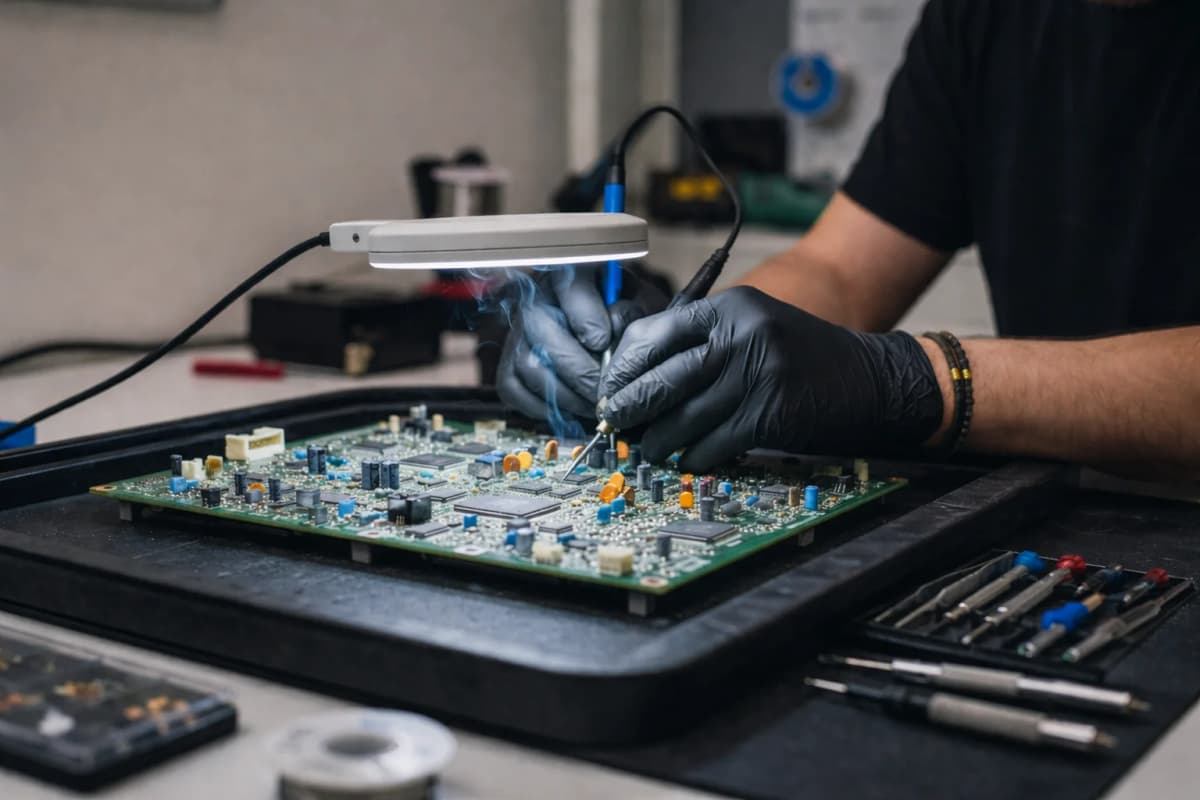
Magneti Marelli MM: typical failures, symptoms, and handling
Magneti Marelli MM engine ECU faulty? Symptoms, actual causes, and workshop options. Precise diagnosis and pairing. Request your personalized quote.
Please note: at Incarline, “repairing” a control unit means cloning. We transfer your original data — coding, immobiliser pairing and adaptations — onto a healthy unit with an identical reference. We do not carry out component-level repairs on your original unit.
The Magneti Marelli MM engine ECU (often identifiable by an IAW marking on the label) manages injection, ignition, and actuators on many petrol engines from the Fiat group and related brands. When it ages or undergoes electrical stress, recurring faults are observed on the internal 5 V supply, the motorized throttle control, the coil power stage, and CAN/K-Line communication. Symptoms can range from unstable idling to an impossible start, through a limp mode with the engine light on and codes related to air/pressure sensors or the ECU's self-diagnosis. On certain city cars and compacts (e.g., Fiat 500 type 312, Panda type 169, Grande Punto type 199), these behaviors are frequent depending on the engine. Depending on the diagnosis, Incarline can clone the data from your Magneti Marelli MM onto a healthy unit with a strictly identical reference, or supply an already-paired used unit: we do not carry out component-level repairs.
Find your exact reference
Search by hardware reference, software reference or control unit name. Click a result to configure and order without leaving the page.
Context and role of this family
In the Magneti Marelli MM family, the ECU (engine control module) orchestrates all injection and ignition functions, controls the electronic throttle, and communicates with the vehicle network via K-Line or CAN depending on the generation. It is notably found on petrol engines with multipoint injection where it must provide a stable reference for sensors (absolute pressure, temperature, throttle position) and power the coil and injector power stages. Typical failures observed on these Magneti Marelli MM often focus around the internal 5 V regulation which, when it drops, triggers a cascade of sensor faults, power cuts, and safety modes. Another recurring issue: the motorized throttle control whose H-bridge may drift, causing unstable idling, hesitation on acceleration, stalling when releasing the accelerator, and dedicated throttle/learning faults. Added to this are issues of immunity to interference (noise on sensor lines) and microcracks in solder joints on multilayer boards, sources of communication losses or intermittent faults difficult to reproduce when hot. In some cases, the memory containing the immobilizer pairing may become corrupted after a battery disconnection or short circuit, leading to a lit key light and a refusal to start. These clinical pictures, well known on the Magneti Marelli MM, require a methodical investigation to distinguish an internal ECU failure from a truly defective peripheral.
Technical particularities
Architecture and memory (flash + EEPROM)
The Magneti Marelli MM of this generation features a 32-bit microcontroller and combines flash memory for mapping and firmware with a small capacity serial EEPROM dedicated to variable data (VIN code, immobilizer, learnings). This separation allows, in the workshop, cloning or "virginization" operations when the original unit is irrecoverable, provided stable reading access to the data area is achieved. When corruption reaches the immobilizer area, the vehicle may start briefly then stall, or remain silent with pairing-oriented faults. On vehicles such as Fiat 500 (type 312), Panda (type 169), and Lancia Ypsilon (type 846), this behavior is regularly reported after electrical interventions or weak batteries. A faithful copy of the EEPROM, followed by proper pairing, generally restores coherence without reprogramming the mapping if it is intact.
5 V supply, throttle control, and communication
A recurring signature of Magneti Marelli MM failures lies in the internal 5 V line that powers multiple sensors. A drop or excessive ripple of this reference triggers simultaneous faults on pressure/position sensors and can put the engine in limp mode with slow throttle response. The H-bridge circuit dedicated to the throttle, when it drifts, results in impossible throttle learning, oscillating idle, and cuts when reapplying throttle. Finally, communication can switch from stable to intermittent due to weakened solder joints, leading to dialogue losses in K-Line during diagnostics or sporadic interruptions on the engine CAN. On certain engines of Fiat Grande Punto (type 199) and Fiat 500 (type 312), these symptoms appear more often after exposure to moisture at the connector or following transient overvoltages (jump starts). The relevant diagnosis consists of validating the stability of the 5 V reference, checking the integrity of throttle control, and confirming the continuity of communication lines before any replacement decision.
For which uses
This Magneti Marelli MM family is suitable for interventions where an internal ECU fault related to the 5 V supply, motorized throttle, ignition stage, or immobilizer pairing is suspected on models like Fiat Panda 169, Fiat 500 312, Grande Punto 199, or Lancia Ypsilon 846 depending on the engine. In the presence of advanced corrosion, burnt casing, or torn tracks, a replacement with a paired used unit remains relevant, while for common electronic faults (regulator, drivers, soldering), a repair followed by a bench test is often the most rational route. Depending on the diagnosis, Incarline can clone the data from your Magneti Marelli MM onto a healthy unit with a strictly identical reference, or supply an already-paired used unit: we do not carry out component-level repairs. Upstream, a simple check of engine grounds, battery, and throttle connector helps validate the ECU origin before immobilizing the vehicle.
Frequently asked questions
How do I know if my Magneti Marelli MM ECU is really at fault?
Which vehicles are most often affected by a Magneti Marelli MM failure?
Can a Magneti Marelli MM be cloned without going through the dealership?
What faults are typical of a failed Magneti Marelli MM on the motorized throttle side?
Can a 5 V supply problem on a Magneti Marelli MM mimic faulty sensors?
When to favor repair vs a paired used Magneti Marelli MM?
My Magneti Marelli MM lost immobilizer pairing after a weak battery, what to do?
Your reference isn’t listed?
Contact us — we can source your control unit or handle your repair on a quote basis.
Contact us