
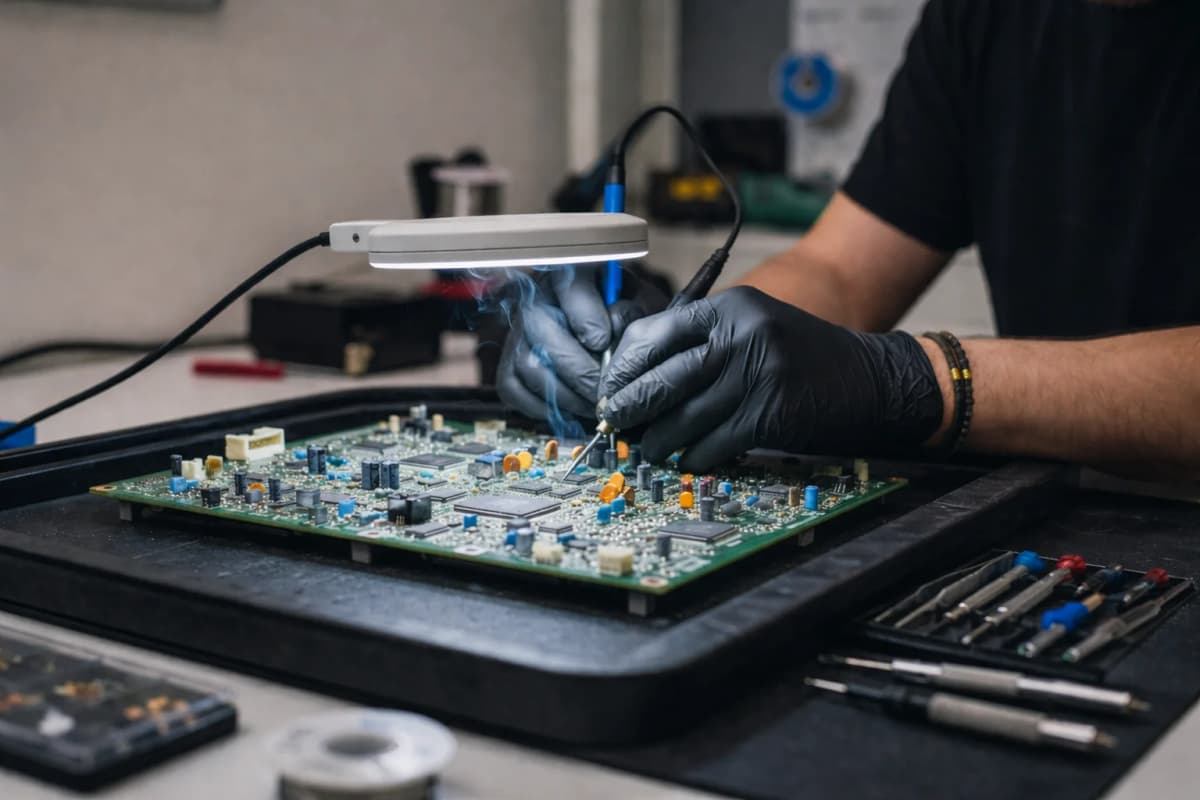
Remapping Magneti Marelli 9GF for ECU engine optimization
Magneti Marelli 9GF: OBD/bench/boot remapping, torque/power optimization safely. Workshop or remote file depending on version. Request your personalized quote.
The Magneti Marelli 9GF engine ECU is a modern petrol management unit, often used on turbocharged or multipoint/direct injection engines depending on the versions. For stage 1/2 optimization or function adjustments (deactivation of components on demand and specific use), the 9GF allows reading/writing via OBD when the protocol permits, or in bench/boot modes for full access. Key maps targeted include injection, ignition timing, torque limiters, boost pressure management, and, depending on the architecture, lambda targets. Incarline can perform the remapping of the Magneti Marelli 9GF in the workshop or provide a calibrated file remotely depending on the version identified on your ECU.
Find your exact reference
Search by hardware reference, software reference or control unit name. Click a result to configure and order without leaving the page.
Technical sheet of this family
The Magneti Marelli 9GF belongs to the category of petrol engine ECUs (ECM). It relies on a 32-bit automotive generation microcontroller, with an internal flash memory dedicated to code and calibrations, and an external serial EEPROM (or non-volatile data area) used for pairing parameters and identification. The logical separation between code areas and calibration areas is typical, allowing partial writes when the protocol allows.
Regarding access, several scenarios are encountered on the Magneti Marelli 9GF family: reading/writing via OBD for the map part on certain references, or access in bench (connectors and stabilized power supply, without opening the unit) and boot-mode (direct access to the microcontroller via test points) for full extraction. The challenge/response called seed-key is common to authorize writing, and checksum management is imperative to avoid blocking. The presence of a BDM/JTAG port is not systematic on this generation: specific boot procedures for the 9GF are preferred when low-level intervention is necessary.
In the workshop, professional interfaces in the field that may offer protocols for Magneti Marelli 9GF, depending on software and hardware versions, include well-known solutions like KESS/KESSv3, MPPS, CMD, or PCMflash. The choice will depend on the type of access (OBD, bench, boot-mode) available on the exact reference and the level of intervention targeted (partial vs full). In all cases, a full backup when possible (full read) is recommended before any modification.
Timing and usage: the Magneti Marelli 9GF is found on petrol engines from the 2010s decade and beyond, with calibration variants managing turbocharging, ignition, and pollution control associated with recent standards. Optimization possibilities depend as much on the 9GF's software strategy as on the mechanical margins of the engine, hence the importance of working on a dyno or with relevant logs after modification.
Commonly optimized maps on Magneti Marelli 9GF: injection tables (base and temperature/pressure corrections), ignition timing (loads and speeds), torque limiters, lambda targets, turbo pressure controls, and safety (boost limiters, overboost management). Depending on the version, anti-lag maps, cold start, or throttle/torque request management may also be present.
Vehicles concerned
The Magneti Marelli 9GF equips petrol engines of modest to intermediate displacements in several European manufacturers historically linked to Magneti Marelli. The most reliable identification remains the label on the unit bearing the mention "Magneti Marelli 9GF" and associated references.
- European petrol city cars with 3 or 4 cylinders, sometimes turbocharged, from the 2010s decade.
- Compact petrol sedans from Italian brands, with turbocharging management depending on versions.
- Urban SUVs and petrol crossovers sharing common mechanical bases.
- Family petrol station wagons/sedans with multipoint or direct injection, 2010s generation.
- Recent vintage models from the same industrial group, with calibration evolutions compliant with standards.
Points of vigilance
Remapping a Magneti Marelli 9GF requires strict management of checksums and seed-key, stabilized power supply in bench/boot, and prior data backup. An incomplete write or incorrect checksum calculation can lead to blocking (bricking) requiring boot-mode intervention for recovery. On this family, the coherence of paired areas (VIN/immo alignment) must be preserved during operations outside OBD. Incarline can handle the remapping of the Magneti Marelli 9GF in the workshop or provide a modified file remotely after reading the ECU, depending on the available protocol and prior reference verification.
Technical and legal limits: the gain depends on mechanical margins (turbo, injection, cooling, available fuel) and the control strategy specific to the 9GF software. Any deactivation of pollution control elements or diagnostic aids (e.g., EGR on concerned versions, or filters/strategies associated with recent petrol engines) must be evaluated with caution and remains reserved for private or off-road use according to regulations. Operational logs (exhaust temperature, knock, richness) are recommended after modification, particularly for a stage 2 with additional hardware.
Practical precautions: prioritize a first OBD read if the protocol is supported to clearly identify the software version, switch to bench/boot for a full backup if necessary, keep the original in a safe place, and document each step (power supply voltage, SW/HW identifiers, CVN). The use of recognized tools (e.g., KESS/KESSv3, MPPS, CMD, PCMflash) must be done with protocols explicitly listed for the 9GF and adapted cabling. For specific needs (anti-unintended deactivation, sensor tolerances, fine limiter adjustments), a methodical map work is essential. Incarline remains available to advise on the safest operating mode before any writing on your Magneti Marelli 9GF.
Frequently asked questions
How can I know if my Magneti Marelli 9GF ECU is compatible with OBD remapping?
Which maps are generally modified on Magneti Marelli 9GF for a stage 1?
Can a Magneti Marelli 9GF be cloned to prepare for remapping safely?
Which professional tools support the Magneti Marelli 9GF?
What to do in case of a brick during the writing of a Magneti Marelli 9GF?
Is it possible to remove EGR or functions related to pollution control on Magneti Marelli 9GF?
How to precisely identify my Magneti Marelli 9GF ECU before requesting a file?
Your reference isn’t listed?
Contact us — we can source your control unit or handle your repair on a quote basis.
Contact us