
Magneti Marelli 9DF — engine ECU, repair and cloning
Fault in your Magneti Marelli 9DF (ECM)? Inspection, component replacement, bench testing and cloning available. Request your personalized quote.
Please note: at Incarline, “repairing” a control unit means cloning. We transfer your original data — coding, immobiliser pairing and adaptations — onto a healthy unit with an identical reference. We do not carry out component-level repairs on your original unit.
The Magneti Marelli 9DF is an engine ECU (ECM) from the IAW range, fitted on recent multipoint petrol engines. When this unit starts to fail, typical symptoms include random starting, hot stalling, power loss, persistent engine lights, or sometimes no diagnostic communication. In the workshop, Incarline specifically addresses the Magneti Marelli 9DF family with a methodical approach: board inspection, memory reading (EEPROM/flash), replacement of power and control components if necessary, followed by bench testing with a simulation harness. The goal is to restore functionality without breaking the ECU's pairing with the vehicle's immobilizer, to avoid any relearning. This page describes how to identify your reference, what options exist (paired used unit, repair, remapping/cloning), and what technically happens when a 9DF is entrusted to us.
Find your exact reference
Search by hardware reference, software reference or control unit name. Click a result to configure and order without leaving the page.
Identify your exact reference
On a Magneti Marelli 9DF, the label generally includes the mention IAW 9DF followed by a suffix (e.g., 9DF.xx) with internal codes and a barcode. To avoid any technical misdirection, note the full title and numbers on the unit before contacting us: variants may involve slightly different maps and components.
- Locate the ECM in the engine compartment (often near the windshield bay or the chassis rail) and disconnect the battery.
- Photograph the complete label (mention IAW 9DF, suffixes, codes) and all connectors.
- Note the vehicle's VIN and, if possible, the state of symptoms (light, limp mode, loss of communication).
- Submit these elements for compatibility verification and preparation of bench tests.
- Fiat 500 (312) — certain 8/16V petrol versions
- Fiat Panda III (319) — depending on petrol engine
- Lancia Ypsilon (846) — related petrol engines
The options available to you
Paired used unit
A used Magneti Marelli 9DF unit can be prepared by cloning immobilizer and configuration data from the original, to avoid dealership visits for relearning, when the electronic state of the faulty unit allows.
Repair by cloning
The repair aims to retain your original Magneti Marelli 9DF by replacing faulty components (power supply, drivers, corrupted memory) and validating the result on the bench, while keeping the vehicle pairing.
Magneti Marelli 9DF remapping / cloning
Cloning involves reading the EEPROM and flash areas of the source 9DF and transferring them to a healthy base, to preserve VIN, immobilizer, and injector codings when required by the variant.
What to expect technically
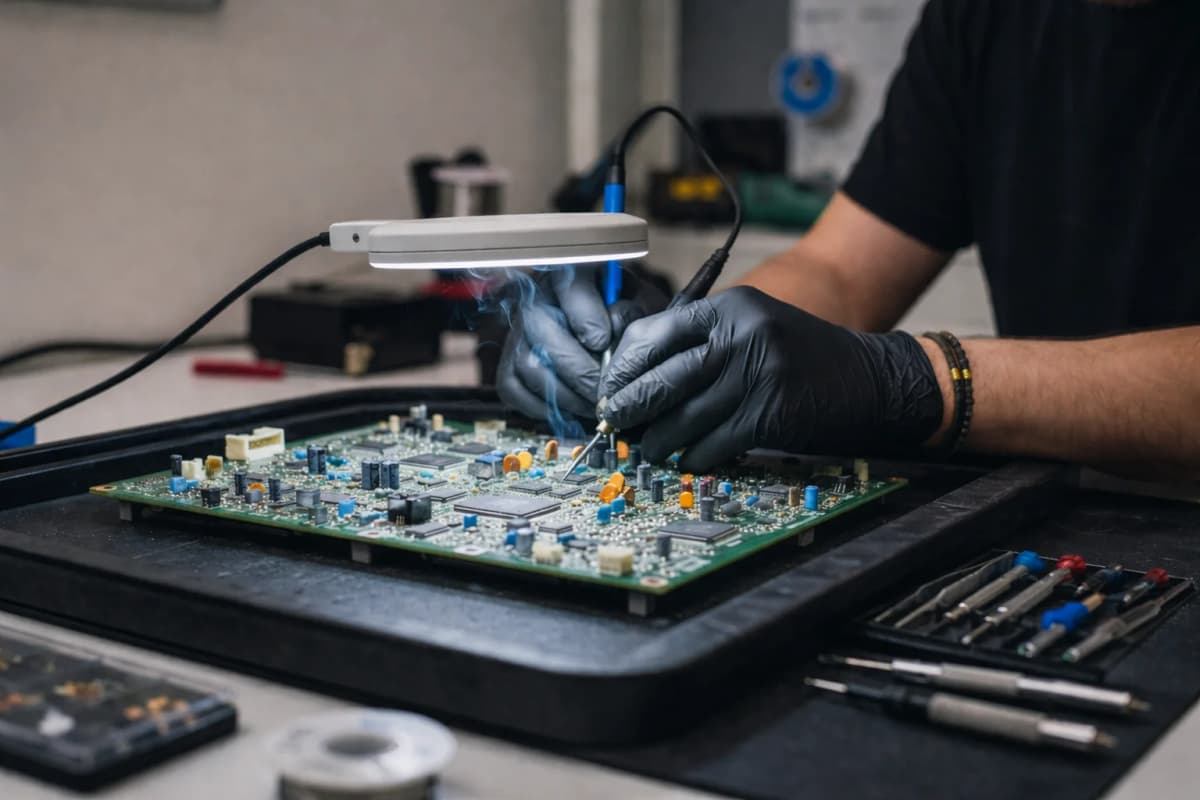
On a Magneti Marelli 9DF, the workshop begins with a meticulous visual inspection of the electronic board: signs of oxidation, liquid residues, cracked varnish, localized overheating. Internal power supplies are checked (ripple, regulators, filtering), as well as sensitive areas like power transistors driving relays and actuators, shunt resistors for current measurement, and capacitors subjected to thermal stress. Common faults result in weakened input/output circuits (temperature/pressure sensors) or unstable power rails causing random starts and sporadic cut-offs.
The next phase is memory reading. The 9DF carries a small capacity serial EEPROM (SPI type, dedicated to identifiers, immobilizer, and adaptations) and a main flash memory integrated into the microcontroller. Reading can be done via the diagnostic port when communication is intact (ISO 15765 compliant CAN bus), or in boot mode via service points on the board when the unit is silent. This step allows for a complete data backup before any hardware intervention.
After backup, the electronics are repaired at the component level. Depending on the diagnosis, incriminated elements (regulators, injector drivers, signal conditioning components, worn capacitors) are desoldered and replaced identically. If the microcontroller mounted in a matrix package requires alloy rework, a BGA/reballing type resoldering can be undertaken to secure internal connections. Tracks, vias, and pads are checked under a microscope, then the area is cleaned and revarnished if necessary.
The 9DF is then verified on the bench with a simulation harness that replicates power supplies, CAN wake-up, and loads on key outputs (injectors, coils, relays). Diagnostic communication, internal power stability, coherence of read values, and absence of generic faults related to the core calculation are checked. If memory sectors are corrupted, software reprogramming can be performed from the backup, with checksum recalculation when the variant requires it.
When the original unit is recoverable, the major advantage is that it remains paired with the vehicle: the immobilizer, VIN, and specific codings remain unchanged, avoiding learning procedures. In case of irreparable hardware, cloning the data from the faulty Magneti Marelli 9DF to a healthy unit allows, once again, to preserve the existing pairing.
Logistically, the timeframe is communicated after the initial diagnosis and depends on both the observed fault and the workshop load. After testing, the ECU is returned ready to be refitted to the vehicle, and the intervention coverage applies according to the current workshop conditions. Incarline returns the Magneti Marelli 9DF with its pairing data preserved to minimize unnecessary immobilizations.
Typical technical points of this family to keep in mind: the Magneti Marelli 9DF communicates in CAN (UDS/ISO 15765 diagnostics depending on the vehicle) and relies on an external serial EEPROM for the immobilizer identifier and certain adaptations. The main flash, integrated into the 32-bit microcontroller, hosts the map and management software. These elements explain why backup/reading of both memory spaces is systematic in repair and during cloning.
Frequently asked questions
How do I know if my Magneti Marelli 9DF ECU is faulty?
Which vehicles are equipped with the Magneti Marelli 9DF ECU?
Can a Magneti Marelli 9DF be cloned without visiting the dealership?
What is the difference between a repair and a paired used unit for a Magneti Marelli 9DF?
What diagnostic and communication protocol does the Magneti Marelli 9DF use?
Where are the immobilizer data located in a Magneti Marelli 9DF?
What should I do if my Magneti Marelli 9DF has been water-damaged or shows signs of oxidation?
Is an immo-off possible on a Magneti Marelli 9DF?
Your reference isn’t listed?
Contact us — we can source your control unit or handle your repair on a quote basis.
Contact us