
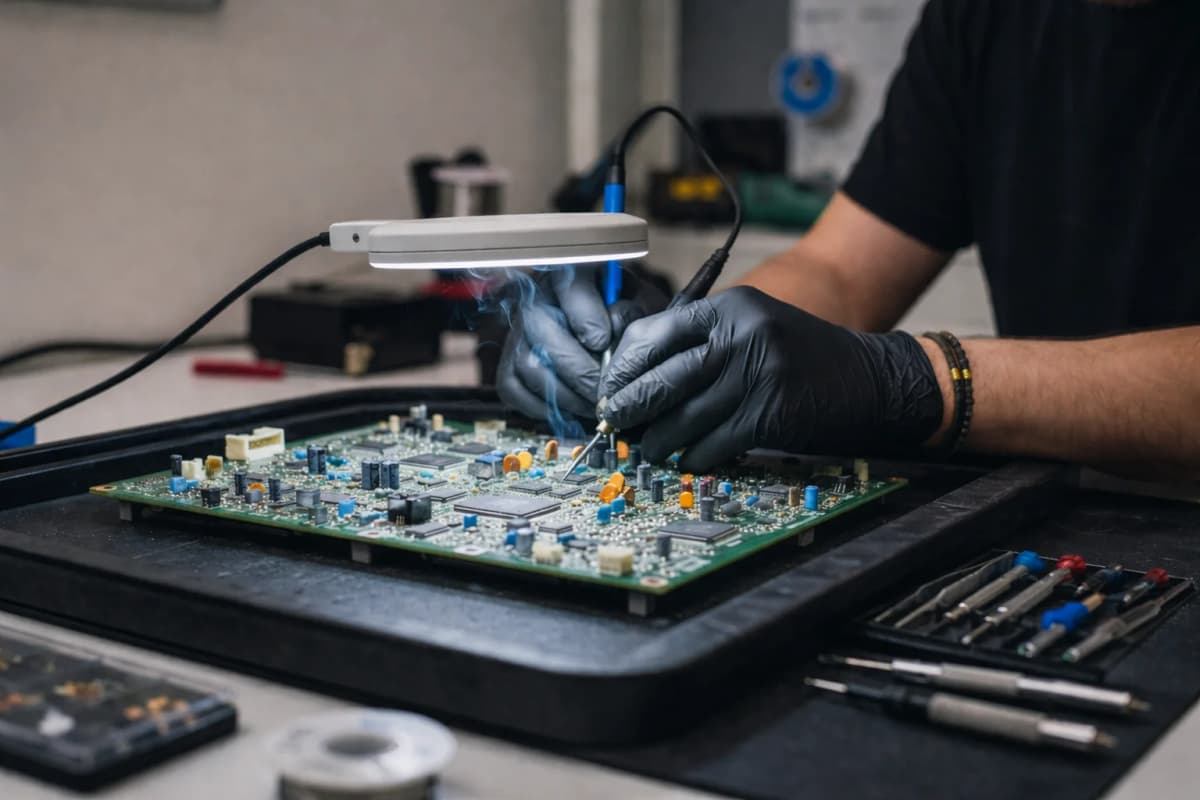
Lucas DCU — engine ECU diagnostics, cloning, and repair
Lucas DCU ECU failure? Diagnostics, repair, and cloning in workshop with bench tests. Your unit remains paired. Request your personalized quote.
Please note: at Incarline, “repairing” a control unit means cloning. We transfer your original data — coding, immobiliser pairing and adaptations — onto a healthy unit with an identical reference. We do not carry out component-level repairs on your original unit.
The Lucas DCU engine ECU is a family of ECUs used on older generation diesel engines. When a Lucas DCU shows a failure, the symptoms are often non-specific (random starting, limp mode, engine light, power loss, hot cutouts). In the workshop, the approach is first to preserve your data (VIN, immobilizer, coding), then to eliminate the hardware cause: actuator drivers, current measurement resistors, power capacitors, or corrupted memory. Reading the EEPROM and program area allows documenting the software state; restoration then involves targeted desoldering, replacement of faulty components, and, if necessary, re-soldering on BGA packages. After repair, a bench test verifies diagnostic communication and main functions. The Lucas DCU ECU remains paired to your vehicle, avoiding any immobilizer relearning.
Find your exact reference
Search by hardware reference, software reference or control unit name. Click a result to configure and order without leaving the page.
Identify your exact reference
The mention "Lucas DCU" usually appears on the case label, alongside a manufacturer part number and a calibration identifier. For reliable processing, it is essential to precisely identify the variant of your Lucas DCU, as power supply schemes, actuator drivers, and memory formats may vary depending on versions and engines.
- Photograph the complete label of the Lucas DCU ECU (readable side, without reflections) ensuring all numbers and barcodes are captured.
- Note the engine type (naturally aspirated or turbo diesel, displacement) and the number of connectors present on the case.
- Record, if possible, a screenshot of the diagnostic tool showing the ECU identification (Lucas DCU family and software version).
- Compare this information with the reference listed in the engine compartment or the vehicle workshop documentation to confirm the match.
Your available options
Used Lucas DCU
Considered as a replacement solution, a used Lucas DCU unit must be paired or cloned to retain the original immobilizer and coding.
Lucas DCU repair in workshop
Electronic diagnostics, replacement of faulty components, and bench testing to restore your existing unit without data loss.
Lucas DCU remapping
Reading/writing the necessary memory areas (EEPROM and program) to restore coherent data after corruption or during cloning.
What to expect technically
When a Lucas DCU arrives in the workshop, the process begins with a visual and microscopic inspection: looking for oxidation, varnish cracks, weakened tracks, hot spots around power transistors and shunt resistors. Power capacitors and regulators are checked, as voltage instability can cause random cutouts and hot restarts. The immobilizer management and identifiers (VIN, coding) part is secured by prior reading of the external serial EEPROM before any intervention.
In this family, a typical architecture of diesel ECUs of this generation is frequently encountered, with a 16-bit microcontroller and a serial EEPROM dedicated to variable data. Diagnostic communication is often via a K-line (previous OBD generation), which allows validating the ECU's availability on the bench after cloning. For versions directly controlling injection pump actuators, solenoid drivers, and current measurement circuits are prioritized for checking.
If a component is declared faulty, desoldering is performed respecting the thermal dissipation of the board: selective varnish removal, hot air soldering, IR station for sensitive areas. QFP, QFN, and, if applicable, BGA packages are handled with appropriate templates and flux; BGA reballing can be performed if necessary. After replacement, an isolation and continuity check is conducted on critical lines (power, grounds, K-line, speed/position sensors, pre/post-heating relay control).
On the software side, reading the Lucas DCU EEPROM allows verifying the integrity of immobilizer data and specific parameters. In case of corruption, reconstruction is attempted from backups and coherent data from your unit. If the program area needs rewriting, remapping is performed in service mode on the bench (when available) or directly on the board, with checksum validation. The goal is to retain the original electronic identity so that the ECU remains paired with the vehicle: no immobilizer relearning procedure is then required on the vehicle side.
The test bench recreates a minimal environment for the Lucas DCU: stabilized power supply, simulation of critical sensor signals (speed/phase), verification of diagnostic communication, and controlled activation of outputs. Final checks include a simulated start test, reading/clearing of generic faults, and stability verification under moderate thermal stress. In practice, this helps rule out intermittent failures related to dry solder joints or marginal power supply.
Typically encountered symptoms on a failing Lucas DCU:
- Engine light on and limp mode without obvious mechanical cause.
- Difficulty starting cold or hot, sometimes accompanied by intermittent communication loss.
- Brief engine cutouts during load (acceleration), then possible restart.
- Non-specific fault codes for the main microcontroller or ECU power supply (to be confirmed by diagnostics).
Regarding workshop lead time and warranty, these depend on the complexity of the failure and necessary tests; upon receipt, the unit is handled according to an established flow, with clear information to the client at each step. The repaired Lucas DCU unit is returned ready to reinstall: it remains paired with the original vehicle, avoiding any immobilizer operation or relearning on the car.
Frequently asked questions
How do I know if my Lucas DCU ECU is faulty?
Which vehicles are equipped with the Lucas DCU ECU?
Can a Lucas DCU be cloned without going to the dealer?
What is the difference between a repair and a paired used unit for a Lucas DCU?
What to do in case of a Lucas DCU failure?
Does the Lucas DCU manage the immobilizer and can relearning be avoided?
Is remapping a Lucas DCU enough to resolve a failure?
Your reference isn’t listed?
Contact us — we can source your control unit or handle your repair on a quote basis.
Contact us