
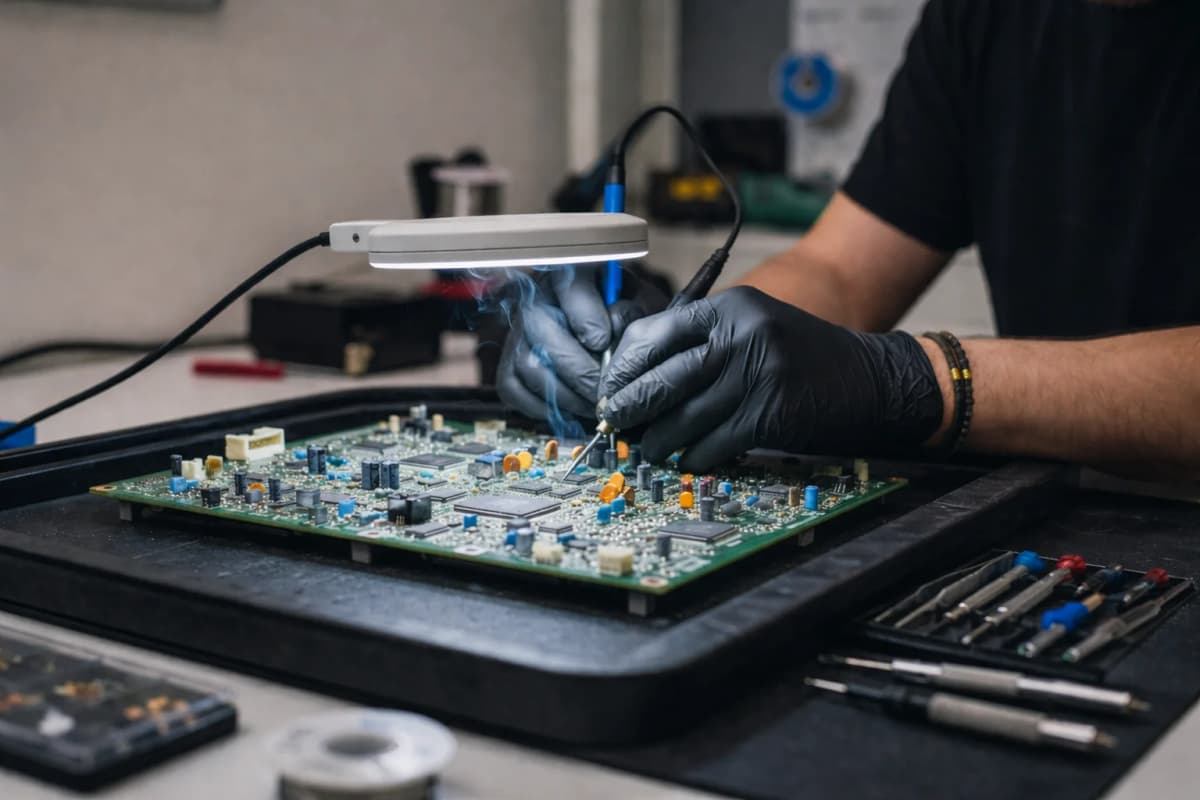
Landi Renzo LPG ECU — workshop diagnostics, cloning, and repair
Landi Renzo LPG repair with full diagnostics, cloning, and bench testing. ECU returned ready to reinstall on your vehicle. Request your personalized quote.
Please note: at Incarline, “repairing” a control unit means cloning. We transfer your original data — coding, immobiliser pairing and adaptations — onto a healthy unit with an identical reference. We do not carry out component-level repairs on your original unit.
The Landi Renzo LPG ECU manages the liquefied petroleum gas injection by relying on the petrol ECU signals to control the gas injectors. In this family (Omegas/EVO type systems), a non-volatile memory contains maps and sensor calibrations, and the power electronics switch the LPG injector supply. As it ages or suffers from overvoltage, typical failures appear: unintended switching to petrol, cuts under load, unstable idle, or inability to switch to gas. In the workshop, a thorough repair of a Landi Renzo LPG involves visual inspection, EEPROM reading, replacement of faulty components, and bench testing that replicates injection signals. The goal is to return a functional ECU, retaining your parameters and immediately recognized by the vehicle, without immobilizer relearning.
Find your exact reference
Search by hardware reference, software reference or control unit name. Click a result to configure and order without leaving the page.
Identify your exact reference
To properly guide the repair of a Landi Renzo LPG ECU, precise identification of the variant (for example, Omegas or EVO) and its hardware/software revision is essential. This information is usually found on the case label (top side) and, if applicable, in the LPG diagnostic software via the system's service port.
- Remove the Landi Renzo LPG case and gently clean the label to make it readable without damaging it.
- Note the visible fields: brand "Landi Renzo", family (often "Omegas" or "EVO"), HW/SW version, and serial number.
- Take clear photos of the label and connector, as well as the LPG harness if a reference is printed on it.
- Submit these elements with a description of the symptoms (petrol/gas switching, cuts, LPG warning light) for compatibility validation before intervention.
Your options
Paired used unit
A used Landi Renzo LPG case can be prepared with your parameters to restore proper operation, a solution to consider if the original electronics are too damaged.
Repair by cloning
Repairing your Landi Renzo LPG involves precisely diagnosing the board, replacing faulty components, and bench testing the entire unit while preserving your calibrations.
Reprogramming / cloning
Landi Renzo LPG cloning copies the configuration memory (EEPROM) to another compatible case to retain original maps, calibrations, and behaviors.
What to expect technically
Upon receipt, the workshop begins with a methodical visual inspection of the Landi Renzo LPG ECU: looking for signs of overheating around the gas injection stages, swollen capacitors, cracked varnish, oxidation near the connector, and anomalies on current measurement resistors (shunt). This step already points to common failures (partially commanded LPG injectors, overvoltage that has stressed the power supply, or poorly read gas sensors).
The second phase targets the data part. A read of the non-volatile memory (external serial EEPROM on this type of case, depending on generation) is performed to back up maps and calibration parameters (gas pressure, gas temperature, injector corrections). This backup allows, if necessary, reliable cloning to a twin case and prevents any loss of configuration specific to your LPG installation.
The in-depth electronic diagnosis then targets at-risk components: transistors or power drivers of the gas injectors, regulators, protection diodes, measurement shunts, and power paths. Faulty components are properly desoldered (hot air or infrared depending on the case size), then replaced with equivalent quality references. If the main microcontroller (typical 16/32-bit architecture) is in a ball grid array package, a BGA reballing/resoldering operation may be conducted if necessary, but most observed failures on Landi Renzo LPGs come from the power stages and power management.
Once the hardware part is restored, the memory is rewritten if corruption has been detected (reconstruction from the healthy backup). An integrity check of the configuration areas is performed to ensure that sensor calibrations and petrol/gas switching tables match your installation. In the case of a replacement, cloning transfers this data to a compatible Landi Renzo LPG ECU (e.g., an Omegas/EVO range unit of the same generation).
The bench test simulates real conditions: petrol injector signals as input, sequential gas switching, monitoring of power stage responses, and validation of petrol ↔ gas switching. Cut-off thresholds, simulated injection times, and sensor feedback consistency (gas pressure/temperature) are observed to rule out any dropout under load or when hot. This final test aims to return a stable ECU, ready to resume its place without reconfiguration.
An important point for this family: the Landi Renzo LPG ECU is an additional case dedicated to the LPG circuit and does not manage the vehicle's immobilizer. The returned module remains naturally paired with your installation (maps, calibrations, options) and reintegrates without immobilizer relearning. The intervention time depends on the diagnosis and components to be replaced; it is communicated at the time of the quote, and a workshop warranty covers the service according to the current conditions.
Typical symptoms of a faulty Landi Renzo LPG:
- Random switching to petrol, especially when hot or under full load.
- Gas supply misses, jerks during acceleration, unstable idle.
- Inability to activate LPG mode, LPG warning light on.
- Non-specific fault codes reported by the engine ECU related to injection behavior (without detailing a specific reference).
Examples of vehicles often encountered in LPG conversion with Landi Renzo systems (for indicative purposes):
- Renault Clio III (X85 generation) with multipoint petrol engine.
- Fiat Grande Punto (type 199) with petrol engine compatible with conversion.
- Volkswagen Golf V (A5 platform) in multipoint petrol version.
Finally, two technical points to keep in mind for the Landi Renzo LPG family: (1) the control is sequential, synchronized with the petrol injector pulses to precisely dose the gas on each cylinder; (2) the vehicle-specific configuration is stored in a dedicated non-volatile memory, allowing cloning when the original case is out of service but its data remains readable.
Frequently asked questions
How do I know if my Landi Renzo LPG ECU is faulty?
Which vehicles are equipped with the Landi Renzo LPG ECU?
Can a Landi Renzo LPG be cloned without going to the dealer?
What is the difference between a repair and a paired used unit for a Landi Renzo LPG?
Does the Landi Renzo LPG ECU manage the vehicle's immobilizer?
Can the Landi Renzo LPG ECU cause an engine limp mode?
Which components most often fail on a Landi Renzo LPG?
After repairing a Landi Renzo LPG, do gas settings need to be redone?
Your reference isn’t listed?
Contact us — we can source your control unit or handle your repair on a quote basis.
Contact us