
GETRAG VGS (TCM) — Workshop repair and secure VGS cloning
GETRAG VGS ECU malfunctioning? Diagnosis, repair by cloning, cloning and paired replacement. Extend the life of your TCM. Request your personalized quote.
Please note: at Incarline, “repairing” a control unit means cloning. We transfer your original data — coding, immobiliser pairing and adaptations — onto a healthy unit with an identical reference. We do not carry out component-level repairs on your original unit.
The GETRAG VGS ECU is a TCM controlling a dual-clutch transmission, with precise management of solenoids, hydraulic pressures, and both clutches. When it fails, typical symptoms include limp mode, jerking, loss of gear engagement, or a transmission warning light. In this family, power electronics (drivers, shunt resistors), memory (EEPROM/flash), and BGA solder joints can be the cause. The intervention involves diagnosing the board, securing pairing data, and restoring the electronic part before bench testing. The goal is to retain your coding and pairing to the vehicle to avoid immobilizer relearning once the TCM is reinstalled. This page details how to identify your GETRAG VGS reference, the possible options, and the technical process of a workshop service restoration.
Find your exact reference
Search by hardware reference, software reference or control unit name. Click a result to configure and order without leaving the page.
Identify your exact reference
The GETRAG VGS exists under similar references (e.g., VGS‑FDCT) and may be integrated into the mechatronic block of the gearbox. Before any request, note the identifier on the ECU label or on the edge of the board. This avoids confusion and ensures compatibility for cloning or replacement operations.
- Remove the cover of the mechatronic block if necessary, then locate the GETRAG VGS TCM label.
- Note the commercial designation (e.g., VGS‑FDCT), the full reference, and any manufacturing suffixes.
- Photograph the label and the main connector to confirm the pinout type.
- Send this information along with the VIN number to validate pairing and software variants related to your vehicle.
The options available to you
Paired used unit
A used GETRAG VGS unit can be supplied and then cloned with your ECU data to remain paired with the vehicle.
Repair by cloning
Your GETRAG VGS is diagnosed, faulty components are replaced, and EEPROM/flash data is secured to retain pairing.
Remapping / cloning
Reading memories, transferring codings, and software remapping of the GETRAG VGS to start without an immobilizer procedure.
What to expect technically
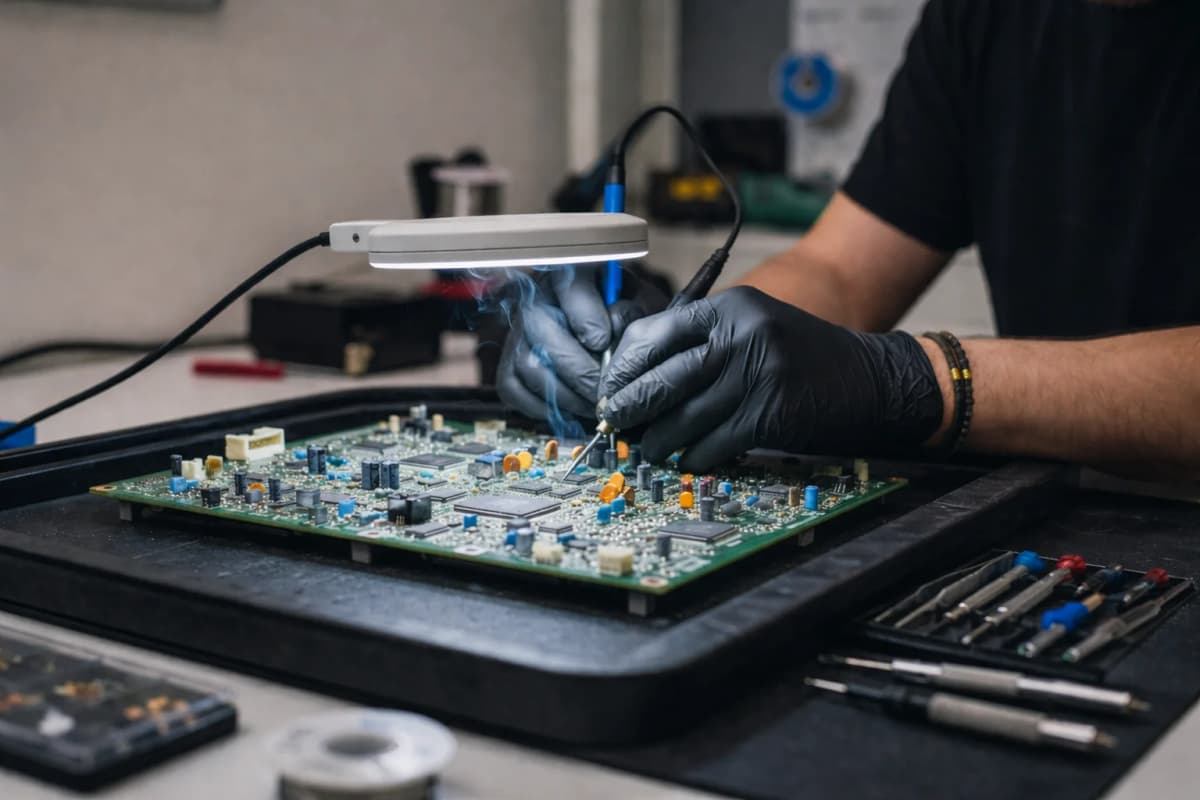
In the GETRAG VGS family, failures can affect both logic (32-bit microcontroller, EEPROM/flash memory) and power (solenoid drivers, pump transistors, current measurement shunt resistors, filtering capacitors). The workshop begins with a meticulous visual inspection: looking for oil-induced oxidation, cracked varnish, hot spots, solder cracks, and sunken BGA pads. A secure EEPROM read is performed first to freeze your identification data, variant coding, and vehicle pairing. Then, measurements are taken on the power supply, CAN lines, and solenoid control stages.
When hardware faults are identified, the incriminated components are removed: clean desoldering (including reballing and resoldering BGA if necessary), replacement of power transistors and drivers, exchange of derived shunt resistors and out-of-tolerance capacitors. Fragile tracks are repaired under a microscope, then cleaning and reapplication of protective varnish are performed. If the memory is corrupted, damaged sectors are reconstructed from the backup, or another compatible GETRAG VGS is cloned by transferring the EEPROM and, if required, useful flash areas.
The test is conducted on a bench: the GETRAG VGS is stimulated via the CAN network and subjected to pressure build-up scenarios, solenoid activation, and typical dual-clutch engagement sequences. Internal sensors (pressure/temperature) and the coherence of shaft speed sensor feedback are verified. At the end, a remapping may be applied if the software needs updating to match the vehicle variant. The ECU is returned paired to its original vehicle, avoiding an immobilizer relearning procedure; upon reassembly, only clutch adaptations and gearbox self-learning may be reset if recommended by the manufacturer.
Typical symptoms of a failing GETRAG VGS:
- Limp mode, locked in a single gear, or refusal to engage.
- Marked jerking, slipping when hot, irregular clutch management.
- Intermittent communication on the CAN network or loss of diagnostics.
Models commonly associated with a GETRAG VGS‑FDCT (compact generation Getrag dual-clutch gearbox):
- Mercedes‑Benz A-Class (W176)
- Mercedes‑Benz B-Class (W246)
- Mercedes‑Benz CLA (C117)
- Mercedes‑Benz GLA (X156)
Notable technical details on this family: communication interface via CAN bus with standardized diagnostics of recent generation; storage of pairing identifiers and gearbox parameters in serial EEPROM and internal flash; dedicated management of both clutches and proportional solenoid assemblies specific to the dual clutch.
Frequently asked questions
How do I know if my GETRAG VGS ECU is faulty?
Which vehicles are equipped with the GETRAG VGS‑FDCT ECU?
Can a GETRAG VGS be cloned without going to the dealer?
Does the GETRAG VGS need to be relearned after cloning?
Which components most often fail on a GETRAG VGS?
What communication protocol does a GETRAG VGS use?
Where is the GETRAG VGS located and how to access it?
Your reference isn’t listed?
Contact us — we can source your control unit or handle your repair on a quote basis.
Contact us