
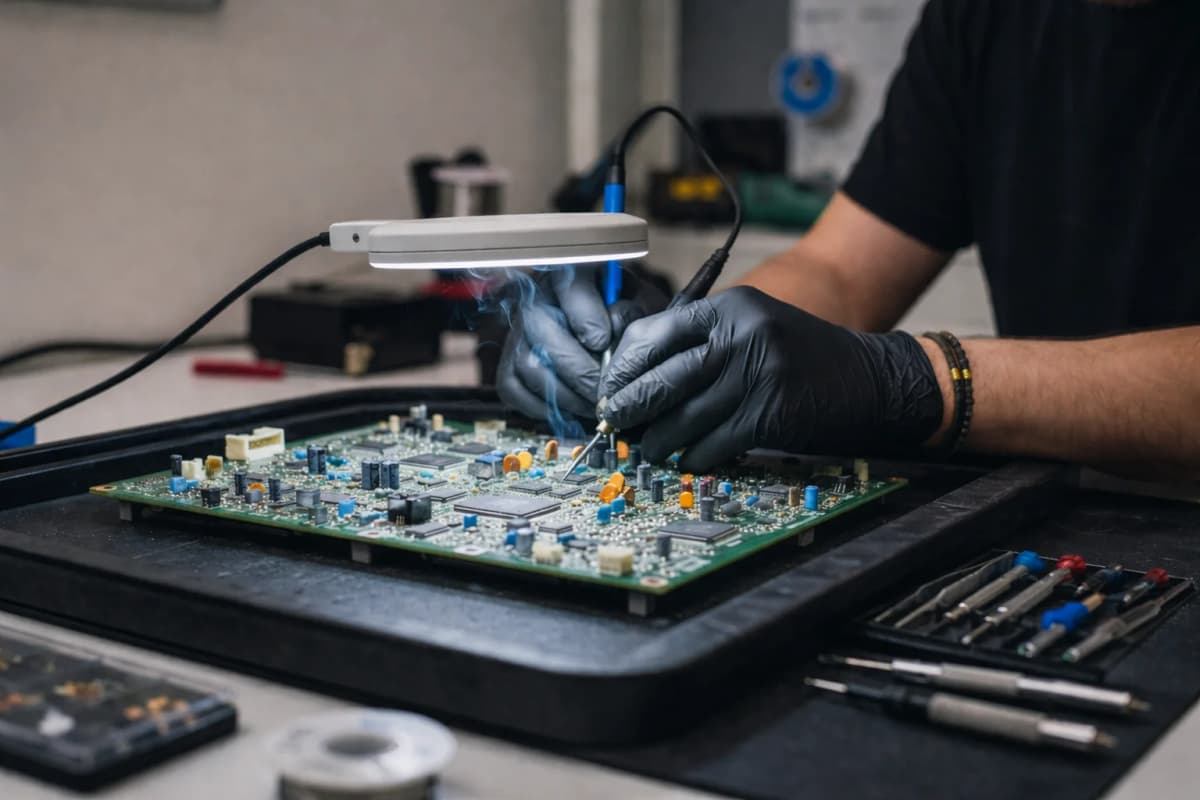
Getrag DC (TCM) — specific failures, diagnosis and solutions
Getrag DC failures: jerks, gear loss, pressure faults. Diagnosis, cloning or exchange depending on the case. Request your personalized quote.
Please note: at Incarline, “repairing” a control unit means cloning. We transfer your original data — coding, immobiliser pairing and adaptations — onto a healthy unit with an identical reference. We do not carry out component-level repairs on your original unit.
The Getrag DC transmission ECU controls the mechatronics of dual-clutch transmissions in this family (e.g., Getrag DC4 TCM). When it drifts or fails, typical symptoms include jerks during engagement, loss of odd or even gears, a limp mode with messages like “check transmission,” and clutch pressure regulation or internal position sensor faults. For a garage, mechanic, or individual, the priority is to identify whether the fault is electronic (TCM), mechatronic (solenoids/sensors), or clutch-related. Depending on the diagnosis, Incarline can clone the data from your Getrag DC onto a healthy unit with a strictly identical reference, or supply an already-paired used unit: we do not carry out component-level repairs.
Find your exact reference
Search by hardware reference, software reference or control unit name. Click a result to configure and order without leaving the page.
Context and role of this family
The Getrag DC is the electronic brain that orchestrates the dual-clutch transmissions of this lineage, separately controlling the two clutches and selection actuators. It manages the adaptation of clutches A/B, the hydraulic pressure of the circuits, the synchronization of even/odd gears, and CAN communication with the engine ECU. On the road, it ensures fast and smooth gear changes; in urban use, it must handle low-speed maneuvers and fluctuating temperatures. Specific failures of this family often appear as loss of gears on one side (odd or even), clutch pressure instabilities, actuator position sensor faults, and, more rarely, communication interruptions. In practice, these failures are regularly reported on Renault models badged EDC, notably some Clio IV, Captur I, and Mégane III/IV equipped with the corresponding transmission.
Technical specificities
Electronic architecture and memory
The Getrag DC ECU is based on a 32-bit microcontroller responsible for real-time control. The firmware resides in flash memory, and the learning parameters (clutches A/B, end points, thermal compensations, selection index) are stored in a non-volatile data area, typically EEPROM or a dedicated flash partition. This data block makes cloning the Getrag DC crucial during replacement to retain the original calibration and VIN/coding pairing. Vehicle communication is via the CAN bus, with diagnostic exchanges conforming to standard UDS services for fault reading/clearing and live data access, allowing confirmation of pressure drift, sensor inconsistency, or internal ECU fault without fully removing the transmission.
Hydraulics, actuators, and sensors specific to the family
The Getrag DC controls proportional solenoids dedicated to each clutch and selection sequences, relying on integrated sensors (transmission oil temperature, actuator positions, shaft speeds) to close the regulation loops. Typical symptoms include a clear loss of odd or even gears depending on the affected subsystem, slipping during engagement, or jerks related to unstable pressure regulation, and actuator position sensor coherence faults. Cases of internal temperature sensor drift lead to inappropriate clutch adaptations after warming up. There are also board failures (weakened solder joints or tracks) causing intermittent solenoid command interruptions or occasional communication loss. On a test bench, analyzing solenoid current curves, target versus measured pressures, and actuator positions helps isolate an electronic failure of the Getrag DC TCM from a purely mechanical transmission issue.
For which uses
When the Getrag DC communicates and faults point to clutch regulation, position measurement, or thermal drift, targeted ECU repair is generally relevant to preserve learned adaptations. If the ECU is silent, has a persistent internal fault, or irrecoverable data corruption, replacement with a paired used Getrag DC via data cloning is preferable to avoid prolonged immobilization. Incarline can guide towards the suitable option after checking faults, live measurements, and adaptation verification, then provide either electronic intervention on the board or a replacement ECU ready to be mounted and synchronized with the vehicle.
Frequently asked questions
How to know if my Getrag DC ECU is faulty?
Which vehicles are most often affected by a Getrag DC failure?
Can a Getrag DC ECU be cloned without going to the dealer?
What diagnostic faults are typical of a faulty Getrag DC?
Repair or paired used for a Getrag DC: what to choose?
After replacing a Getrag DC, is reprogramming necessary?
What tests help distinguish a Getrag DC failure from a clutch problem?
Your reference isn’t listed?
Contact us — we can source your control unit or handle your repair on a quote basis.
Contact us