
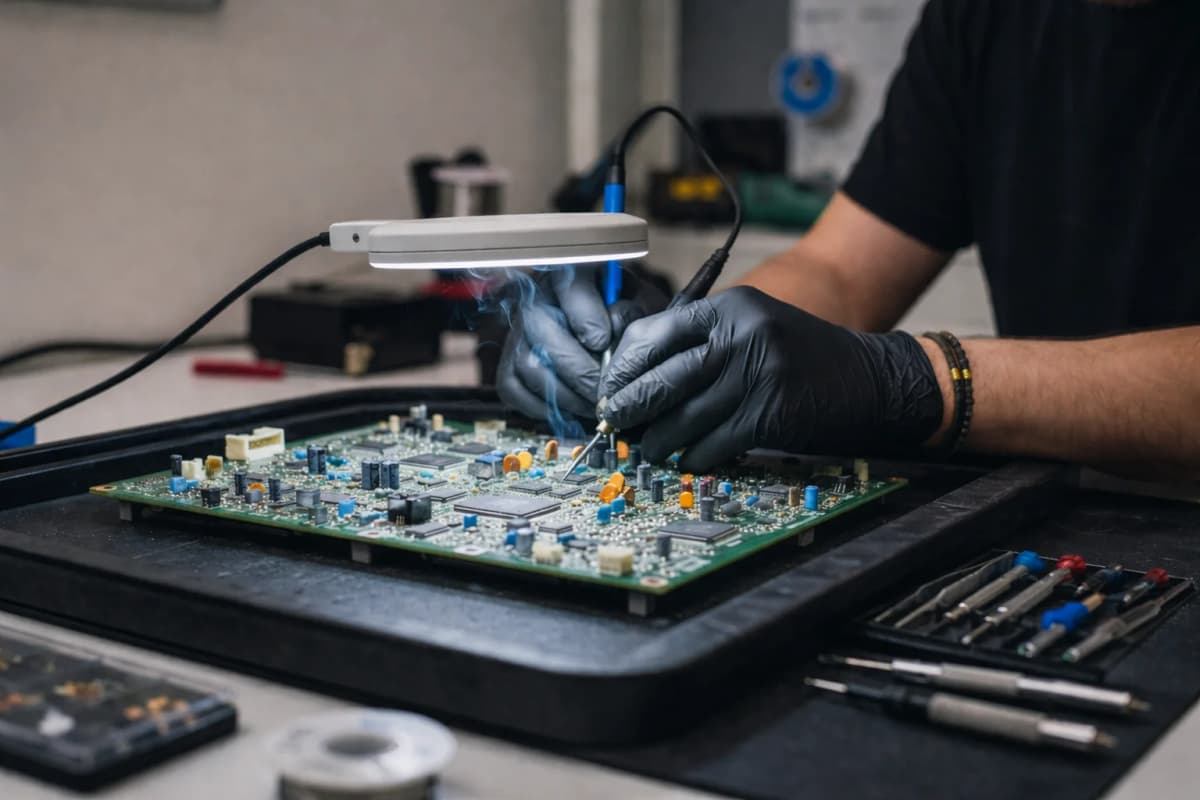
TCM Getrag 7DCT: identify the exact correct reference
Exact reference of the TCM Getrag 7DCT: where to read it, HW/SW, non-interchangeable. Find your part via our configurator. Request your quote.
Please note: at Incarline, “repairing” a control unit means cloning. We transfer your original data — coding, immobiliser pairing and adaptations — onto a healthy unit with an identical reference. We do not carry out component-level repairs on your original unit.
Is your dual-clutch transmission managed by a Getrag 7DCT TCM malfunctioning? Before any order, it is essential to identify the exact reference on your unit. On the outer label of the mechatronic block, you will generally find: the manufacturer reference (e.g., internal format of the vehicle manufacturer), the supplier number (Getrag/Magna Powertrain), a software code (SW), and a serial number. Inside, the markings printed on the board (HW revisions, PCB codes) may slightly differ from the label descriptions; they mainly serve to confirm the hardware version. Take clear photos of each side of the label, separately note the 'HW' line and the 'SW' line when they exist. Then, use our configurator on this page: search either by HW/SW ref. or by vehicle. Important reminder: within the Getrag 7DCT family, only the identical reference (same HW indices and, ideally, same SW) is suitable; close variants are not interchangeable.
Find your exact reference
Search by hardware reference, software reference or control unit name. Click a result to configure and order without leaving the page.
Symptoms that bring you here
On a transmission managed by a Getrag 7DCT ECU, typical warning signs combine gearbox behaviors and dashboard alerts. Often observed are hesitant gear shifts when cold, pronounced jerks during gear changes, inability to engage reverse or certain gears, a flashing PRND indicator, or a limp mode. Driving may remain possible but with unusual revving, loss of traction at low revs, or abrupt engagements upon restarting. These symptoms may be intermittent and worsen when hot, as the mechatronic block oil reaches its operating temperature.
In other cases, the vehicle refuses to move while the engine runs normally, or does not leave a gear for safety. Generic messages related to the transmission may appear, accompanied by non-specific fault codes stored in the TCM. After a battery disconnection or voltage drop, clutch and actuator self-adaptation may lose its reference, resulting in imprecise engagements. If you recognize any of these scenarios on a Getrag 7DCT gearbox, rigorous identification of the correct ECU reference will be the first step before any intervention.
Technical causes in this family
The Getrag 7DCT TCM controls a 7-speed dual-clutch gearbox via an integrated mechatronic, with communication on the CAN network and generally UDS diagnostics (ISO 14229). It relies on a 32-bit microcontroller, flash memory for software, and a serial EEPROM for identification, calibration, and pairing data. In this family, encountered failures are due as much to the control electronics as to the thermal environment and hydraulic demands of the block.
- Aging of the power stages of the solenoids (drivers) powering the hydraulic actuators, causing engagement faults or irregular gear shifts.
- EEPROM alteration (coding and variant data) after voltage drops or electrical interventions, with loss of learnings or startup incompatibility.
- Oil migration at the mechatronic connector or localized sealing failure, leading to false contacts and inconsistent sensor readings.
- Repeated thermal stresses of the Getrag 7DCT block (expansion/contraction) causing microcracks in solder joints or oxidation on the electronic board.
- HW/SW version mismatch during an unpaired replacement, blocking gear selection or network communication.
- Pressure/position sensors of the hydraulic circuit out of range, inducing a limp mode even if the initial fault comes from electronic conditioning.
What Incarline offers
To avoid any misdirection, start by precisely noting the markings on your Getrag 7DCT TCM: manufacturer reference (often printed in bold), supplier reference, SW code (software), and serial number. If the label is partially unreadable, internal markings on the board (HW revision, PCB version) help secure identification. On this page, our configurator accepts direct search by HW/SW reference or, failing that, by brand/model/engine of your vehicle; this allows isolating the exact variant of the Getrag 7DCT transmission ECU corresponding to your original setup. Keep in mind that mechatronics in this family are frequently paired to the vehicle by VIN and variant codings; even a slight mismatch can prevent gear engagement.
Depending on the diagnosis, Incarline can clone the data from your Getrag 7DCT onto a healthy unit with a strictly identical reference, or supply an already-paired used unit: we do not carry out component-level repairs. Depending on the configuration, pairing includes retrieving identifiers, synchronizing variants, then learning clutches and actuators upon restart. Technically, we manage key data stored in flash/EEPROM and verify the consistency of HW/SW indices displayed on the label against internal markings. If you hesitate between several close references, upload photos of your label into the configurator and filter by HW code, then by SW: you will arrive at the exact compatible reference, essential for the Getrag 7DCT family.
Frequently asked questions
How do I know if my Getrag 7DCT ECU is faulty?
Which vehicles are equipped with the Getrag 7DCT ECU?
Where is the exact reference on a Getrag 7DCT and how to read it?
Can a Getrag 7DCT ECU be cloned without going to a dealership?
Is a used Getrag 7DCT interchangeable if the reference differs slightly?
What are the differences between a repair and a paired used unit for a Getrag 7DCT?
Does the Getrag 7DCT require coding or pairing after replacement?
What diagnostic protocols apply to the Getrag 7DCT TCM?
Your reference isn’t listed?
Contact us — we can source your control unit or handle your repair on a quote basis.
Contact us