
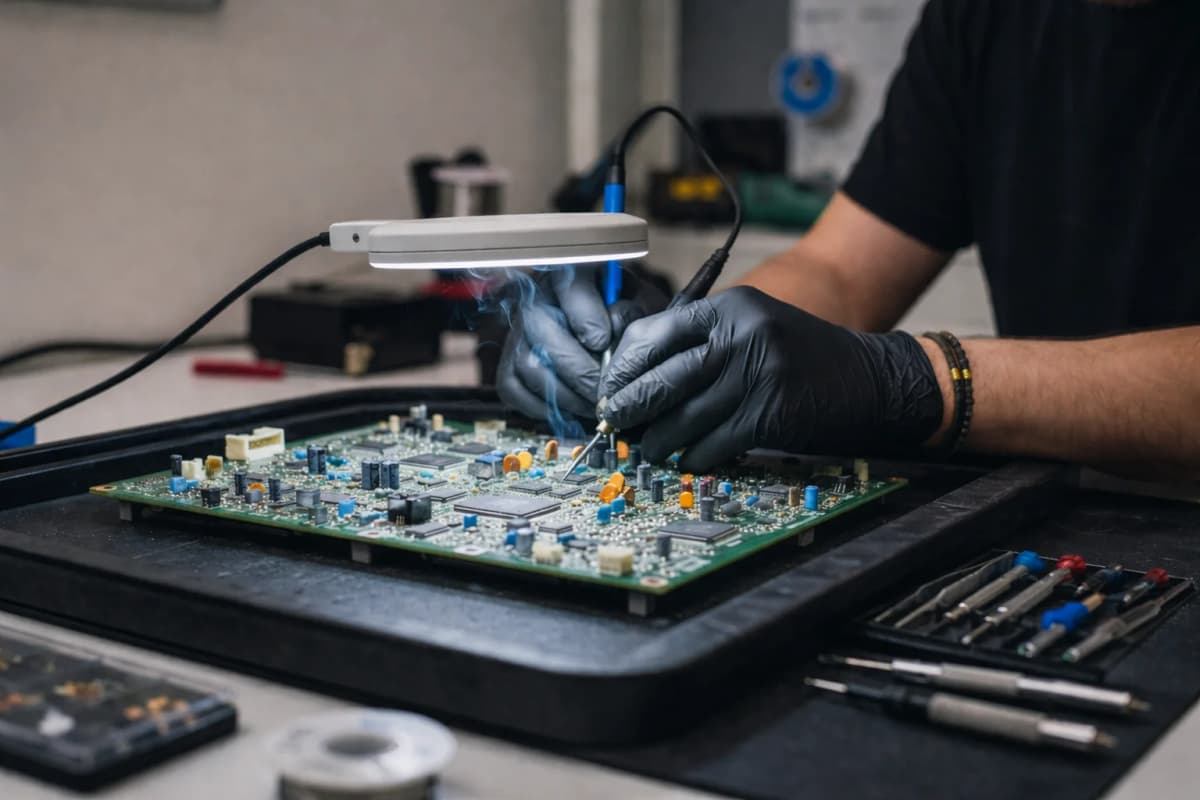
Denso N Engine ECU — Workshop Diagnostic and Repair
Denso N ECU failure? Workshop diagnostic, repair, and pairing retained. Bench tests if needed. Request your personalized quote.
Please note: at Incarline, “repairing” a control unit means cloning. We transfer your original data — coding, immobiliser pairing and adaptations — onto a healthy unit with an identical reference. We do not carry out component-level repairs on your original unit.
Is your Denso N engine ECU showing symptoms (random starting, engine light, limp mode, power loss) or is the vehicle refusing to start despite correct power supply? The Denso N is a typical engine management ECM in Japanese productions, based on a 32-bit microcontroller with internal flash memory and an external serial EEPROM for calibration/immobilizer data. In the workshop, the approach involves securing the memory content, diagnosing the power stages, and restoring critical I/O functions before validating the repair on the bench. The advantage of intervening on your Denso N is to retain the existing pairing (VIN/immobilizer), avoiding often cumbersome relearning. If you suspect software corruption or hardware failure (injection transistors, internal sensors, power supply), a structured diagnostic will determine whether repair, cloning, or scheduled replacement is needed.
Find your exact reference
Search by hardware reference, software reference or control unit name. Click a result to configure and order without leaving the page.
Identify Your Exact Reference
For any request regarding a Denso N ECU, the first step is to precisely identify the hardware reference and software label, as variations in mapping, connectors, and protocol (diagnostic via KWP2000 or UDS on CAN depending on generations) determine the intervention. On Denso units, you generally find a manufacturer label with the DENSO logo, an internal reference, and, in some cases, an alphanumeric identifier like Nxxx that guides the handling (EEPROM reading, boot mode, test harness).
- Turn off the ignition, disconnect the battery, then carefully remove the Denso N ECM noting the connector positions.
- Record all references from the label (Denso reference, manufacturer code, possible Nxxx marking) and take a clear photo of the faces and connectors.
- Note the observed symptoms (light, stalling, inability to communicate via OBD, fan running continuously) as well as the conditions of occurrence.
- Submit these elements with your request to guide the procedure (connector reading, on-table or EEPROM extraction depending on the Denso N concerned).
- Vehicles often equipped with Denso ECMs (to be verified by exact reference): Toyota Corolla, Mazda 3, Subaru Forester, among others, depending on engines and markets.
Options Available to You
Paired Used Unit
A used Denso N unit can, in some cases, be cloned from your original to retain immobilizer and codings, verifying hardware/software compatibility.
Workshop Repair
Repairing a Denso N involves securing data (EEPROM/flash reading), targeting faulty components, restoring solder joints, and validating on the bench with an adapted protocol.
Remapping/Cloning
Denso N cloning copies identifier and immobilizer areas when accessible, while remapping corrects software corruptions or updates firmware if necessary.
What to Expect Technically
Upon receipt, the Denso N unit is first visually inspected: checking for oxidation, cover deformation, overheating traces at injection/ignition stages, varnish cracks, and corrosion points under the connector. The integrity of the internal power supply (regulators, LC filters) and ground network is then verified. Depending on the variant, the Denso N relies on a 32-bit microcontroller commonly found on Denso platforms of this generation, with an external serial EEPROM (93Cxx/95xxx families are common) storing parameters such as immobilizer, VIN number, and adaptation adjustments. When reading via the connector is not possible or OBD communication is silent, boot mode or direct in-circuit reading is preferred to extract the internal flash and EEPROM without risking altering pairing data.
The functional diagnostic focuses on the most stressed elements in real use. Power transistors (coil/injector control), current measurement shunt resistors, and some aging decoupling capacitors are classic failure points in case of overcurrent, downstream short circuit, or moisture. Once the faulty area is located, controlled desoldering (hot air or infrared depending on encapsulation), component replacement, and resoldering with endoscope control and pull test are performed. On possible BGA chips, reballing may be considered if a thermal false contact is diagnosed, with verification by X-ray or magnifying glass inspection depending on workshop availability.
Memory receives particular attention. Before any writing, a full dump of the EEPROM and, if accessible, the internal flash of the Denso N is archived. This backup allows, if necessary, cloning to a strictly compatible donor unit or restoring a corrupted area. In case of inconsistency in immobilizer or VIN segments, different approaches are possible depending on the architecture: selective block copying, bench pairing with a simulation harness, or, failing that, a vehicle synchronization procedure if the Denso N protocol allows it. The goal is to return a plug-and-play unit, thus remaining paired to your original vehicle, without requiring immobilizer relearning.
Next comes the bench testing phase. Using a harness adapted to the exact Denso N reference, the ECU is powered, sensor signals are simulated (RPM/TDC, temperature), and diagnostic dialogue (KWP2000 or UDS on CAN depending on the case) as well as output activation are verified. Reprogrammed areas are reread and compared, power element temperatures are monitored at restart, and it is ensured that no code related to the main microcontroller or internal power supply reappears. A report summarizes the operations performed, saved memory blocks, and tests passed.
In practice, the typical process includes: 1) Denso N diagnostic and memory backup, 2) electronic restoration (active/passive components, soldering, possible reballing), 3) bench validation and, if necessary, corrective remapping. The timeframe depends on the nature of the fault and the availability of specific parts, and it is communicated at the time of the quote. If replacement is chosen due to irreparability, cloning is preferred to retain pairing; otherwise, initialization may be offered when the Denso N architecture and vehicle accept it. To outline the scope, Denso N or derivatives are found on many Japanese vehicles (for example, some Toyota Corolla, Mazda 3, or Subaru Forester, depending on engines), but only the reference on the label can confirm exact compatibility.
- Common symptoms of a failing Denso N: engine light on, difficult or impossible starting, fan triggered continuously, loss of OBD communication, ignition/injection misfires, limp mode with power loss.
- Possible operations on Denso N: targeted hardware repair, corrective remapping, memory cloning (if readings are intact), replacement with compatible unit with data transfer.
Depending on the diagnosis, Incarline can clone the data from your Denso N onto a healthy unit with a strictly identical reference, or supply an already-paired used unit: we do not carry out component-level repairs.
Frequently asked questions
How do I know if my Denso N ECU is faulty?
Which vehicles are equipped with the Denso N ECU?
Can a Denso N be cloned without going to the dealer?
What is the difference between a repair and a paired used unit for a Denso N?
What to do in case of Denso N failure after an overvoltage or injector short circuit?
Does the Denso N use a CAN or K-line protocol for diagnostics?
What does the EEPROM of a Denso N ECU contain and why read it first?
Your reference isn’t listed?
Contact us — we can source your control unit or handle your repair on a quote basis.
Contact us