
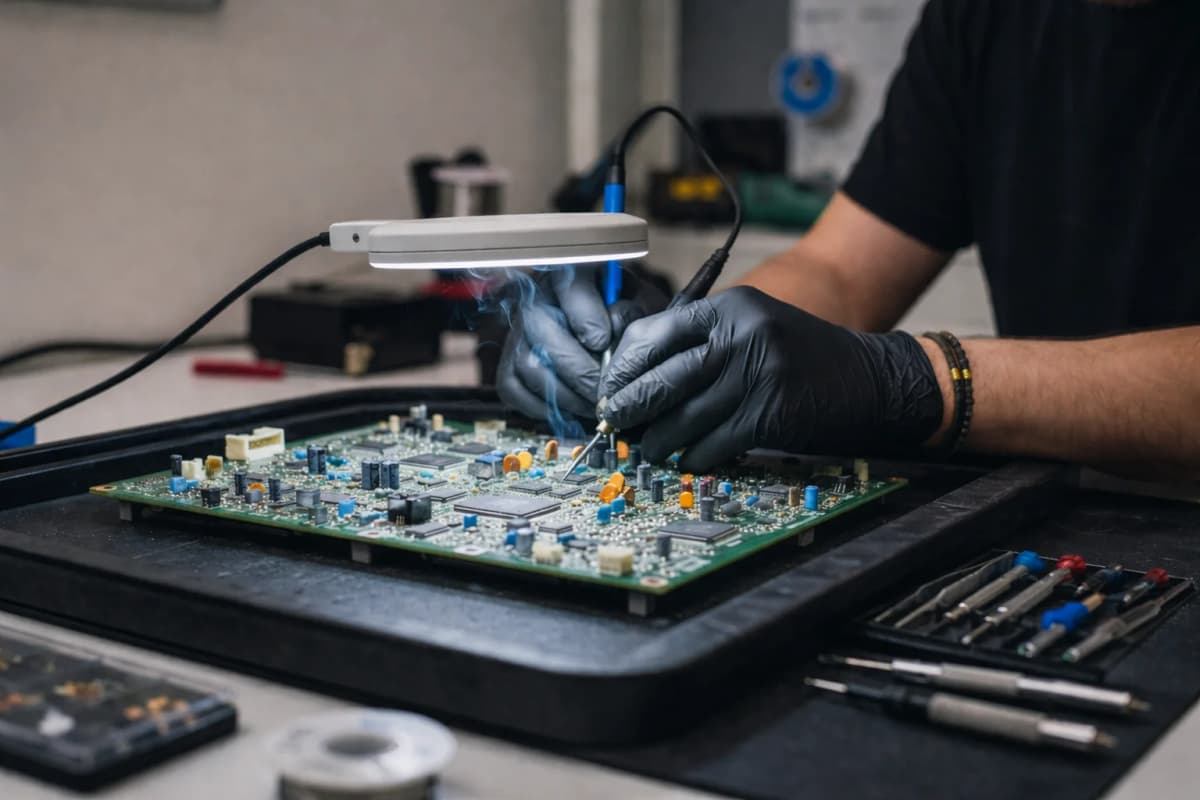
Delphi DDCR: typical failures, diagnosis and repair paths
Recurring failures Delphi DDCR (hard starting, cut-offs, unstable rail pressure). Targeted diagnosis and adapted solutions. Request your personalized quote.
Please note: at Incarline, “repairing” a control unit means cloning. We transfer your original data — coding, immobiliser pairing and adaptations — onto a healthy unit with an identical reference. We do not carry out component-level repairs on your original unit.
The Delphi DDCR engine ECU controls the common rail injection on many small diesels and centralizes sensor power supply, injector control, and pressure regulation. When it ages or undergoes electrical stress, specific faults appear: very long starting hot or cold, random stalling while driving, warning light on, and sometimes loss of diagnostic communication. These symptoms do not always originate from the pump or injectors, as the DDCR can present internal power failures, 5 V sensor issues, or flow solenoid management problems. A methodical check of the ECU, both on the bench and in the vehicle, allows distinguishing between an electronic failure and a peripheral issue. If the DDCR is the cause, solutions exist, from reconditioning to a paired second-hand replacement, depending on the state of the electronics and immobilizer data.
Find your exact reference
Search by hardware reference, software reference or control unit name. Click a result to configure and order without leaving the page.
Context and role of this family
The Delphi DDCR family ensures, at the heart of the injection system, the synchronization of high-pressure diesel with camshaft and crankshaft information, while modulating the pump solenoid and injector control. This unit is found on compact cars and MPVs with 1.5 dCi engines, such as Renault Clio II, Renault Kangoo I, and Dacia Logan I, where it is exposed to significant thermal and vibrational stresses. Over time, some DDCRs develop characteristic faults: impossible starting despite rail pressure rising then falling, clean cut-offs after a few minutes when hot, misfires accompanied by injection warnings, or intermittent diagnostic dialogue. These signs often point to internal electronics rather than a mechanical component. When an injector presents a short circuit or a voltage drop occurs during starting, the DDCR's power stage can be weakened; conversely, an unstable internal power supply can alone skew sensor readings and trigger fault codes oriented towards 'rail pressure' or 'speed/phase sensors' even when peripheral parts are healthy. This is why targeted diagnosis of the Delphi DDCR, with power supply measurements, pilot output checks, and data verification, is crucial before any decision.
Technical specificities
Power supply, drivers, and rail pressure management
The Delphi DDCR includes an internal power stage that delivers sensor reference voltages (often the 5 V line), as well as control stages for injectors and actuators. Typical failures involve drift or intermittent drop of the 5 V, causing incoherent readings from rail pressure and position sensors, and injection cut-offs for safety. The power transistors of the injectors can fail following a short circuit on a harness or a solenoid at its limit, resulting in impossible starting or a silent cylinder. The control of the pump flow solenoid (PWM controlled by the ECU) is also a sensitive point: when it becomes unstable on the ECU side, the target pressure is no longer maintained, resulting in pressure surges and slowdowns and transitions to limp mode. Other documented cases include micro-cracked solder joints on power components or around connectors, favored by thermal cycles and vibrations, leading to more frequent hot failures than cold engine ones. In this context, refurbishment involves checking the primary power supply, rail pressure measurement conditioning, and drivers, with replacement of faulty elements when the general condition of the printed circuit allows.
Memory, immobilization, and diagnostic communication
On Delphi DDCR, an 8-pin serial EEPROM (95xxx family) retains key data: identifiers, injector codings, and immobilizer information. Corruption of these blocks after a weak battery or overvoltage can result in non-starting with the warning light on without any mechanical component being at fault. The best practice is to read and secure the EEPROM content before any intervention, to allow cloning to a replacement unit or a 'reset' (virginization) followed by pairing with the vehicle. On the communication side, the DDCR communicates diagnostically via typical protocols of its generation, often on K-Line (ISO 14230/KWP2000) and, depending on versions and platforms, on CAN. Intermittent dialogue losses, while power supplies and grounds are present at the connector, point to weaknesses in the transceiver or internal power supply rather than a network fault. When replacement is necessary, cloning the Delphi DDCR data preserves the immobilizer and avoids having to recode the injectors; otherwise, a virginization followed by pairing and injector recoding with the manufacturer’s diagnostic is possible. In all cases, bench access to the ECU (reading/writing on the bench in secure mode) allows extracting and reinjecting useful data.
For what uses
The Delphi DDCR is advantageously repaired when the 5 V power stage, injector control, or rail pressure management present identified and localized faults, especially in case of hot failure, random starting, or intermittent communication loss; for heavily oxidized boards, extensive burns, or units already opened without method, replacement with a paired second-hand ECU with cloning or virginization is more relevant. Depending on the diagnosis, Incarline can clone the data from your Delphi DDCR onto a healthy unit with a strictly identical reference, or supply an already-paired used unit: we do not carry out component-level repairs. If remapping is necessary after intervention, it is done while retaining the immobilizer data and, when possible, the injector codes to limit subsequent adaptations.
Frequently asked questions
How do I know if my Delphi DDCR ECU is really at fault and not the pump or injectors?
Which vehicles are most often affected by a Delphi DDCR ECU failure?
Can a Delphi DDCR be cloned without going back to the dealer?
What are the most typical electronic faults on a Delphi DDCR?
What is the difference between repairing a Delphi DDCR and replacing it with a paired second-hand unit?
My Delphi DDCR has lost diagnostic communication at times, but the fuses are good: what should I check?
After battery disconnection, my Delphi DDCR no longer starts: is it related to the EEPROM?
Your reference isn’t listed?
Contact us — we can source your control unit or handle your repair on a quote basis.
Contact us