
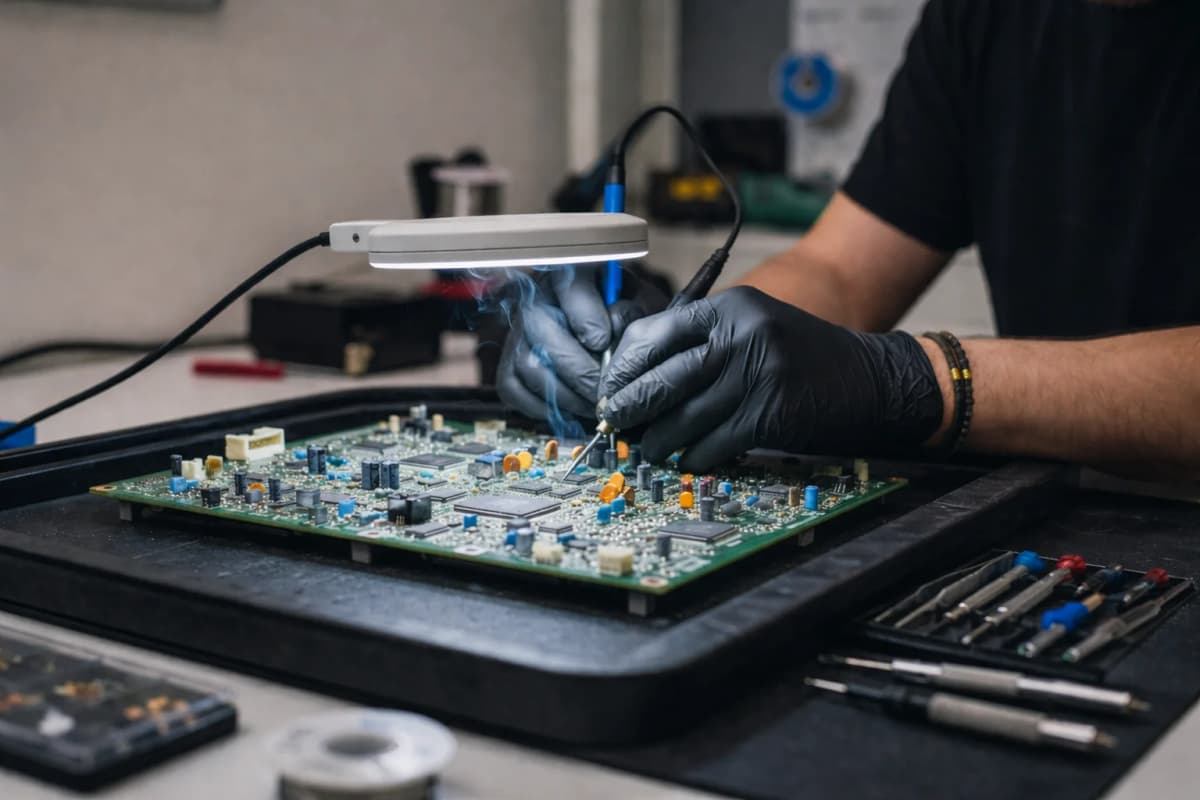
Delphi DCM: engine ECU repair and cloning
Delphi DCM engine ECU faulty? Diagnosis, repair, and cloning with ECU returned paired. Request your personalized quote.
Please note: at Incarline, “repairing” a control unit means cloning. We transfer your original data — coding, immobiliser pairing and adaptations — onto a healthy unit with an identical reference. We do not carry out component-level repairs on your original unit.
The Delphi DCM (Diesel Control Module) family includes engine ECUs widely used in modern diesel engines. When a Delphi DCM fails, typical symptoms include difficult starting, limp mode activation, an illuminated engine light, or communication faults. Depending on the diagnosis, Incarline can clone the data from your Delphi DCM onto a healthy unit with a strictly identical reference, or supply an already-paired used unit: we do not carry out component-level repairs. Depending on the variants, communication is done via CAN with KWP2000 or UDS protocols, and key data (VIN, immobilizer, injector coding) reside in a serial EEPROM and flash memory. The goal of a meticulous intervention is to target the faulty component (power stage, measurement shunt, power supply, corrupted memory) and then validate on the bench that the signals and injection/air strategies meet manufacturer expectations.
Find your exact reference
Search by hardware reference, software reference or control unit name. Click a result to configure and order without leaving the page.
Identify your exact reference
Before any intervention on a Delphi DCM ECU, it is essential to precisely identify its reference (e.g., DCM1.x, DCM3.x, DCM6.x, DCM7.x). These units are found on models from the Renault group, such as Renault Clio IV, Renault Mégane III, and Dacia Duster I, depending on the engine. This identification allows adapting the read/write procedure (EEPROM/flash), anticipating the components likely to be involved, and planning bench tests. The ECU labels and information read via OBD can also indicate the software variant and protocol (KWP2000 or UDS on CAN) used by your Delphi DCM.
- Turn off the ignition, remove the ECU, and note the references printed on the label (Delphi DCM family + complete ref.).
- If possible, retrieve ECU info (VIN, software ref., protocol) via the diagnostic tool.
- Photograph the ECU faces and connector to document the condition (impacts, oxidation, heat traces).
- Transmit the complete reference and observed symptoms to prepare the appropriate procedure.
Your available options
Paired used unit
A used ECU can be an alternative when the original is irreparable, provided the unit is paired to the vehicle (transfer of immobilizer data and VIN, adaptation of injector coding). This requires reliable memory cloning or virginization followed by complete pairing.
Repair by cloning
Repair retains your original Delphi DCM unit, preserves existing pairing, and generally avoids any immobilizer relearning. It involves diagnosing the faulty stage, replacing the defective components, and revalidating the electronics on the bench.
Remapping / cloning
Cloning a Delphi DCM reproduces the useful areas (EEPROM and, if necessary, parts of the flash) to migrate the electronic identity to a healthy unit. Remapping corrects software corruption or aligns software versions after cloning.
What to expect technically
A workshop visit for a Delphi DCM ECU follows a precise sequence. After a visual and microscopic inspection (search for oxidation at the connector, solder cracks, thermal impacts), a complete data backup is performed: reading the serial EEPROM (often from the 95xxx family) and flash memory via an adapted mode (in-circuit, boot, or on the bench). This step secures the ECU's identity (VIN, immobilizer, specific coding) before any intervention.
The electronic diagnosis then targets the critical areas typical of Delphi DCM: primary power supply, power transistors driving actuators, current measurement shunt resistors, sensor lines (rail pressure, temperature, flow meter), and memory integrity. In case of a confirmed fault, components are properly desoldered, replaced with equivalent references, and then resoldered with oscilloscope control and continuity testing. When necessary, a BGA rework (reflow/reball) is performed on encapsulated circuits to restore reliable interconnections.
The ECU is then validated on the bench: stabilized power supply, sensor signal simulation, verification of CAN lines and KWP2000/UDS protocol, control of the driven injection and power stage response. Remapping may be initiated if flash segment corruption is detected, followed by partial or complete cloning if migrating to a replacement unit. On a correctly repaired or cloned Delphi DCM, the ECU returns paired to the original vehicle, without immobilizer relearning required.
To outline the technical scope, the Delphi DCM family covers generations ranging from earlier 32-bit microcontrollers to more recent versions using advanced architectures, with systematic CAN communication and KWP2000 or UDS diagnostic protocols depending on the variant. INCARLINE performs these operations in a specialized workshop, with generally short lead times and a formalized intervention guarantee, without announcing a specific duration.
Common symptoms justifying intervention on a Delphi DCM:
- Impossible or random starting, power loss, limp mode.
- Illuminated engine light and faults related to injection/air control.
- Unstable communication with the ECU, disrupted CAN protocol.
- Recurring fault codes not targeted on a single sensor (generic reading).
If you opt for a replacement with a reconditioned used unit, INCARLINE can, upon request, proceed with the cloning of your Delphi DCM data in a single phrase without detailed figures.
Frequently asked questions
How do I know if my Delphi DCM ECU is faulty?
Which vehicles are equipped with the Delphi DCM ECU?
Can a Delphi DCM be cloned without going to the dealer?
What is the difference between a repair and a paired used unit for a Delphi DCM?
What to do in case of a Delphi DCM failure?
Which diagnostic protocol does the Delphi DCM use?
What data does the Delphi DCM's EEPROM contain?
After repairing a Delphi DCM, is immobilizer relearning necessary?
Your reference isn’t listed?
Contact us — we can source your control unit or handle your repair on a quote basis.
Contact us