
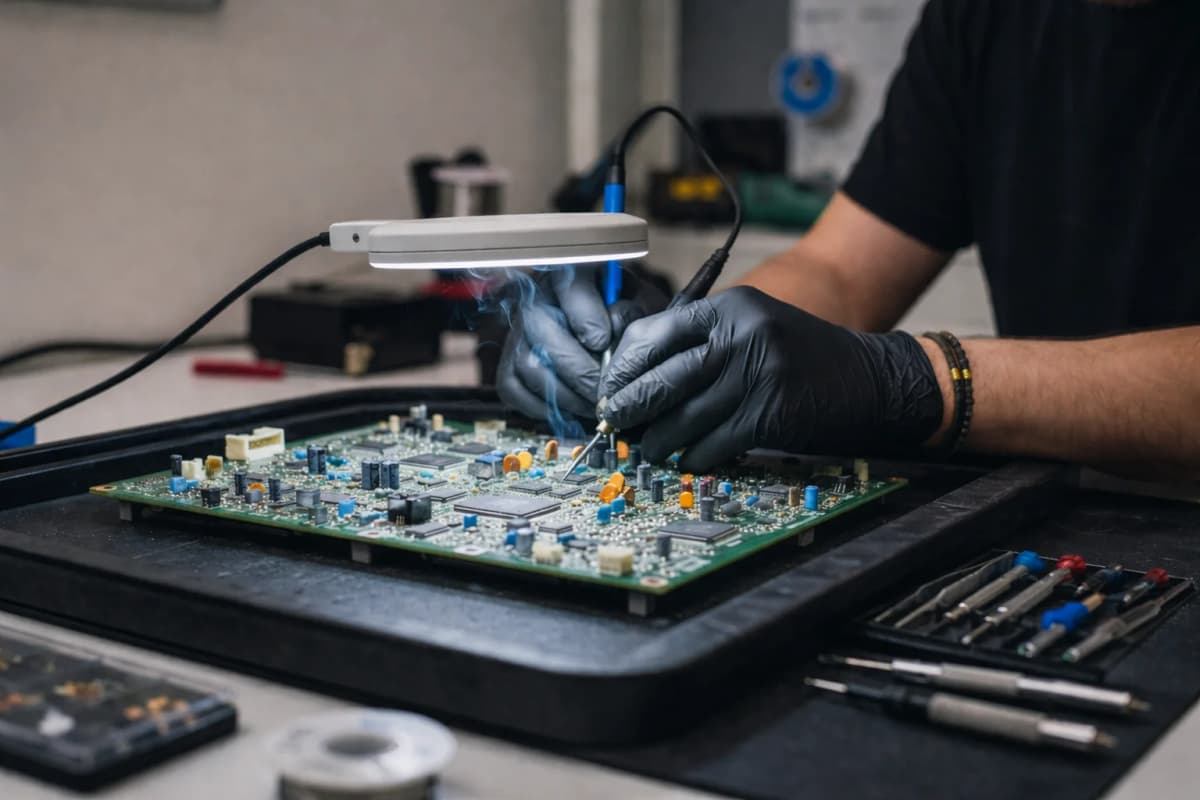
Delphi CRD Engine ECU — Fault Diagnosis and Solutions
Engine light, limp mode, unable to start on Delphi CRD? Diagnosis, cloning or paired replacement. Request your personalized quote.
Please note: at Incarline, “repairing” a control unit means cloning. We transfer your original data — coding, immobiliser pairing and adaptations — onto a healthy unit with an identical reference. We do not carry out component-level repairs on your original unit.
Have you just run diagnostics and your diesel is in limp mode, lacking power or refusing to start? Delphi CRD ECUs manage common-rail injection, rail pressure, and engine synchronization. When they fail, you often see a persistent engine light, intermittent communication losses, and faults related to the rail or injector control. As these symptoms can also stem from a sensor or wiring, the challenge is to methodically determine the cause. This page guides you on the reflexes to adopt, reading typical DTCs of this Delphi CRD range, the clues pointing to an ECU fault rather than a sensor, and the logical next steps: electronic bench diagnosis, data cloning, repair or paired replacement.
Find your exact reference
Search by hardware reference, software reference or control unit name. Click a result to configure and order without leaving the page.
In Brief
The Delphi CRD family is fitted on many common rail diesels, notably in Mercedes. It controls high pressure, injectors, and key actuators. In case of a fault, you encounter limp mode, significant power loss, difficult or impossible starts, and codes related to internal management or the rail. A rigorous diagnosis allows distinguishing a faulty ECU from a sensor issue.
Frequently Asked Technical Questions
Why does this ECU fail?
The Delphi CRD unit works at the heart of the injection system and undergoes significant thermal and vibrational stresses, often in the engine bay. Over time, this can cause solder micro-cracks, power stage failures (injector control, pressure regulator), or memory corruptions. Overvoltages related to a weak battery or jump-starting can also damage the internal power supply. In vehicles like the Mercedes C-Class W204, E-Class W212, or Sprinter W906, these usage conditions expose the ECU to intermittent failures: communication losses on CAN, random restarts, or internal faults appearing when hot. The design includes a 32-bit microcontroller, flash memory, and an EEPROM dedicated to immobilizer; a fault in these areas can prevent pairing or starting.
What symptoms point to a Delphi CRD rather than a sensor?
An isolated sensor (mass airflow, rail sensor, EGR) generally generates targeted behavior and DTCs consistent with that component. Conversely, a faulty Delphi CRD tends to produce cross-symptoms: multiple seemingly unrelated codes, intermittent diagnostic dialogue loss, or unstable values on several sensors simultaneously. If the measured rail pressure remains inconsistent despite a checked supply and sensor, or if injection is cut off without a clear reason, the ECM may be at fault. Another clue on Mercedes: the immobilizer pairing (coupling to VIN and EIS/EZS module) may sporadically fail, leading to a refusal to start without explicit sensor codes. Finally, when the power supply, grounds, and CAN line are good but UDS communication on CAN drops when hot, the Delphi CRD ECU is suspect.
What DTCs are often seen on the Delphi CRD range?
Without listing specific references, recurring fault families are observed: rail pressure anomalies (persistent setpoint/measurement discrepancy), injector or pressure regulator control refusals, coherence errors related to crankshaft/camshaft position sensors when tested sensors are compliant, internal ECU communication faults, and dialogue losses on the network. On Delphi CRD, 'internal errors' may indicate corrupted memory or disturbed calculation logic. When the vehicle enters limp mode immediately upon contact, with frozen values and incomplete CAN frames, it moves away from a simple sensor issue, and the ECM becomes the main lead. These patterns are particularly encountered on common rail diesel platforms like the Mercedes W204, W212, and Sprinter W906 equipped with this Delphi CRD management.
How to make a reliable diagnosis on a Delphi CRD before replacement?
Start by confirming the power supply: permanent +12 V and after contact, clean grounds, and no voltage drops. Check CAN integrity (resistance, short circuits, continuity). Verify rail pressure consistency with cross-checking (diagnostic tool vs. indirect measurement) and test the regulation sensor and actuator. If sensors are compliant but values start to drift during UDS communication losses on CAN, suspect the ECU. A thorough inspection involves reading data areas (flash and immobilizer EEPROM) and bench testing control stages. Pairing with the Mercedes immobilizer system (EIS/EZS) and VIN is central: a discrepancy in these data blocks injection authorization. In case of persistent doubt, sending the Delphi CRD for electronic diagnosis allows validating the ECM lead without multiplying costly sensor replacements.
Possible Solutions
If the Delphi CRD is at fault, three options exist: professional bench diagnosis to confirm and target the fault, cloning when relevant, or replacement with a paired/cloned used unit on your data (immobilizer and VIN). Incarline can perform cloning of useful areas or restore service after control, and provide, if necessary, a paired replacement unit. Contact us to describe your symptoms and get the most rational solution without random trials.
Frequently asked questions
How to know if my Delphi CRD ECU is really faulty?
Which vehicles are equipped with the Delphi CRD ECU?
What fault codes are often encountered on a Delphi CRD?
Can a Delphi CRD be cloned without going to the dealer?
What is the difference between repair and paired used for a Delphi CRD?
After a weak battery, my Delphi CRD stopped communicating: is it related?
Do elements need recoding after replacing a Delphi CRD?
Your reference isn’t listed?
Contact us — we can source your control unit or handle your repair on a quote basis.
Contact us