
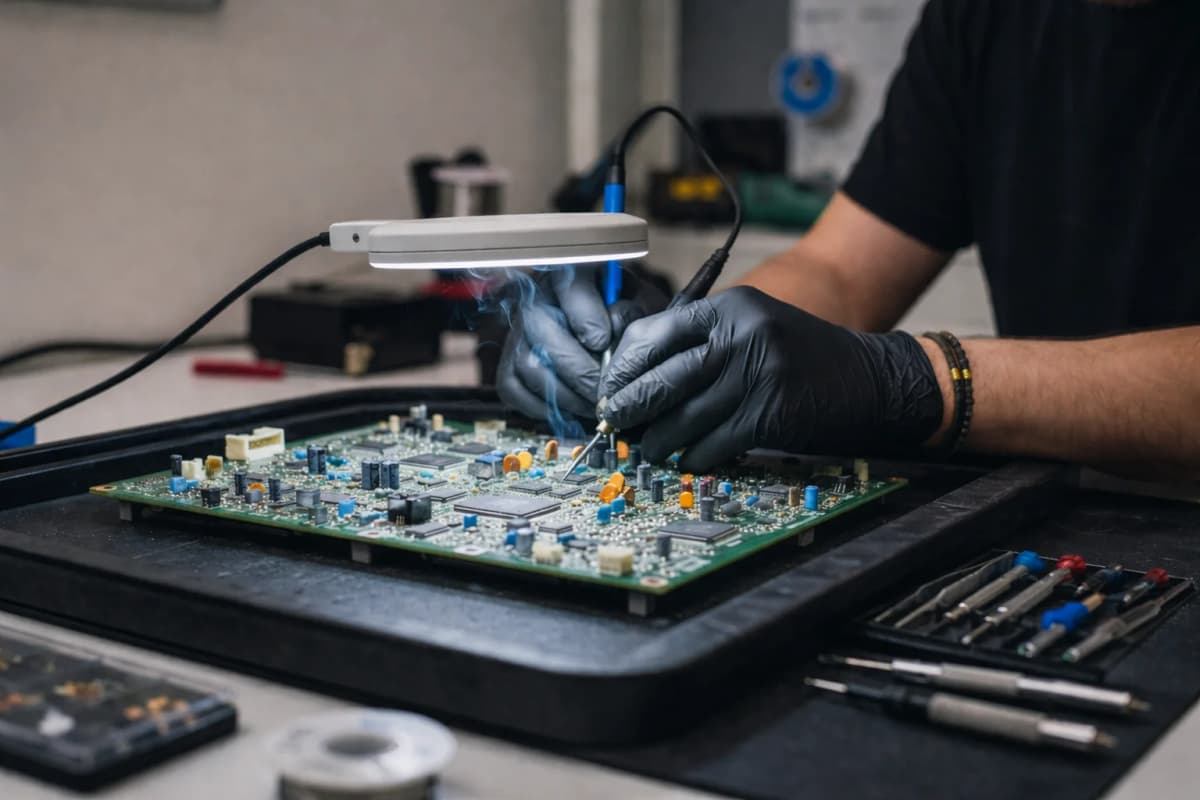
Delco BFMC — ECU Repair, Diagnostic and Test
Delco BFMC ECU failure? Inspection, BGA re-soldering, bench testing, and remapping if needed. Pairing retained. Request your personalized quote.
Please note: at Incarline, “repairing” a control unit means cloning. We transfer your original data — coding, immobiliser pairing and adaptations — onto a healthy unit with an identical reference. We do not carry out component-level repairs on your original unit.
A faulty Delco BFMC ECU can cause random starts, limp mode, or a persistent engine light. In the workshop, the process follows a precise flow: visual inspection with a magnifier, EEPROM reading to secure pairing and parameters, power rail and control line tests, then targeted repair on the board (ignition/injector transistors, shunt resistors, filtering capacitors, memory management). After clean desoldering and replacement, careful BGA/SMT re-soldering is performed, followed by bench testing and, if necessary, remapping. At Incarline, this Delco BFMC refurbishment aims to return your original unit, already paired with your vehicle, avoiding any immobilizer relearning.
Find your exact reference
Search by hardware reference, software reference or control unit name. Click a result to configure and order without leaving the page.
In Brief
Your Delco BFMC is checked, repaired, and bench-validated while retaining the VIN and immobilizer data. Why does this ECU fail? Often due to worn power components, micro-cracked solder joints, or partially corrupted memory; the workshop precisely targets these points before concluding with a functional test and, if needed, a software realignment.
Frequently Asked Technical Questions
Why does this Delco BFMC ECU fail?
With age, thermal cycles and vibrational stresses challenge the solder joints and power components. On a Delco BFMC, typical failures are seen in control stages (coil/injector transistors), drifting shunt resistors, capacitors losing capacity, or corrupted memory areas. An unstable battery voltage can also trigger erratic behavior. Hence the importance of a methodical diagnostic combining optical inspection, electrical measurements, and EEPROM reading.
How does the repair by cloning of a Delco BFMC proceed from start to finish?
After identifying and carefully opening the unit, a high-magnification visual inspection reveals oxidation, overheating, or fragile solder joints. EEPROM reading saves pairing and parameters. Power supplies, drivers, and sensor feedbacks are measured to isolate the cause. Defective components are desoldered (hot air, infrared, or micro station), pads are cleaned, and new parts are installed. When a unit includes a BGA component, BGA re-soldering is performed with a suitable thermal profile to ensure wetting. The ECU is then bench-tested with input stimulation and output control, and remapping is considered if a software area has been altered.
What data is read on a Delco BFMC and why is the EEPROM crucial?
The small serial EEPROM (often an 8-pin package) contains essential pairing information (immobilizer, sometimes VIN and specific codings). Reading it at the start of the process protects your data: in case of heavy repair or potential reflash, these contents are reinjected so that the Delco BFMC remains recognized as is by the immobilizer and vehicle network. The main firmware usually resides in internal flash memory within the 16/32-bit microcontroller, read or verified as needed.
Does the Delco BFMC communication protocol complicate testing?
Depending on the generation and vehicle architecture, the Delco BFMC may communicate over a legacy diagnostic line (K-Line type) or via a more recent bus (CAN type). In the workshop, the test bench powers and stimulates the ECU by reproducing these connections, allowing validation of communication, simulated sensor coherence, and actuator response. The choice of dialogue mode does not prevent repair: it mainly guides the validation method and, if necessary, the remapping procedure.
Possible Recourses
Are you hesitating between repair, cloning, or replacement? Refurbishing the Delco BFMC retains the existing pairing, avoiding relearning on the vehicle. Incarline can, on a case-by-case basis, offer cloning of Delco BFMC to another compatible unit if the board is irreparable, or guide towards a suitable replacement. The timeframe is communicated in the quote based on workshop load, and warranty application follows the current general conditions.
Frequently asked questions
How do I know if my Delco BFMC ECU is faulty?
Can a Delco BFMC be cloned without going to the dealer?
Which vehicles are equipped with the Delco BFMC ECU?
After repairing a Delco BFMC, is immobilizer relearning necessary?
What does BGA re-soldering on a Delco BFMC involve and why is it important?
Can a Delco BFMC fault be resolved solely by remapping?
Does the Delco BFMC communicate via K-Line or CAN for diagnostics?
What if the Delco BFMC EEPROM memory is unreadable?
Your reference isn’t listed?
Contact us — we can source your control unit or handle your repair on a quote basis.
Contact us