
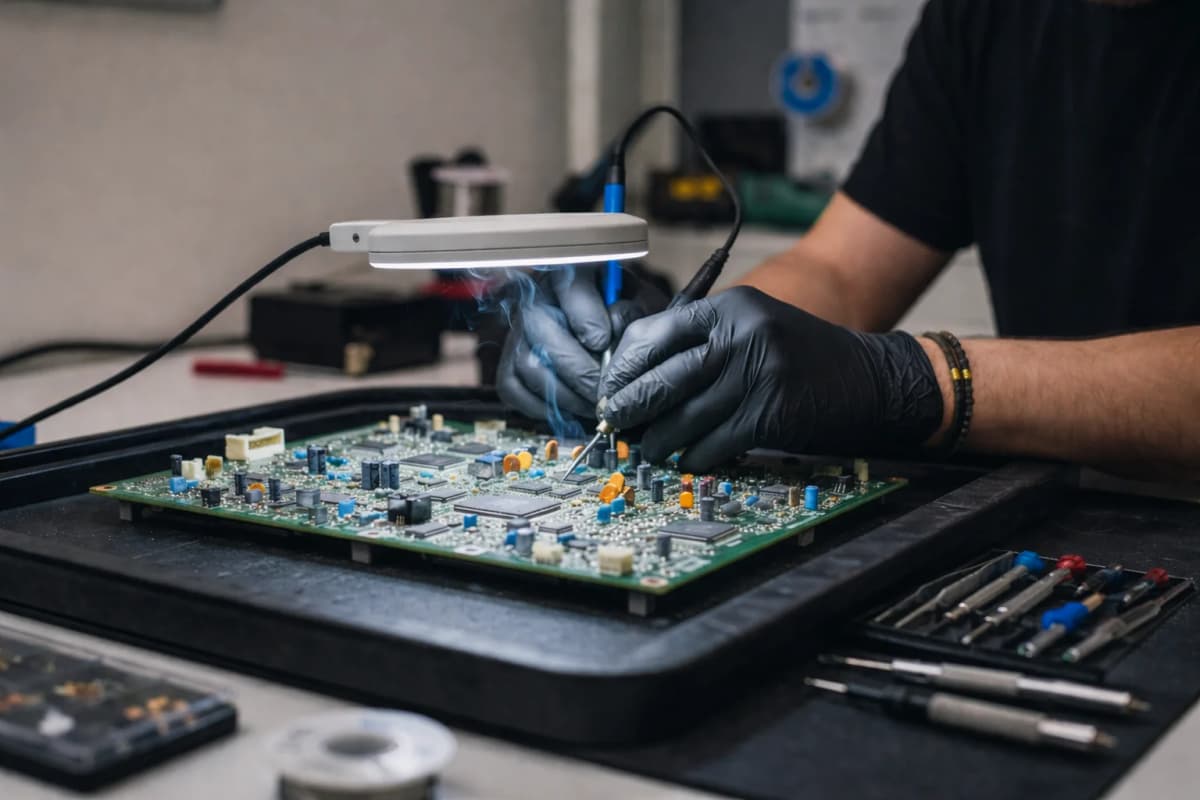
Bosch VGS paired used TCM — ready-to-install replacement
Bosch VGS ECU faulty? Opt for a paired used TCM, same HW/SW ref., tested and ready to drive. Request your personalized quote.
What the term "repair" covers here: for a Bosch VGS, Incarline performs a cloning. We transfer your original data (coding, pairing, adaptations) onto a healthy unit of identical reference, without touching the electronics of your BSI.
The Bosch VGS is an automatic transmission ECU (TCM) housed at the heart of the mechatronic block, in contact with the transmission oil. As it ages, typical symptoms include entering limp mode, jerks during downshifting, inability to engage R or D when hot, or internal faults not related to external sensors. These symptoms are frequently encountered on Mercedes-Benz models such as the E-Class W211, C-Class W204, or ML SUV W164 equipped with modern automatics. In these generations, the VGS manages shift laws, internal element clutches, and stores adaptations. Rather than opening an old BSI with components that have become rare, the option of a paired used Bosch VGS with the same HW/SW reference often allows for a reliable and quick return to the road, with VIN and parameter cloning for plug-and-drive installation and simple relearning if necessary.
Find your exact reference
Search by hardware reference, software reference or control unit name. Click a result to configure and order without leaving the page.
A typical case
A workshop receives a sedan whose gearbox refuses kickdown and remains stuck in a fixed gear once warm. Road test, fault reading, and harness check show nothing abnormal on the mechanical peripherals side. The diagnosis converges towards the transmission ECU integrated into the mechatronic block. On this vehicle, replacement with a strictly identical Bosch VGS in hardware and software is preferred. The tested used unit is prepared with the vehicle's data: VIN number, pairing, and adaptation tables are transferred to reproduce the initial behavior. After installation with compliant oil and a reset of the learnings, a few kilometers are enough for the shifts to become smooth and the limp mode to disappear. This approach avoids the uncertainties of cloning on an old BSI while respecting the specifics of the gearbox used by models such as Mercedes-Benz E-Class W211, C-Class W204, or ML W164.
Why this ECU has this fragility
The Bosch VGS operates in a demanding environment: it is attached to the mechatronic electronic board, close to the internal speed sensors and solenoids. Repeated thermal cycles, residual moisture, and vibrations eventually fatigue the solder joints, some flex connections, and more generally, the power electronics driving the actuators. Added to this is the inevitable aging of the transmission oil which, when contaminated, can accelerate measurement drifts and actuator overconsumption that the ECU compensates for until it reaches its limits. Over the years, we also observe data adaptation corruptions and intermittent faults that do not refer to a specific mechanical component but to the central electronics of the TCM.
Architecturally, this generation relies on a 32-bit microcontroller typical of its time, communicating via CAN with the engine ECU and the instrument cluster, and storing the VIN, coding, and learning values in a non-volatile EEPROM memory in addition to an internal flash. The software calibration is closely linked to the transmission ratio, clutch type, and gearbox code; this is why a replacement Bosch VGS must have exactly the same HW/SW reference to guarantee the same shift laws and hydraulic pressures. This constraint, combined with the decreasing availability of new components, makes the option of a paired used BSI particularly relevant for these now older families, including variants mounted on series such as the Mercedes-Benz CLS W219 or S W221.
What changes when you send it to us
Upon receipt of your TCM, technicians read its memories (EEPROM and configuration areas), verify the exact reference, then prepare a strictly identical used Bosch VGS in hardware/software from a twin unit. Immobilization data, VIN, and useful adaptations are cloned to avoid a dealership visit; the unit is then validated on a bench via CAN communication and actuation tests before shipment. Once installed, a short relearning of the clutches and fill times may be requested by the diagnostic tool or via an adaptation drive, to refine the smoothness of the shifts. Depending on the diagnosis, Incarline can clone the data from your Bosch VGS to a healthy reference unit strictly identical, or provide you with an already paired used unit: we do not perform component-by-component refurbishment. Incarline can also provide VIN pairing or a "virgin" setup when the manufacturer procedure requires it, to ensure a clean start of the learnings on the vehicle.
Frequently asked questions
How do I know if my Bosch VGS ECU is faulty?
Which vehicles are equipped with the Bosch VGS ECU?
Can a Bosch VGS be cloned without going to the dealership?
What is the difference between a repair and a paired used Bosch VGS?
Is the same HW/SW reference required to replace a Bosch VGS?
Where is the Bosch VGS located and how is the installation carried out?
What adaptations are necessary after replacing a Bosch VGS?
Can a "virgin" used Bosch VGS be installed on my vehicle?
Your reference isn’t listed?
Contact us — we can source your control unit or handle your repair on a quote basis.
Contact us