
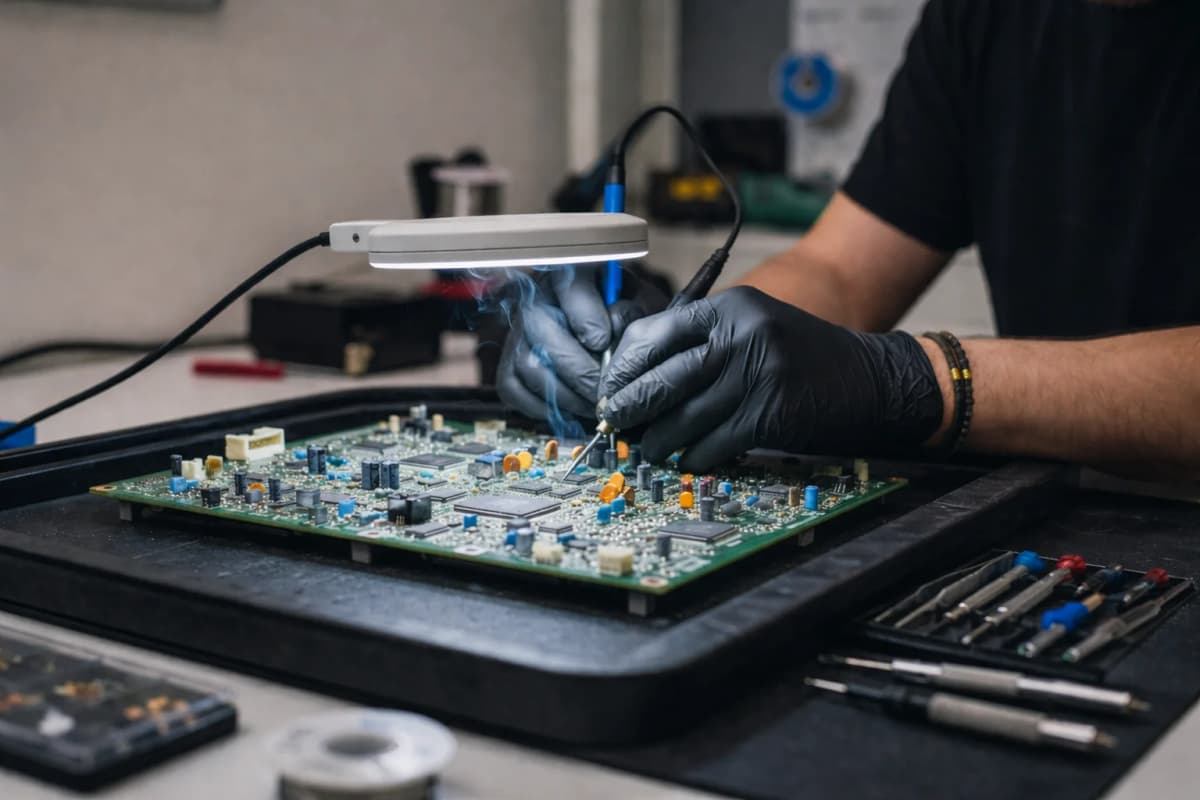
Bosch TC60 TCM — Remapping, optimization and maps
Optimize your Bosch TC60 (TCM): clutch maps, pressure, shifts. Remapping in workshop or calibrated file remotely. Request your quote.
The Bosch TC60 is a transmission control unit (TCM) responsible for controlling the hydraulics, clutch/torque converter, and shift strategies of the automatic gearbox. Targeted optimization affects shift strategies, line pressure, and torque limits accepted via the CAN interface with the engine ECU. Unlike an engine stage, it does not manage injection or turbo pressure: the focus here is on speed, smoothness, and torque handling under load. Software access is performed depending on the versions via OBD, in bench, or in boot-mode/BDM to read/write calibration areas. A stabilized power supply and checksum management are essential to avoid any brick. For a garage, mechanic, or demanding individual, remapping the Bosch TC60 allows for proper exploitation of increased engine torque and improved comfort, while respecting the mechanical limits of the transmission.
Find your exact reference
Search by hardware reference, software reference or control unit name. Click a result to configure and order without leaving the page.
Technical sheet of this family
Category: Bosch transmission control unit (TCM). The Bosch TC60 controls the automatic gearbox via a typical 32-bit microcontroller of this generation, with internal flash memory for firmware and dedicated calibration areas, as well as an external EEPROM or a non-volatile data segment for coded parameters and learnings. The interface with the engine ECU is done via CAN bus for torque exchange, downshift orders, and status. Depending on the versions and integration variants, the TC60 can be mounted on the mechatronic block (in the gearbox) or in a separate housing.
Software access and protocols: on some vehicles, partial reading/writing of maps is possible via the OBD port; when OBD is limited or locked, access is done in bench (pins on table) or in boot-mode/BDM for the complete area (firmware + calibration). The choice of protocol depends on the required access level (calibration only vs full), the type of protection, and the exact generation of the TC60. Common professional tools in the sector, if the protocol is supported, include for example Alientech KESSv3/KESS, MPPS, CMD, and PCMflash; their use must be done with a driver/ID explicitly compatible with the Bosch TC60.
Maps and parameters typically modifiable on a Bosch TC60 TCM: shift strategies (speed/load/temperature tables), overlap and fill times, lock-up management (converter/clutch), line pressure/clutch pressure, adaptation filters, torque limits accepted via the engine interface, thermal thresholds, and safety strategies (limp mode). Note: injection, ignition timing, turbo pressure, or DPF/EGR/AdBlue systems functions are the responsibility of the engine ECU, not the Bosch TC60.
Technical limits and precautions: writing incorrect areas (e.g., firmware instead of calibration), a voltage drop during flashing, or poor checksum/CRC management can render the TC60 inoperative (brick). It is imperative to make full backups (full read and extraction of coding data), use a stabilized power supply, and validate file integrity before any flash. Some areas (OTP/anti-tuning) are not modifiable. After intervention, a gearbox reset/adaptation and a learning cycle may be required to stabilize shifts.
Vehicles concerned
The Bosch TC60 is found on 6-speed automatic gearbox configurations managed by Bosch or in partnership, in passenger cars and light commercial vehicles of various brands. The exact equipment varies depending on markets and years; reliable identification is done from the TCM label (TC60.x.x reference) or by reading identifiers via diagnostics.
- Some European compact sedans with 6-speed automatic, 4-cylinder petrol or diesel engines
- Intermediate family cars equipped with a hydraulically controlled transmission with separate TCM
- Compact SUVs and crossovers with CAN torque interface and optimized lock-up strategy
- Compact MPVs where the TCM is integrated into the gearbox mechatronic block
- Light commercial vehicles 2.0–2.3 L equipped with a 6-speed automatic controlled gearbox
Points of attention
Before any optimization of the Bosch TC60, check the mechanical condition: solenoids, oil pressure, gearbox temperature, presence of metal shavings, manufacturer updates, and learnings. Remapping will not compensate for a hydraulic failure or worn clutch. Adapt torque limits to the actual capabilities of the transmission to avoid slipping or overheating, and keep safety margins on line pressure and lock-up management. Anti-pollution functions (EGR/DPF/AdBlue) do not fall under the TC60, their possible removal is done on the engine ECU side and must comply with local regulations.
For software access, prioritize a clear protocol identifier (ID, family, version) and explicitly compatible tooling; if OBD is locked, switch to bench or boot-mode/BDM with stabilized power supply and prior backup of coding data. After flashing, perform an adaptation reset and a controlled road cycle to validate temperature, slipping, and shift times. Incarline can perform Bosch TC60 remapping in the workshop with backup and validation on gearbox power bench when relevant. If you already have a valid read, Incarline can also provide a calibrated file remotely, adjusted to the mechanical limits of the transmission and intended use.
Frequently asked questions
How do I know if my Bosch TC60 ECU is faulty or just poorly calibrated?
Can the Bosch TC60 be reprogrammed via OBD without removing the gearbox?
Which maps can be modified on a Bosch TC60 to optimize shifts?
Can a Bosch TC60 be cloned without going to the dealer?
Does DPF/EGR/AdBlue removal concern the Bosch TC60?
What are the risks of bricking during a Bosch TC60 remapping?
Which protocol to choose for working on a Bosch TC60: OBD, bench, boot-mode, or BDM?
Which tools can safely read/write a Bosch TC60?
Your reference isn’t listed?
Contact us — we can source your control unit or handle your repair on a quote basis.
Contact us