
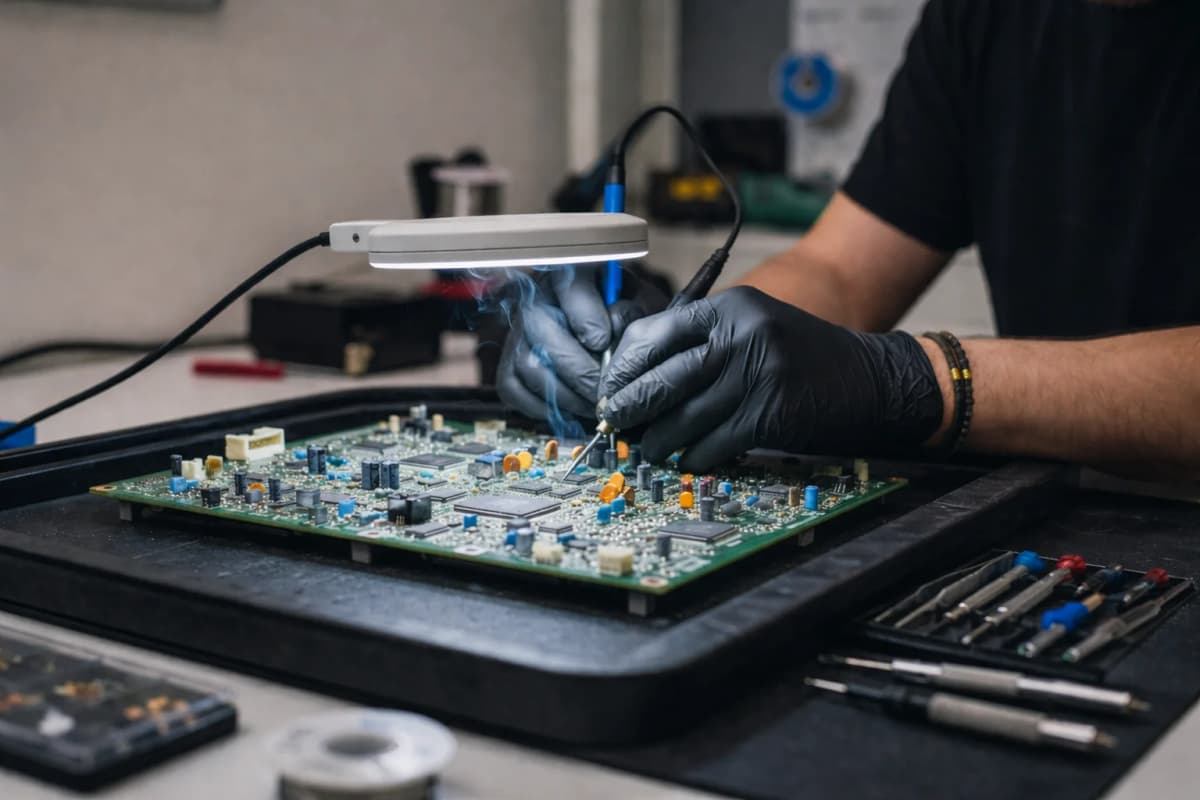
Bosch MITSUBISHI — ECU engine repair and testing in workshop
Bosch MITSUBISHI ECU failure? Professional bench diagnostic, testing, and servicing. Request your personalized quote.
Please note: at Incarline, “repairing” a control unit means cloning. We transfer your original data — coding, immobiliser pairing and adaptations — onto a healthy unit with an identical reference. We do not carry out component-level repairs on your original unit.
The Bosch MITSUBISHI engine ECU (diesel family type EDC17) manages the vehicle's common rail injection, turbocharging, and CAN communication. When it fails, typical symptoms include limp mode, an illuminated engine light, difficult starts, or unexpected shutdowns. In the workshop, the approach involves documenting the fault, securing data (EEPROM reading), then addressing the power electronics and memory before a bench test. Circuits typically involved include control transistors, current measurement shunt resistors, filtering capacitors, or corrupted memory. Bosch MITSUBISHI relies on a 32-bit microcontroller from the EDC17 generation and a serial EEPROM containing the VIN and immobilizer. The goal is to return a fully functional ECU already paired with the vehicle, avoiding any immobilizer pairing procedure upon reinstallation.
Find your exact reference
Search by hardware reference, software reference or control unit name. Click a result to configure and order without leaving the page.
Identify your exact reference
Before any intervention on a Bosch MITSUBISHI ECU, it is essential to identify the manufacturer's label on the cover. It usually includes a designation like EDC17CPxx, a Bosch number, a manufacturer code, and sometimes a barcode. This identification ensures the correct procedure is followed (boot reading, test points, bench pinout) and avoids confusion between similar variants.
- Remove the engine ECU and clean the surface to make the label perfectly readable.
- Record the Bosch reference (starting with 0 281 ...) and the EDC17CPxx type string when printed.
- Note the vehicle's VIN code and engine code if available, useful for verifying pairing and calibrations.
- Submit this information with clear photos of the label to confirm the compatibility of Bosch MITSUBISHI repair or cloning procedures.
Examples of commonly affected vehicles (depending on engine): Mitsubishi Outlander diesel, Mitsubishi ASX diesel, Mitsubishi L200/Triton with common rail injection.
Your options
Used
A used Bosch MITSUBISHI ECU can be provided paired by cloning immobilizer data/parameters from your original unit, avoiding any vehicle reprogramming.
Repair by cloning
The Bosch MITSUBISHI repair by cloning targets faulty components (power, supply, memory), followed by a bench test and CAN communication check before return.
Remapping
A Bosch MITSUBISHI remapping can be performed when flash data needs rewriting or adapting after internal component replacement.
What to expect technically
Upon receipt of the Bosch MITSUBISHI ECU, the workshop conducts a detailed visual inspection: checking the casing, looking for oxidation, heat marks, cracked varnish, and any broken solder joints. The cover is carefully opened to preserve sealing upon reassembly, and sensitive tracks are protected before any localized heating. The first critical step is to back up the serial EEPROM (family 95xxx/25xxx depending on variants), as it contains the VIN, immobilizer, and specific codings; this backup allows for Bosch MITSUBISHI cloning if the PCB is irrecoverable.
The electronic diagnosis relies on in-circuit and out-of-circuit measurements to locate recurring failures of this EDC17 generation: drifting current measurement shunt resistors (rail/actuators), weakened internal power supply filtering capacitors, damaged actuator drivers (EGR, turbo, relays), or memory sector corruption causing random starts. Power stages and primary supply are checked, as well as CAN networks (impedance and continuity) to rule out communication loss with the vehicle network.
When a component is implicated, clean desoldering is performed using hot air/IR microsoldering, with temperature control to avoid PCB layer delamination. SMD components are replaced with equivalent references, then pads are cleaned and tinned; if a BGA package is involved (e.g., a critical management component), reballing and controlled resoldering are performed using a template with optical inspection. After reinstallation, X-ray inspection is not systematic, but flatness and wetting of balls/pads are checked under a binocular microscope.
The testing phase includes stabilized ECU power supply on the bench with signal simulation (sensors/actuators) and CAN communication line validation. A boot mode read/write (typical EDC17 procedure) may be necessary to reprogram the internal flash, rebuild checksums, and correct altered areas; this operation is always accompanied by verifying the integrity of the already backed-up EEPROM. When applicable, a software initialization restores default parameters while retaining VIN/immobilizer pairing.
In practice, symptoms frequently addressed on a Bosch MITSUBISHI include late or erratic starting, power loss with limp mode activation, a fan running continuously due to strategy failure, or inability to communicate in diagnostics. After intervention, the ECU is resealed with an appropriate gasket and retested on the bench for a sequence of simulated cold/hot cycles, then labeled with key measurements recorded during tests.
The important point for the end user: the returned ECU remains paired with the original vehicle, avoiding immobilizer relearning and allowing direct restart after reinstallation, provided the rest of the system (power supply, sensors, wiring) is sound. Regarding typical lead time, the workshop operates according to a technical queue and fault complexity; communication is provided as milestones are reached (diagnosis, repair, testing). A workshop warranty applies to the performed intervention, limited to the scope of treated components and validated bench tests.
If replacement is more appropriate than refurbishment, Bosch MITSUBISHI cloning transfers the electronic identity and useful calibrations from your unit to another of the same family, achieving an operational Bosch MITSUBISHI replacement without key learning. Finally, for specific needs (after engine swap or update), a Bosch MITSUBISHI remapping can align the mapping and options, respecting the original parameters required by the vehicle.
Frequently asked questions
How do I know if my Bosch MITSUBISHI ECU is faulty?
Which vehicles are equipped with the Bosch MITSUBISHI ECU?
Can a Bosch MITSUBISHI be cloned without going to the dealer?
What is the difference between a repair and a paired used unit for a Bosch MITSUBISHI?
What to do in case of Bosch MITSUBISHI failure after engine wash or water infiltration?
Which memories are read on a Bosch MITSUBISHI in the workshop?
Does the Bosch MITSUBISHI use CAN communication for diagnostics?
Your reference isn’t listed?
Contact us — we can source your control unit or handle your repair on a quote basis.
Contact us