
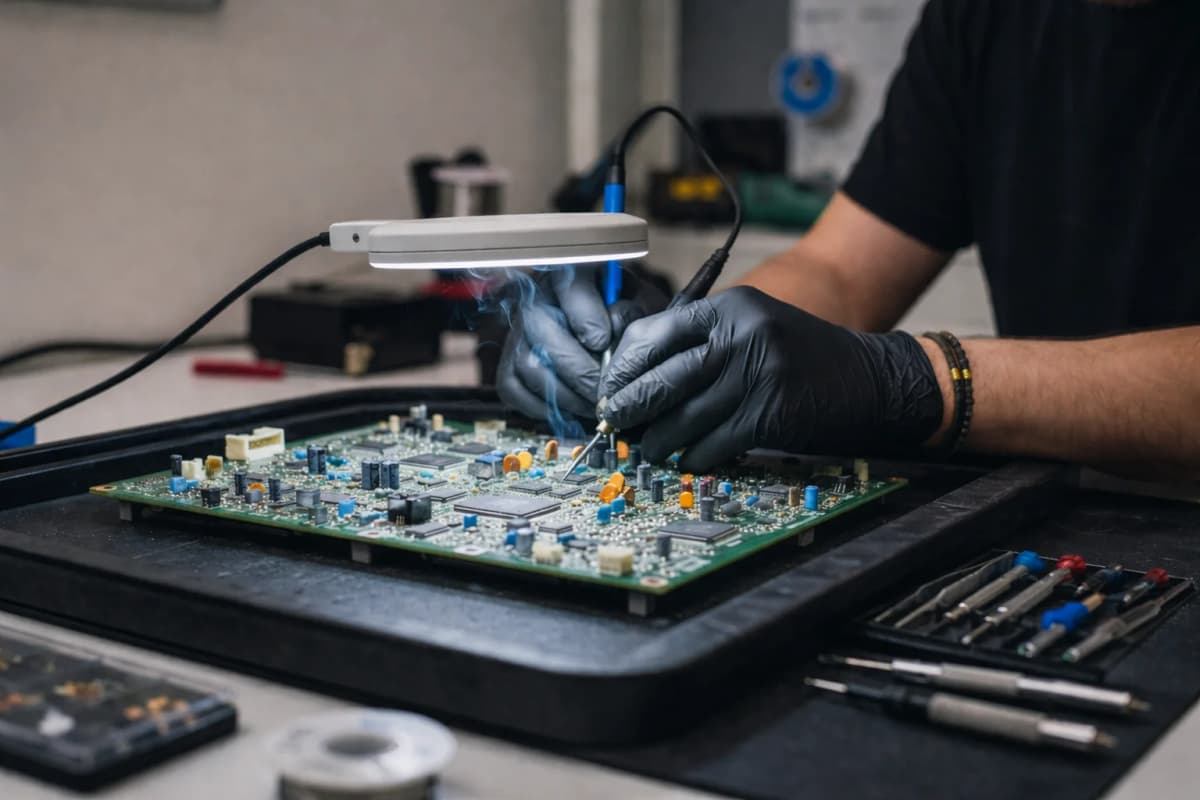
Bosch MG1: engine remapping, optimization, and secure protocols
Bosch MG1 remapping via OBD, bench, or boot-mode. Torque, injection, turbo adjustment, with TPROT precautions. Workshop or file. Request your quote.
Please note: at Incarline, “repairing” a control unit means cloning. We transfer your original data — coding, immobiliser pairing and adaptations — onto a healthy unit with an identical reference. We do not carry out component-level repairs on your original unit.
The Bosch MG1 is a recent generation petrol engine ECU (ECM) equipped with a 32-bit microcontroller from the TriCore family, internal flash memory, and protected zones (OTP/TPROT) that restrict any writing attempts. This architecture requires choosing a reliable access protocol (OBD, bench/service mode, or boot-mode) and tools truly compatible with the MG1 platform. For optimization purposes (stage 1, stage 2, GPF/OPF or EGR deactivation depending on variants), injection, ignition timing, torque, and boost pressure maps are typically adjusted while respecting safety and thermal limits. Incarline can perform Bosch MG1 remapping in the workshop or provide a calibrated file remotely, depending on the exact reference and possible technical access.
Find your exact reference
Search by hardware reference, software reference or control unit name. Click a result to configure and order without leaving the page.
Bosch MG1 Remapping: Protocols, Tools, and Key Maps
On Bosch MG1, OBD access may be possible depending on the variant and lock status, but it is common to use a bench mode (service mode on connector) or a boot-mode with test point to bypass read/write protections without risking a brick. BDM is not the appropriate method for this TriCore-based family. Recent professional flashing platforms, such as Alientech KESSv3, CMDFlash, or PCMflash, are commonly used for reading and writing in OBD/bench/boot when the MG1 protocol is supported. Historical tools (e.g., earlier generations of KESS, some MPPS-type solutions) only cover limited cases, if at all, depending on the reference; verifying the protocol before any operation is therefore essential.
The accessible mapping zones generally include injection (richness/AFR and durations), ignition timing, torque limiters and models, boost pressure management, and, depending on versions, maps related to exhaust and boost temperature controls. Optimizing a Bosch MG1 also involves respecting internal models (torque model, airflow) to maintain consistency between ECUs and avoid entering limp mode. EGR or GPF/OPF deactivation operations, when technically feasible on certain MG1 variants, must remain confined to off-road use in accordance with local regulations.
Identify Your Exact Reference
The Bosch MG1 family includes several sub-references (e.g., MG1CS0xx). The access protocol, OBD possibility, and protection management vary by reference. Before any intervention, unambiguously identify the ECU label and diagnostic tool information.
- Turn off the ignition, disconnect the battery if necessary, and locate the engine ECU in the compartment provided by the manufacturer.
- Note the Bosch label ("Bosch MG1" family + suffix) and the manufacturer reference, as well as the VIN number if displayed by the diagnostic tool.
- Perform a diagnostic scan to confirm the family (engine ECM/ECU), note the authorized access type, and the protection status.
- Transmit this information to confirm the protocol (OBD, bench/service mode, boot-mode) and the appropriate security strategy.
Your Options
Paired Used Unit
A used Bosch MG1 ECU can be paired with the vehicle if the reference matches and the immo/VIN are correctly managed (cloning or pairing). This route is suitable in case of confirmed hardware failure.
Repair by cloning
When the Bosch MG1 exhibits general electronic symptoms (engine light, limp mode, random starts), targeted repair can be considered if the hardware remains usable and the memories are intact.
Remapping
For performance optimization (stage 1/2) and specific adjustments (EGR/GPF/OPF depending on variants), Bosch MG1 remapping is performed via OBD when authorized, or in bench/boot to secure read/write and manage TPROT.
What to Expect Technically
The Bosch MG1 features a 32-bit microcontroller from the TriCore range with secure boot, integrity checks, and flash counters/fingerprints. Some zones are OTP and cannot be modified. Successful remapping requires: stabilized power supply during the entire write process, automatic checksum calculation, management of necessary temporary RAM patches when protections require it, and post-write validation (backup reading, road test, and parameter readings). The main risk is bricking in case of write interruption, inappropriate protocol, or inconsistency in torque and air models; a fallback plan (backup restoration) is essential.
In this family, the "torque model" serves as the backbone: limiters, boost pressure, and ignition must be harmonized to avoid throttle closures, protection triggers, or torque downgrades due to disagreements between ECUs. Vehicles equipped with a Bosch MG1 are notably found on certain turbocharged petrol compacts and sedans. For example, this ECU is found on some versions of Volkswagen Golf 7/7.5 TSI, Audi A3 8V TFSI, and Skoda Octavia 3 TSI; it is also found on recent petrol-powered BMW 3 Series F30/F31 and, depending on variants, on Ford Focus Mk4 EcoBoost. The exact presence depends on the engine and production year, hence the importance of checking the label and internal reference before any action.
Incarline can perform Bosch MG1 remapping in the workshop or produce a calibrated file remotely based on complete readings and vehicle data. Bosch MG1 replacement or cloning remains possible when a hardware defect prevents writing, provided a compatible reference and immo/VIN pairing conform to original systems. Finally, any modification targeting anti-pollution systems (GPF/OPF, EGR) should be considered with caution and reserved for authorized usage conditions.
- Typical access: OBD (depending on unlocking), bench/service mode via connector, boot-mode with test point; BDM not applicable on this generation.
- Common maps: torque/limiters, injection/AFR, ignition timing, turbo pressure, thermal controls, and throttle management.
- Constraints: TPROT/OTP protections, secure boot, possible CVN/write counters, checksums to recalculate, risk of brick in case of interruption.
- Best practices: full backup before writing, stabilized power supply, validated protocol for the reference, model consistency test.
Frequently asked questions
How do I know if my Bosch MG1 ECU is compatible with OBD remapping?
Which vehicles are equipped with the Bosch MG1 ECU?
Can a Bosch MG1 be cloned without going to the dealer?
What is the difference between a repair and a paired used unit for a Bosch MG1?
Which maps are modifiable during a stage 1 on Bosch MG1?
Is GPF/OPF or EGR deactivation possible on Bosch MG1 and is it legal?
Which protocol to use if my Bosch MG1 is locked (TPROT)?
Which professional tools are suitable for operations on Bosch MG1?
Your reference isn’t listed?
Contact us — we can source your control unit or handle your repair on a quote basis.
Contact us