
Bosch MEV17: typical failures, diagnosis and concrete solutions
Bosch MEV17 ECU failures on PSA petrol engines. Targeted diagnosis, cloning or paired replacement possible. Request your personalized quote.
Precision: on a Bosch MEV17, our intervention is a cloning, not an electronic repair. Your data — coding, pairing, learned adaptations — are transferred to a healthy unit of the same reference. We do not intervene on your board's components.
The Bosch MEV17 engine ECU is fitted to many naturally aspirated petrol engines with variable valve timing at PSA. It is notably found on Peugeot 207 and 308 I (VTi), Citroën C3 II and DS3 I in 1.4/1.6 VTi versions, with variants such as MEV17.2, MEV17.2.2, MEV17.4 and MEV17.4.2. When this Bosch MEV17 deteriorates, the symptoms are often very concrete: random or impossible starting, unstable idle, fan running at full speed as soon as the ignition is on, power losses with limp mode activation, or lack of diagnostic communication. The recorded codes typically indicate internal ECU faults, sensor power supply inconsistencies, or actuator command failures. Depending on the diagnosis, Incarline can clone your Bosch MEV17 data to a healthy unit of strictly identical reference, or provide you with a pre-paired used unit: we do not perform component-by-component repairs.
Find your exact reference
Search by hardware reference, software reference or control unit name. Click a result to configure and order without leaving the page.
Context and role of this family
Designed to control multipoint petrol engines with variable camshaft timing and motorized throttle, the Bosch MEV17 focuses on complete torque and emissions management on compact PSA platforms. In practice, it orchestrates coil-by-coil ignition, sequential injection, variable distribution actuators, throttle control, as well as regulation via lambda sensors and pressure/temperature sensors. On widely distributed models like Peugeot 207 and 308 I VTi, Citroën C3 II and DS3 I, this ECU communicates on the vehicle's CAN network, ensures immobilizer function via specific data stored in non-volatile memory, and interfaces with the BSI. Its under-hood environment exposes it to thermal cycles, vibrations, and sometimes moisture, factors that explain the recurrence of internal electronic failures observed in this family. When the Bosch MEV17 deviates, sensor coherence faults, ignition/injection command interruptions, or significant communication losses appear, with a very marked limp mode.
Technical particularities
Architecture and electronics
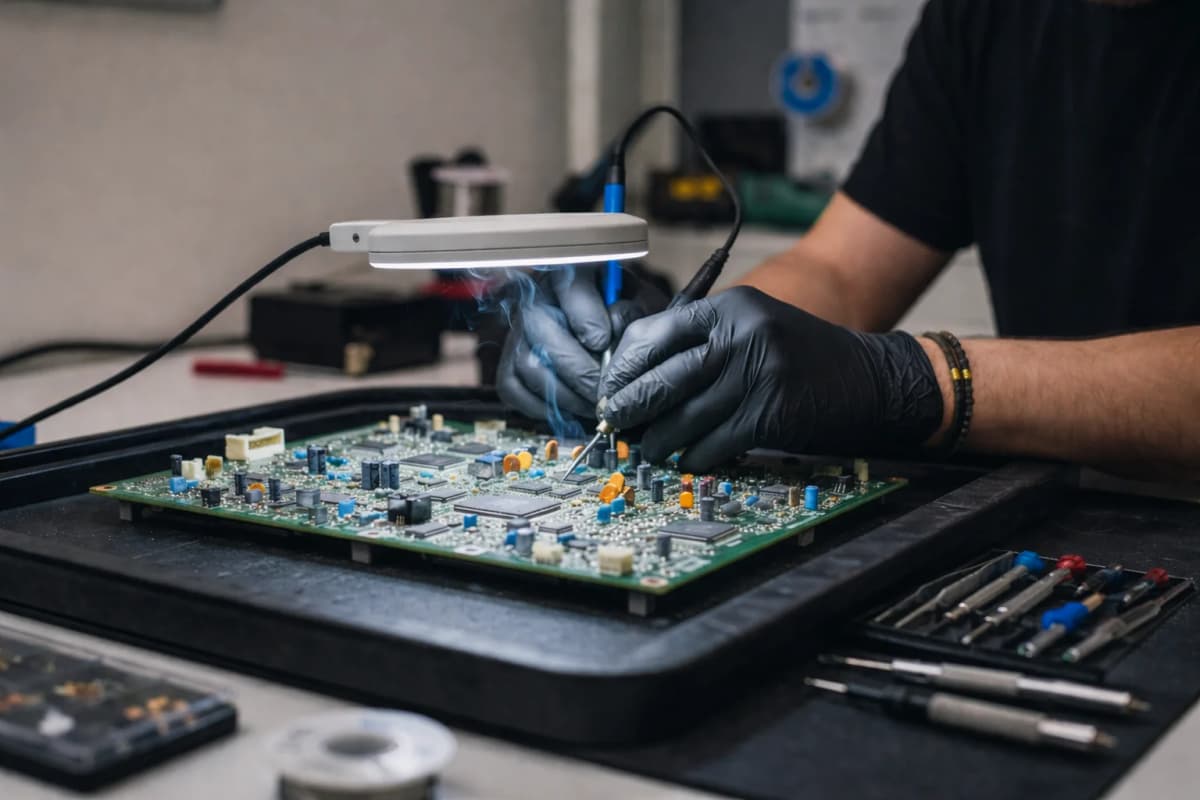
The Bosch MEV17 relies on a current-generation 32-bit microcontroller for these petrol ECUs, with internal flash memory for software and maps, and an external serial EEPROM dedicated to identifiers (VIN, codings) and learned parameters. Sensor power supply is based on a 5 V regulator and monitored internal references, while low/high-side drivers ensure the switching of inductive loads (coils, injectors) and actuator management like the motorized throttle. On the diagnostic and programming side, communication generally occurs via CAN with diagnostic protocols of this generation (KWP2000/UDS), and reading/writing of the immobilizer area is typically done in bench mode by accessing the memory component. These characteristics make cloning, EEPROM reading, and virginization possible when the original unit is too damaged to be properly reprogrammed via the OBD port.
Recurrent failures observed on MEV17
In this family, several failure scenarios repeat. The drift or drop of the 5 V sensor rail causes throttle angle, air pressure, or pedal position inconsistencies, with immediate limp mode activation, fan on, and capped speed. Ignition command paths may cease to be driven after a coil short-circuit, causing persistent misfires on one or more cylinders despite new peripheral components. Communication losses on CAN or lack of ECU contact are also observed, linked to cracked solder joints or localized oxidation near the unit's junctions, resulting in a completely silent ECU to the diagnostic tool. Finally, EEPROM content corruption after voltage drops or assisted starting can unpair the immobilizer (VIN or synchronization), resulting in an active starter but an engine that does not start, without any obvious mechanical fault. In more severe cases, the motorized throttle command remains blocked by a damaged power bridge, or the cooling relay output remains stuck, hence a fan at full speed with ignition on. These scenarios are typical of the Bosch MEV17 on vehicles such as Peugeot 308 I VTi, Peugeot 207 VTi, Citroën C3 II or DS3 I, and require distinguishing an internal electronic failure from a simple sensor failure. The stored codes then indicate internal ECU faults, out-of-tolerance sensor power supplies, or failing actuator command circuits, without an external sensor being systematically at fault. The most reliable approach is to confirm power supply integrity, check for stable 5 V presence, continuity of coil/injector paths, and CAN exchange before engaging in cloning, cloning to another compatible MEV17 reference, or virginization for proper vehicle pairing.
For which uses
The Bosch MEV17 is usefully repaired when symptoms point to a localized failure (5 V regulator, actuator drivers, EEPROM corruption) and the unit remains communicative; however, after immersion, prolonged communication absence, burned board, or heavily oxidized unit, replacement with a paired used unit often becomes the most rational path. In both cases, mastery of EEPROM operations (reading, cloning, VIN/immobilizer pairing) is crucial for a hassle-free restart. Depending on the diagnosis, Incarline can clone your Bosch MEV17 data to a healthy unit of strictly identical reference, or provide you with a pre-paired used unit: we do not perform component-by-component repairs.
Frequently asked questions
How to know if my Bosch MEV17 ECU is faulty rather than a VTi sensor being the cause?
Which vehicles are most often equipped with the Bosch MEV17 and subject to these failures?
Can a Bosch MEV17 be cloned without going through the dealership?
What faults are characteristic of a Bosch MEV17 with a failed 5 V rail?
What is the difference between a repair and a paired used unit for a Bosch MEV17?
After a battery boost, my Bosch MEV17 won't start: what to check?
Can the Bosch MEV17 lose immobilizer pairing after a failure?
Your reference isn’t listed?
Contact us — we can source your control unit or handle your repair on a quote basis.
Contact us