
Bosch MEDG17: identify the correct ECU reference
Locate the correct Bosch MEDG17 reference (HW/SW, VIN, Bosch/OEM number). Markings and compatibility guide. Use the configurator. Request your personalized quote.
The Bosch MEDG17 is a gasoline engine ECU for direct injection. To avoid any part error, all visible references on its label must be noted. You will generally find a manufacturer reference (e.g., type format 8K0 907 115), a Bosch number (often in the format 0 261 xxx xxx), a software code frequently starting with 1037xxxxx, and a serial number sometimes associated with a QR/datamatrix. Inside, printed markings on the board (HW, SW, index) may slightly differ from external mentions and are used to confirm the exact variant. A Bosch MEDG17 ECU is not interchangeable with another sub-variation of the same family: only the exact reference is suitable. Therefore, have the HW/SW numbers and the Bosch/OEM number ready, then use the configurator on this page (search by reference or by vehicle) to find the part that precisely matches your car.
Find your exact reference
Search by hardware reference, software reference or control unit name. Click a result to configure and order without leaving the page.
A typical case
A garage receives a gasoline direct injection car with erratic starting, unstable idle, and limp mode activation when hot. The electronic diagnosis reveals several recurring non-localized faults, and the harness continuity is correct. The mechanic then removes the engine ECU: the front clearly shows the Bosch MEDG17 mention with a Bosch number in 0 261 xxx xxx, an OEM reference specific to the manufacturer, and a software code starting with 1037… The workshop hesitates: several online listings display the same family but not the same HW/SW suffixes. By comparing the external markings and the internal inscriptions on the board (engraved HW reference and revision index), it becomes evident that only a strict match of identifiers will allow plug-in installation without unexpected reprogramming. The garage enters the HW/SW pair + Bosch number in the page configurator, filters by engine type, then selects the correct entry. After pairing the immobilizer data and copying the injection parameters, the vehicle regains stable idle and normal acceleration. If needed, Incarline can perform cloning or VIN pairing of the Bosch MEDG17 to avoid prolonged immobilization for the customer.
Why this ECU has this fragility
The Bosch MEDG17 controls sensitive functions of gasoline direct injection engines (high-pressure pump control, coil-by-coil ignition strategy, richness management via lambda sensors, knock detection). This functional density relies on a 32-bit microcontroller typical of this generation and an internal flash memory associated with a serial EEPROM for anti-theft and identification data. With the engine compartment heat and repeated thermal cycles, certain areas are stressed: internal 5 V supply, cover seals, and critical component solder joints. A random drop in regulation voltage or a microcrack can cause brief interruptions resulting in limp mode, ignition misfires, or non-specific communication faults.
In terms of communication, the Bosch MEDG17 generally exchanges via the CAN network with a UDS protocol for diagnostics, and it may require bench mode access (boot/bench) via service pads when the unit no longer responds correctly in the vehicle. Internal identifiers (OTP areas, HW/SW index) and calibration checksums must remain consistent: any discrepancy between the expected software version and the present hardware leads to pairing refusals or safety mode activation. This is why an ECU 'from the same family' but with a different suffix cannot be randomly installed. The only reliable method is to precisely note the Bosch number, manufacturer reference, HW/SW revisions, and, if possible, confirm by reading the internal identifiers before any replacement or update attempt. Incarline, when requested, bases its guidance on these identifiers to direct towards the correct solution without trial and error.
What changes when you send it to us
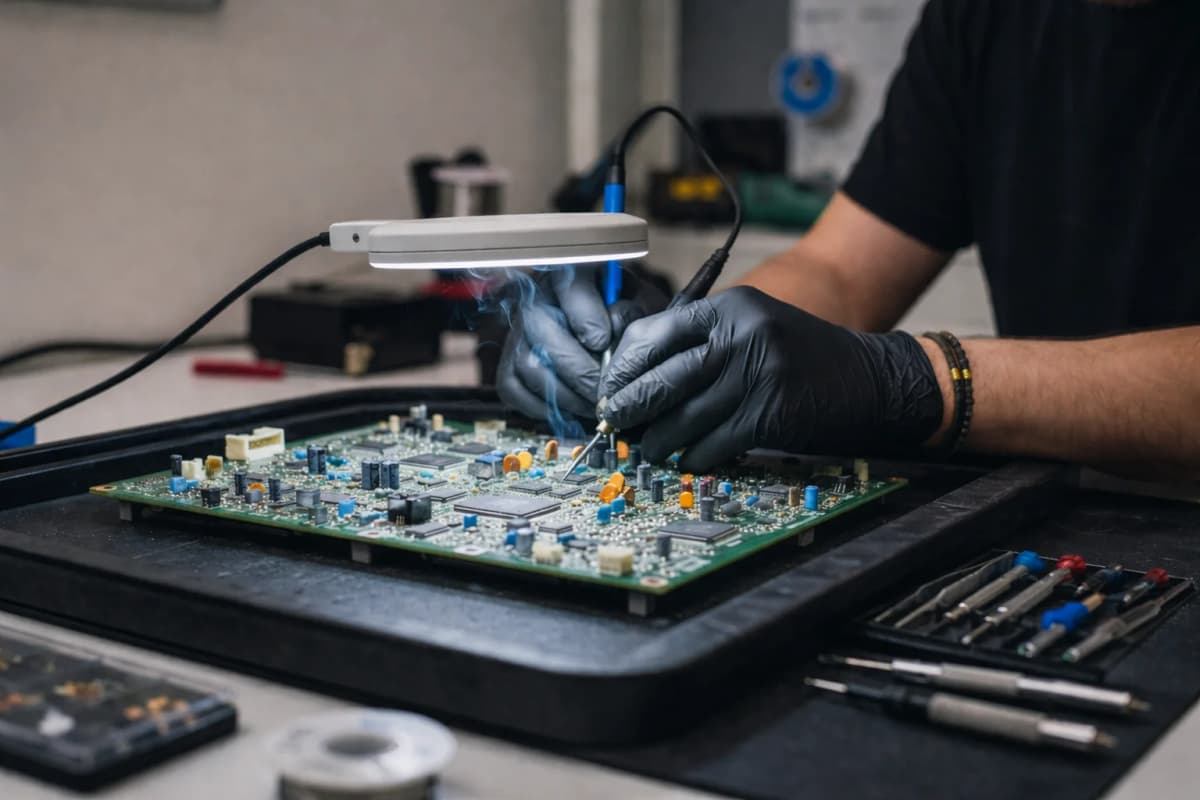
Upon receiving a Bosch MEDG17, we start by certifying the identification (external label + board markings), then we read the useful areas (EEPROM/flash when the unit responds) to preserve the immobilizer and injection parameters. The unit is then placed on a test harness simulating power supplies and CAN lines, with hot and cold checks to reproduce intermittent thermal failures. When the chosen solution involves a replacement, we proceed with identifier pairing (VIN, immobilizer, codings) so that the installation is seamless upon restart. Depending on the case, Incarline can provide an equivalent unit already paired or perform a targeted intervention on your ECU, always retaining the necessary data for starting.
Frequently asked questions
How do I know if my Bosch MEDG17 ECU is faulty?
Where can I find the correct reference on a Bosch MEDG17 for replacement?
Can a Bosch MEDG17 be cloned without going through the dealer?
Which vehicles are equipped with the Bosch MEDG17 ECU?
What is the difference between external and internal markings on a Bosch MEDG17?
Can a used Bosch MEDG17 with a close reference work?
How to use the configurator for a Bosch MEDG17 not found by vehicle?
Your reference isn’t listed?
Contact us — we can source your control unit or handle your repair on a quote basis.
Contact us