
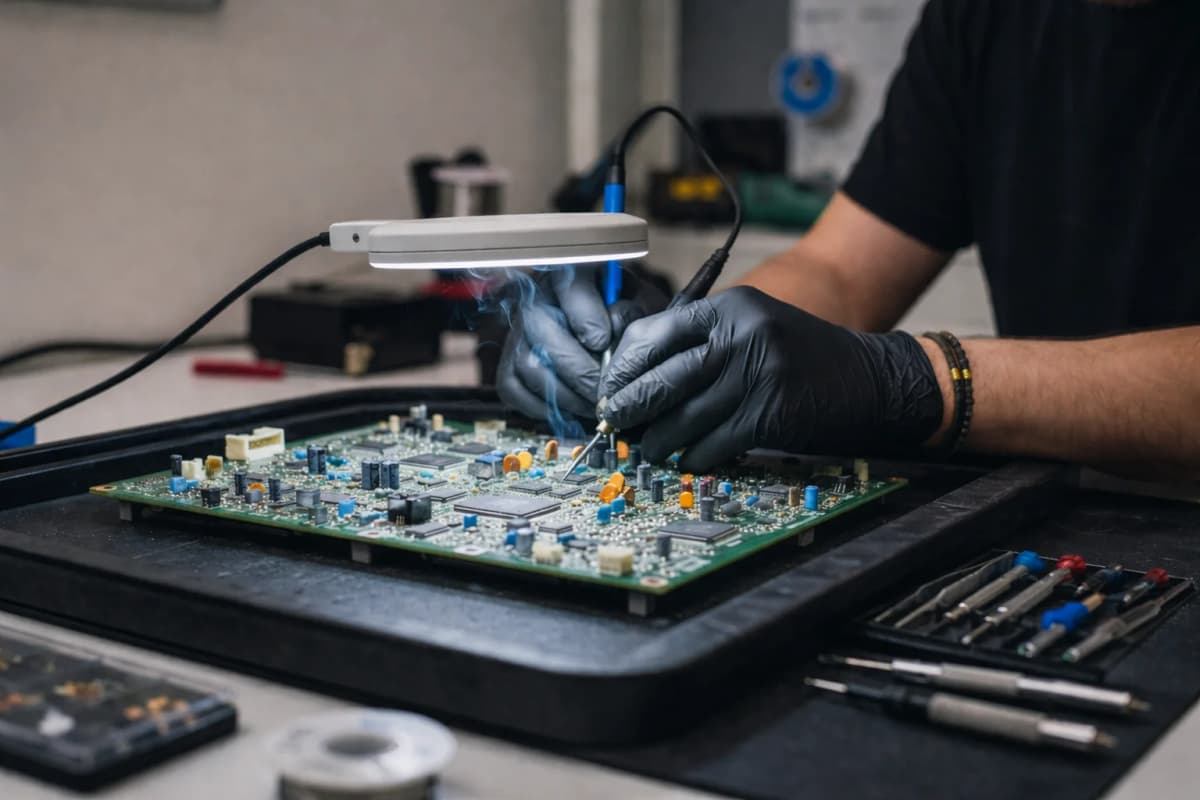
Bosch MEDC17 ECU: diagnostics, symptoms and solutions
Engine light, limp mode, starting issues on Bosch MEDC17? Professional diagnostics, repair or paired replacement. Request your personalized quote.
Please note: at Incarline, “repairing” a control unit means cloning. We transfer your original data — coding, immobiliser pairing and adaptations — onto a healthy unit with an identical reference. We do not carry out component-level repairs on your original unit.
You arrive with an illuminated engine light, limp mode, or starting issues after a diagnostic scan. On Bosch MEDC17 ECUs (engine ECM), these symptoms are common when an internal fault disrupts sensor/actuator power supply, CAN communication, or memory management. Diagnostic reports often show generic anomalies related to the control module, signal coherence of injection/ignition, and internal faults not attributed to a specific sensor. The goal here is to understand what distinguishes a Bosch MEDC17 fault from a sensor issue, and to explain the logical next steps: sending the ECU for bench testing, Bosch MEDC17 cloning if necessary, or replacement with a paired used unit when repair is not viable.
Find your exact reference
Search by hardware reference, software reference or control unit name. Click a result to configure and order without leaving the page.
Why your vehicle is failing with a Bosch MEDC17
When a Bosch MEDC17 starts to fail, typical symptoms include: persistent engine light, power loss with limp mode, jerking during acceleration, sporadic stalling, or starting issues. Diagnostic scans often reveal general faults: internal control module anomalies, inconsistencies in injector/high-pressure pump control, or communication faults on the diagnostic network. A strong indicator of an ECU issue is the simultaneous presence of multiple unrelated faults on sensors powered by the same 5 V reference, or intermittent communication absence with the ECM while the rest of the CAN network responds.
To differentiate a faulty sensor from a failing Bosch MEDC17, proceed methodically: first check the +12 V power supplies and grounds at the ECU, then the presence of a stable 5 V reference at key sensors. A short circuit on a sensor can pull the 5 V line down: if the voltage returns to normal when disconnecting a specific sensor, it is likely a peripheral issue. If all lines remain unstable despite sensors being disconnected, the internal regulator of the ECU may be at fault. Also observe faults that reappear immediately after clearing without starting, or according to temperature (frequent internal thermal failures): these clues point towards the ECM.
Technical sheet of this family
The Bosch MEDC17 belongs to a generation of engine ECMs using a 32-bit microcontroller from the typical tri-core family of this "C17" era. The memory combines internal flash for software and maps, and a data area (internal EEPROM or dedicated series) containing the VIN identifier, immobilizer, and pairing parameters. Diagnostic communication is primarily conducted over high-speed CAN bus with UDS/ISO 14229 protocol (fault reading/clearing, real-time measurements, coding). On the bench, full read/write is generally performed in boot mode via microcontroller access; via OBD, only certain operations are possible depending on active protections.
Units in this family integrate control stages for injectors and engine actuators, as well as management of the motorized throttle and peripheral systems (EGR, pump, etc., depending on the engine). Write protections, integrity verification, and read-only memory segments make Bosch MEDC17 cloning more technical than on older generations, but achievable with correct extraction of identification and immobilizer areas. As an illustration of internal nomenclature, one might encounter the designation Bosch MEDC17.9 ECM in some catalogs.
Vehicles concerned
The exact assignment of a Bosch MEDC17 depends on engines and markets; it is found on CAN-managed injection engines of the C17 generation, particularly on European compacts, sedans, and SUVs. Indicatively (depending on versions and model years), it is found on:
- Audi A3 petrol direct injection 1.8–2.0 L (years depending on model year and market)
- Volkswagen Golf petrol direct injection 1.4–2.0 L (years depending on model year and market)
- SEAT Leon turbo petrol direct injection (years depending on model year and market)
- Škoda Octavia petrol direct injection (years depending on model year and market)
- Certain Peugeot/Citroën turbo petrol direct injection models (years vary depending on application)
Always check your unit's label: the Bosch MEDC17 mention, complete reference, and vehicle pairing take precedence over the commercial model.
Step-by-step Bosch MEDC17 specific diagnostics
1) Basic checks: battery, voltage drops at start, injection fuses and relays. 2) Network: presence of CAN High/Low at the ECU, line continuity, and absence of short circuits. 3) References: measure 5 V and 12 V sensors, identify a collapsed 5 V line by a short-circuited peripheral. 4) Signal coherence: camshaft/crankshaft sensor, rail/rail pressure, throttle position; if the diagnostic tool reports "internal module/processor control" or "internal memory error" faults without a sensor cause, suspect the ECM. 5) Thermal tests: if the fault appears when the engine is hot or due to vibrations and disappears when cold, the ECU is a probable candidate. 6) Selective disconnection: if disconnecting a sensor does not change the faults, it is compatible with an internal cause.
When the ECM is targeted, the logical next step is sending the Bosch MEDC17 for bench diagnostics to confirm internal power supply, UDS communication, and memory area integrity. Depending on the result, a repair may target the power stage, restore boot access, and reprogram data areas. If the electronics are too damaged, replacement with a paired used Bosch MEDC17 to the VIN/immobilizer is a viable alternative.
Points of attention
Before any shipment, document: exact Bosch reference, VIN number, and note present faults, especially those indicating internal inconsistencies rather than isolated sensors. Avoid any hazardous OBD writing on an unstable Bosch MEDC17: a software lock can complicate memory recovery. In this family, cloning requires a clean copy of identification and immobilizer areas; a simple "copy-paste" of mapping is not enough. Finally, false positives are frequent: a sensor short circuit can mimic an ECM fault. Incarline can perform a Bosch MEDC17 bench diagnostic to confirm the electronic origin. Depending on the diagnosis, Incarline can clone the data from your Bosch MEDC17 onto a healthy unit with a strictly identical reference, or supply an already-paired used unit: we do not carry out component-level repairs. In case of ECU change, a Bosch MEDC17 cloning operation can be proposed to retain original immobilizer and calibration.
Frequently asked questions
How to know if my Bosch MEDC17 ECU is faulty?
Which vehicles are equipped with the Bosch MEDC17 ECU?
Can a Bosch MEDC17 be cloned without going to the dealer?
What are the typical symptoms of a Bosch MEDC17 failure?
What is the difference between a repair and a paired used Bosch MEDC17?
What to do after a diagnostic scan with internal faults on Bosch MEDC17?
Can an OBD remapping block a Bosch MEDC17?
Does the Bosch MEDC17 manage the immobilizer and VIN?
Your reference isn’t listed?
Contact us — we can source your control unit or handle your repair on a quote basis.
Contact us