
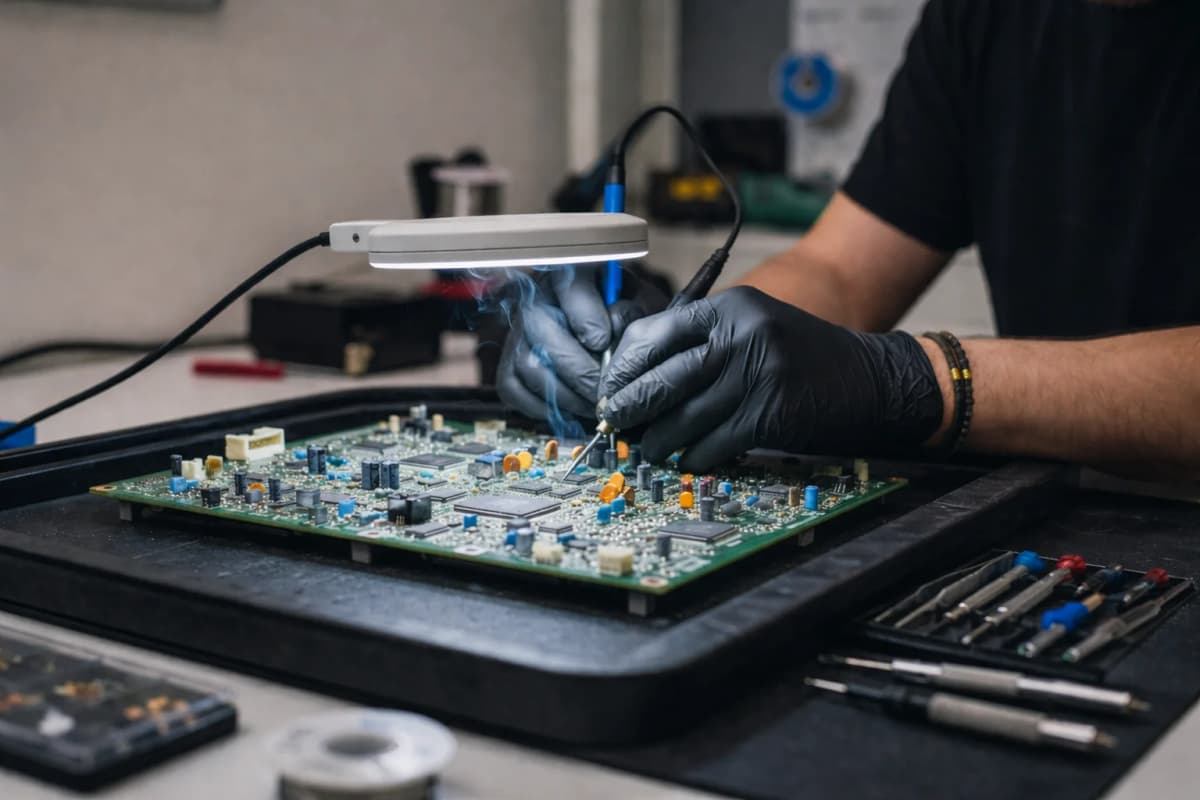
Paired used Bosch MED9 — ready-to-install engine ECU
Tested and paired Bosch MED9 ECU (same HW/SW) for direct injection engines. Ready-to-install replacement with old unit return. Request your quote.
Please note: at Incarline, “repairing” a control unit means cloning. We transfer your original data — coding, immobiliser pairing and adaptations — onto a healthy unit with an identical reference. We do not carry out component-level repairs on your original unit.
The Bosch MED9 ECU is a generation of petrol ECUs dedicated to direct injection, widely used on FSI/TFSI engines from the VAG group. Over time, these units may experience failures related to electronic aging or power supply issues, leading to random starts, limp mode, power loss, and warning lights. In this family, immobilizer pairing and exact adherence to hardware and software references are crucial. Rather than attempting uncertain repairs on an old unit, a relevant solution is to install a paired used Bosch MED9 from an identical and tested vehicle, with the same HW/SW label, for plug & play installation when cloning is possible. Incarline can supply this type of unit and arrange the return of the old ECU as a standard exchange.
Find your exact reference
Search by hardware reference, software reference or control unit name. Click a result to configure and order without leaving the page.
Context and role of this family
At the heart of direct injection petrol engines, the Bosch MED9 orchestrates high-pressure fuel pressure, injector control, ignition, and boost strategies when the engine is equipped. It also manages variable camshaft timing, electronic throttle, and emissions. It is notably found on 2.0 FSI/TFSI engines installed in Volkswagen Golf V GTI, Audi A3 8P, Seat Leon 1P, Skoda Octavia II vRS, or Audi TT 8J depending on the versions. With age, some MED9 units experience intermittent failures, hot shutdowns, or communication losses related to thermal and electrical stresses. In this context, pairing precision is crucial: a Bosch MED9 must match the same hardware reference and a compatible software base to accept immobilizer data and vehicle configuration. This is why, for older ranges where the availability of new parts or internal components is dwindling, replacement with a paired used Bosch MED9 with the correct HW/SW label is often the most rational path. It avoids lengthy fault-finding and repair attempts whose cost can match that of a replacement, while securing restart through correct pairing and prior bench testing.
Technical particularities
Architecture and memories
The Bosch MED9 relies on a 32-bit microcontroller of its generation, with external flash memory containing the software and calibrations, and a small-capacity serial EEPROM dedicated to persistent data such as the VIN and immobilizer. Diagnostic communication is conducted via K-Line and/or CAN on the OBD port depending on the generation. For advanced service operations (full read, cloning, or virginization), access can be made on a bench through interfaces provided by the manufacturer on this family (e.g., BDM/JTAG modes depending on the variant), allowing extraction of the flash and EEPROM content to transfer the electronic identity from one ECU to another when relevant. These characteristics make Bosch MED9 cloning scenarios realistic but require strict adherence to original references and mapping to maintain compatibility with the vehicle network.
Pairing and starting
On Bosch MED9, immobilizer pairing and VIN/coding alignment are essential. Two approaches exist depending on the condition of the original unit and version compatibility: either a full cloning of useful data (when reading is possible) or the preparation of a 'virgin' unit followed by learning with the vehicle's electronics. After installation, adaptive relearning may be necessary: clearing self-adaptation values, motorized throttle learning, idle stabilization, and, in some cases, a short drive to refine fuel corrections on direct injection. By proceeding this way, a paired used Bosch MED9 replacement generally regains a firm start, consistent injection times, and stable network communication, provided HW/SW compliance and peripheral sensor/actuator integrity have been verified beforehand.
For which uses
You will opt for a paired used Bosch MED9 when the original ECU is silent, flooded, burned, unstable when hot, or when recurring faults return despite external repairs. It is also relevant if the repair is expected to be costly given the unit's age, or if the unit has damage preventing any reliable reading. In these situations, a Bosch MED9 replacement with the same HW/SW reference, prepared with your immobilizer data and tested before shipment, allows for a quick restart and limits immobilization. Incarline verifies exact pairing, provides installation and relearning instructions, and offers a functional warranty on the supplied unit while arranging the return of your old ECU as a standard exchange.
Frequently asked questions
How do I know if my Bosch MED9 ECU is faulty?
Which vehicles are equipped with the Bosch MED9 ECU?
Can a Bosch MED9 be cloned without going to the dealer?
What is the difference between a repair and a paired used Bosch MED9?
Does replacing a Bosch MED9 require special learning?
How to check the correct HW/SW reference of a Bosch MED9 before ordering?
Can a used Bosch MED9 solve injection cuts on 2.0 TFSI?
Your reference isn’t listed?
Contact us — we can source your control unit or handle your repair on a quote basis.
Contact us