
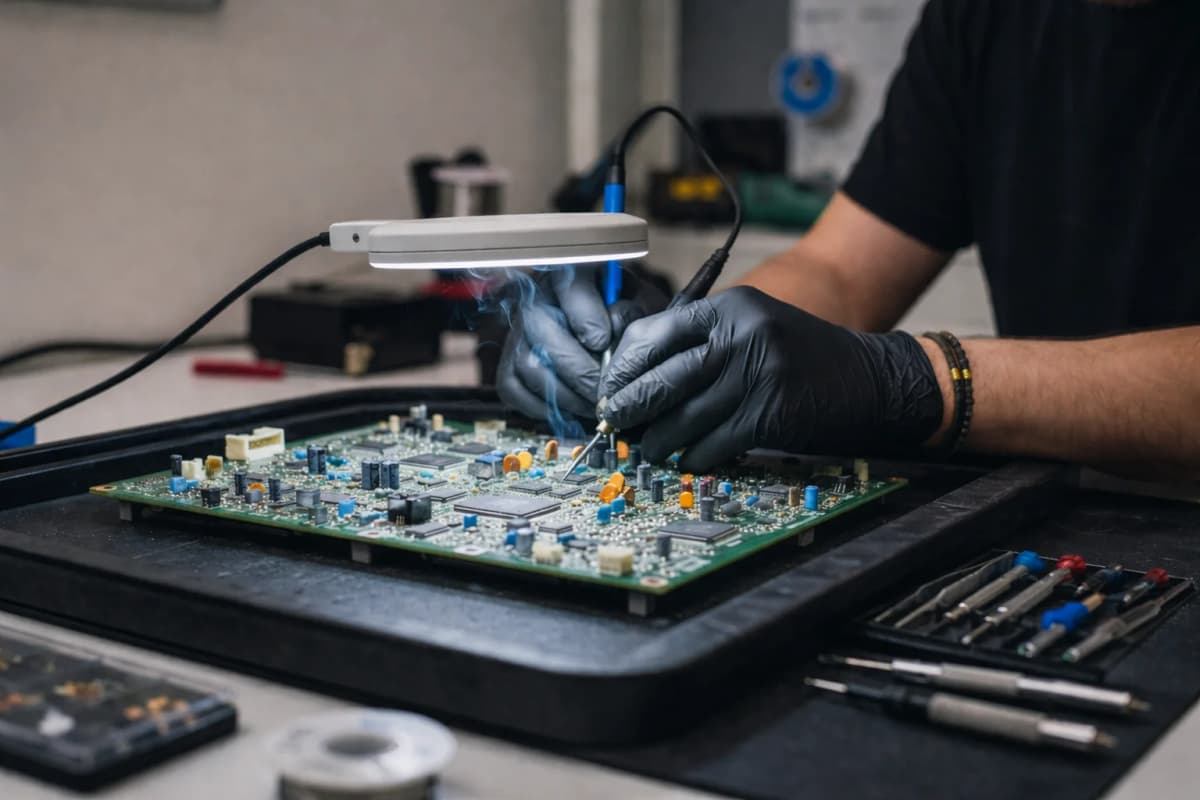
Bosch MED17: typical failures, symptoms, tests, and solutions
Bosch MED17 ECU malfunctioning? Typical symptoms, DTCs, and options (repair, cloning, paired used unit). Contact INCARLINE for a personalized quote.
Please note: at Incarline, “repairing” a control unit means cloning. We transfer your original data — coding, immobiliser pairing and adaptations — onto a healthy unit with an identical reference. We do not carry out component-level repairs on your original unit.
The Bosch MED17 engine ECU (direct injection petrol ECU family) is used in many recent turbo and naturally aspirated engines. When it ages or experiences a cut-off during OBD programming, recurring failures occur: no communication on the CAN, internal processor errors, 5 V sensor line failure, or non-controlled actuators (throttle, coils, injectors). Generic fault codes related to the internal module (e.g., P0606 or P0601) and the inability to start (active immobilizer, often indicated by a code like P1570 on some VW group vehicles) are typical. The Bosch MED17 family generally interfaces via UDS on CAN and is read/written in boot mode (TriCore) on a bench in case of a brick. INCARLINE can intervene on this basis to guide towards the appropriate solution for the confirmed case.
Find your exact reference
Search by hardware reference, software reference or control unit name. Click a result to configure and order without leaving the page.
Identify your exact reference
The Bosch MED17 family covers many variants (e.g., MED17.5.x, MED17.7.x, MED17.8.x, MED17.9.x) used by different manufacturers. To avoid any pairing error, it is essential to precisely identify the reference engraved/labeled on your ECU and compare it with the vehicle label and the diagnostic tool.
- Turn off the ignition, disconnect the battery, then remove the Bosch MED17 ECU by noting its location (engine compartment or windshield bay depending on models).
- Note the complete designation on the label (e.g., "Bosch MED17.x.x" + Bosch reference and possibly the manufacturer reference) and photograph it.
- If the ECU still communicates, read the ECU ID via OBD to confirm the family (most often UDS protocol on CAN) and the software number.
- Compare these elements with the registration document and the engine type to validate compatibility in case of replacement or cloning.
The options available to you
Replacement with a paired used ECU
A quick solution when the Bosch MED17 is irrecoverable (internal short circuit, deep corruption): a compatible used ECU can be prepared by cloning immobilizer/OTP data if allowed, to avoid a dealership visit for pairing.
Repair of the existing ECU
Suitable in case of known failures on MED17 (5 V sensor regulator failure, damaged CAN transceiver, actuator power bridges, flash corruption); the advantage is to keep the original unit and its calibrations.
Remapping (software restoration/cloning)
In case of an OBD brick or after an incomplete update, a read/write in boot mode (TriCore) often allows restoring the flash partitions and performing a complete or partial cloning of the immo areas.
What to expect technically
A Bosch MED17 combines a 32-bit microcontroller from the TriCore family, internal flash memory (maps/firmware), and, depending on the variants, a dedicated or emulated EEPROM area for the immobilizer, VIN, and certain learning parameters. Diagnostic exchanges are generally done in UDS on CAN, with security sequences requiring specific accesses for programming functions. On benches, boot mode (BSL) activation via test points allows recovering a "bricked" unit after an interrupted OBD write. In a Bosch MED17 cloning process, several layers must be distinguished: 1) the base software and calibrations (maps), 2) the immobilizer data (CS/PIN, VIN, synchronization), 3) the protected/OTP areas that do not always copy as is; an identical copy of the entire content is not systematically possible depending on the revisions, hence the need for a selective transfer strategy and possible final pairing to the vehicle.
Recurring failures observed on the Bosch MED17 family include: 1) Internal errors type "Internal Control Module" with engine light on and limp mode; DTCs such as P0606 (processor) or P0601 (memory checksum) are often noted when the flash is corrupted or the ECU has suffered an electrical shock. 2) Inability to start with immobilizer lock: on VW group platforms, a P1570 may accompany an immo desynchronization after replacement or data corruption. 3) Loss of communication with the ECU (no CAN dialogue, fan running in safety, inert gauges): the internal CAN transceiver or main power supply may be damaged. 4) 5 V sensor line failures: an external sensor short circuit can drop the 5 V reference; if the internal regulator is affected, simultaneous sensor faults (pressure, temperature, throttle) and unstable idle are observed. 5) Actuator control disrupted: throttle H-bridge or coil/injector drivers in fault leading to persistent misfires despite new parts, or a P2101 DTC on the throttle body depending on the engine.
These symptoms are particularly described on: Volkswagen Golf 6 2.0 TSI (MED17.5 family), Audi A4 B8 2.0 TFSI (MED17.x family), Mercedes C-Class W204 1.8/2.0 CGI (MED17.7.x family). Other petrol models from the VW/Skoda/Seat group and the Mercedes range equipped with direct injection also use this ECU. When faults appear after an OBD remapping (or an interrupted update), restoration almost systematically involves a full bench read and rewriting of the software/emulated EEPROM segments, with checksum and software ID verification. In case of alternator cut-off or overvoltage, it is not uncommon for the Bosch MED17 to show damage to the internal power supply; targeted cloning (5 V regulator, drivers, CAN transceiver) can then be considered before validating software integrity.
In practice, the choice between repair and replacement will depend on: 1) the physical condition of the PCB (oxidation, burn, infiltration), 2) the feasibility of software recovery in boot mode, 3) the ability to properly transfer immobilizer data. A replacement with a used Bosch MED17 is relevant if the power section is irreparable or if corrosion is extensive; conversely, cloning is recommended if the ECU's hardware layer still provides stable bases. INCARLINE can confirm the appropriate scenario after diagnosing your unit.
To limit returns: 1) always check the +12 V power supplies and grounds, 2) check the 5 V line and disconnect all sensors in case of a short circuit, 3) ensure that the Bosch MED17 update or remapping is done with a stabilized power source, 4) after cloning, validate the immobilizer adaptation and the VIN via UDS. When possible, a "virgin" of certain MED17 allows OBD pairing to the donor vehicle; otherwise, complete cloning remains the safest route. For support, INCARLINE offers a quote based on the exact reference and observed symptoms.
Frequently asked questions
How do I know if my Bosch MED17 ECU is faulty or just software corrupted?
Which vehicles are most often affected by Bosch MED17 failures?
Can a Bosch MED17 be cloned without going to the dealership?
What fault codes are typical of an internally faulty Bosch MED17?
Can a throttle or sensor fault originate from the Bosch MED17 itself?
My Bosch MED17 no longer communicates after remapping: what should I do?
Should I prefer repair or a used replacement for an oxidized Bosch MED17?
Your reference isn’t listed?
Contact us — we can source your control unit or handle your repair on a quote basis.
Contact us