
Bosch ME9 (petrol engine ECU) – typical failures and solutions
Problems with your Bosch ME9 ECU? Targeted symptoms, known causes and explained recovery paths. Request your personalized quote.
Please note: at Incarline, “repairing” a control unit means cloning. We transfer your original data — coding, immobiliser pairing and adaptations — onto a healthy unit with an identical reference. We do not carry out component-level repairs on your original unit.
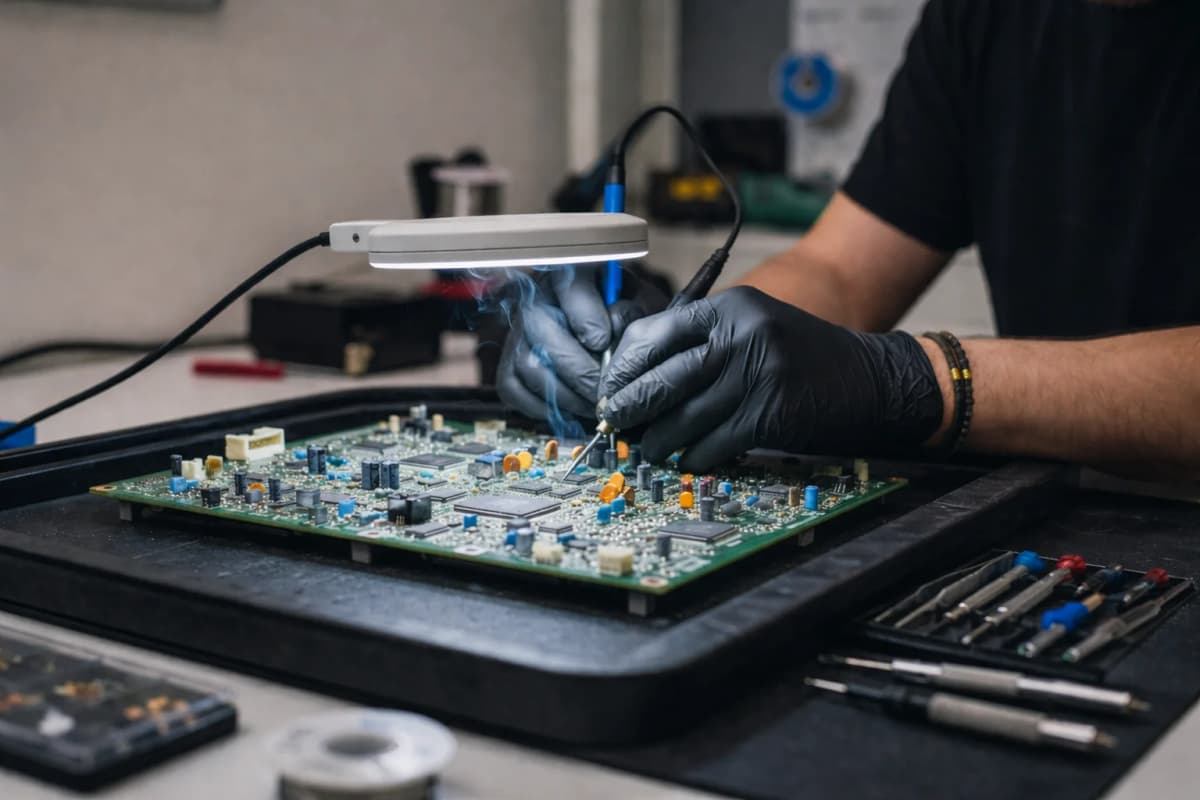
The Bosch ME9 ECU is a petrol engine ECU that manages injection, ignition, electronic throttle, and lambda loops on many vehicles. This generation relies on a 32-bit microcontroller, a main flash memory, and a serial EEPROM that notably carries the immobilizer and VIN coding. On models like Mercedes-Benz E-Class W211 350, C-Class W204 280/350, ML W164 350, or SLK R171 350 equipped with period V6/V8 engines, recurring failures combine CAN communication losses, unstable 5 V sensor power supply, and stressed internal drivers (lambda sensor heaters, EVAP). Symptoms range from an impossible start to unstable idling, through a limp mode with engine light and an inoperative accelerator pedal. This page summarizes the warning signals, characteristic technical causes, and suitable recovery options for the Bosch ME9.
Find your exact reference
Search by hardware reference, software reference or control unit name. Click a result to configure and order without leaving the page.
Symptoms that bring you here
On a struggling Bosch ME9, a very telling combination is often observed: random or impossible starting despite a cranking engine, intermittent diagnostic communication absence, engine fan running at contact, or accelerator pedal with no effect with throttle stuck in safety. On the road, a difficult-to-stabilize lean/rich operation, sharp cuts during acceleration, and simultaneous misfires on several cylinders point more towards disturbed internal management than a simple isolated sensor. These manifestations are regularly reported on Mercedes-Benz E-Class W211 350, C-Class W204 280/350, ML W164 350, and SLK R171 350 using this type of ECU.
Another classic scenario for the Bosch ME9: after an electrical intervention (discharged/boosted battery, short circuit on a lambda sensor or purge valve), the vehicle may lose all diagnostic dialogue, refuse to start, or start then stall immediately. In these cases, non-specific internal faults related to the microcontroller or memory may arise when communication is still possible, while the physical blocks powered by the ECU (fuel pump via relay, coils, injectors, throttle actuator) show erratic commands. With the immobilizer remaining paired to the ECU, a desynchronization of the coding can also result in an active starter but inhibited injection/spark.
Technical causes in this family
The Bosch ME9 family shares an architecture where the ECU concentrates regulated 5 V internal power supplies for sensors, power drivers for actuators (lambda sensor heaters, EVAP, etc.), vehicle CAN communication, and critical data storage (VIN, immobilizer) in serial EEPROM. These specifics explain why certain electrical aggressions or peripheral faults translate into recurring ECU-side failures, especially on aging harnesses as encountered on W211, W204, W164, or R171.
- Worn or overloaded internal 5 V regulator after sensor short circuit: pedal/throttle position and manifold pressure sensors become inconsistent, inducing a Bosch ME9 characteristic safety mode.
- Damaged lambda sensor heater drivers due to external short circuit: the ECU cuts or no longer correctly drives the sensors, the lambda loop goes out of range, and the engine enters unstable enrichment/leaning.
- Weakened integrated CAN transceiver: sporadic or total network communication losses and inability to query the ECU, with cascading anomaly messages on the instrument cluster.
- Corruption of the EEPROM area containing the immobilizer identifier and coding: impossible start despite an active starter, or even the need to realign VIN/immobilizer.
- Oxidation or localized heating on connector/PCB (after infiltration or overload): weakened tracks/connections causing hot stalls and cold returns.
- Stressed throttle/injector control stages: after battery overvoltage or faulty wiring, the output transistors may go into protection or remain inoperative.
What Incarline offers
Depending on the diagnosis, the interest is to distinguish a clear hardware failure (destroyed 5 V power supply, burnt lambda driver, silent CAN transceiver) from a software/data failure (corrupted EEPROM, immobilizer desynchronization). Upstream, a methodical check of power/ground supplies, the sensor harness, and the throttle actuator avoids sending an external cause back to the ECU that would reproduce the failure. To preserve vehicle pairing, extracting and saving the flash and EEPROM content is a priority on Bosch ME9, as these areas carry the VIN, adaptations, and immobilizer parameters.
Depending on the diagnosis, Incarline can clone the data from your Bosch ME9 onto a healthy unit with a strictly identical reference, or supply an already-paired used unit: we do not carry out component-level repairs. If communication remains possible and the main damage concerns the data, a Bosch ME9 cloning (copying flash/EEPROM areas to transfer VIN, immobilizer, and coding) allows switching to another compatible unit without returning to the dealership. And if the hardware is too damaged or contaminated, a Bosch ME9 replacement with a paired used unit is feasible, ensuring reference compatibility and immobilizer alignment before installation.
Frequently asked questions
How do I know if my Bosch ME9 ECU is faulty?
Which vehicles are equipped with the Bosch ME9 ECU?
Can a Bosch ME9 be cloned without going to the dealership?
Why do lambda sensor heaters cause a Bosch ME9 to fail?
Is the immobilizer contained in the Bosch ME9?
Loss of CAN communication with a Bosch ME9: what to check?
After a battery overvoltage, my Bosch ME9 no longer responds: is it repairable?
Your reference isn’t listed?
Contact us — we can source your control unit or handle your repair on a quote basis.
Contact us