
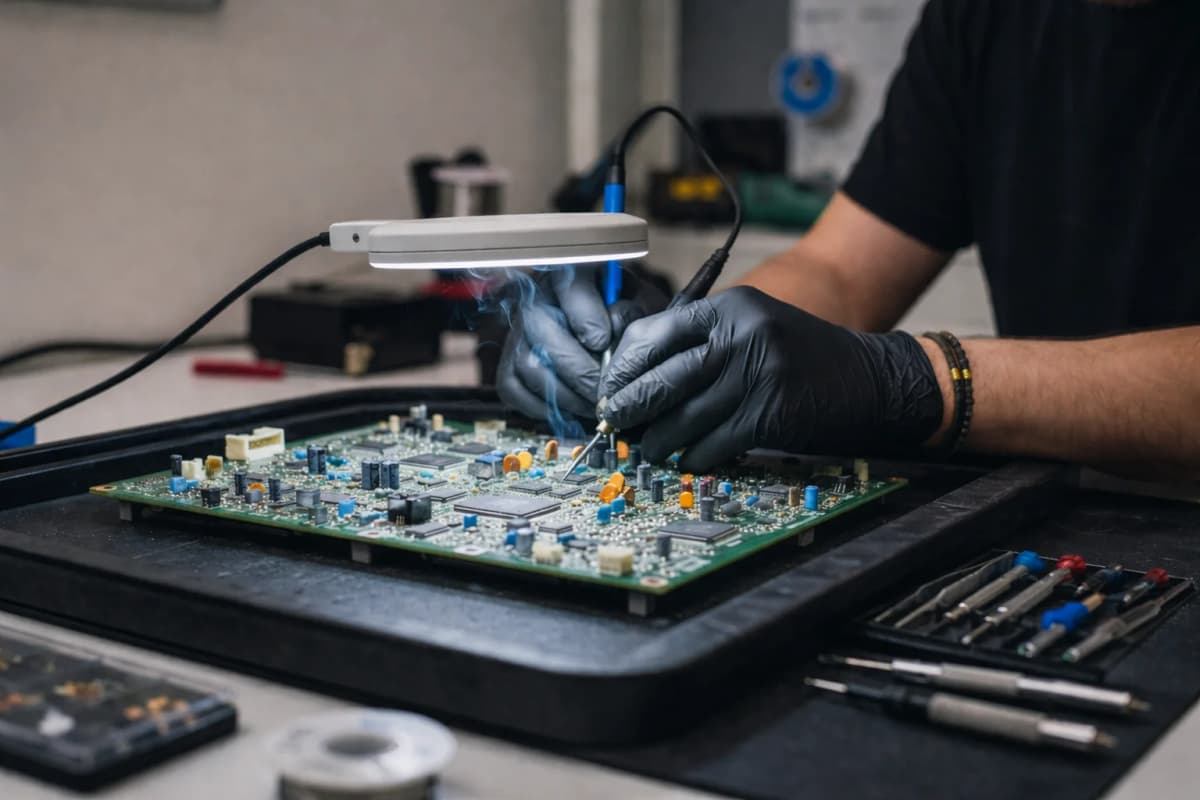
Bosch ME17 — Engine Remapping, Stages 1/2 and Optimization
Bosch ME17 remapping via OBD, bench, or boot-mode. Stages 1/2, EGR/DPF/AdBlue off, torque/injection/timing maps. Request your personalized quote.
Please note: at Incarline, “repairing” a control unit means cloning. We transfer your original data — coding, immobiliser pairing and adaptations — onto a healthy unit with an identical reference. We do not carry out component-level repairs on your original unit.
The Bosch ME17 is a modern gasoline engine ECU from the Bosch range, commonly operated via CAN-UDS and based on a 32-bit tri-core microcontroller. This architecture manages complex torque models, injection and timing maps, as well as boost pressure and lambda controls. In remapping, access can be done via OBD, in bench (service mode), or in tri-core boot-mode depending on the variant and software protection. Incarline can perform remapping in the workshop or provide a calibrated file remotely, after a secure full read.
Find your exact reference
Search by hardware reference, software reference or control unit name. Click a result to configure and order without leaving the page.
In Brief
The Bosch ME17 encompasses numerous references (e.g., ME17.5.20, ME17.7.8) covering multipoint and direct injection gasoline engines. OBD, bench, and boot-mode accesses allow reading/writing, while torque, injection, ignition timing, turbo pressure, and lambda maps are adjusted for measured stages 1/2. Protected sections (checksums, secure access) require reliable tools and procedures to avoid any bricking.
Frequently Asked Technical Questions
On which vehicles is a Bosch ME17 found?
The Bosch ME17 and its variants are found on many European gasoline vehicles. Common examples include Volkswagen Golf VI in 2.0 TSI (MED17 family), Peugeot 308 I in 1.6 gasoline (MED/MEV17 family), Mercedes-Benz A-Class W176 in turbo gasoline engines (MED17 family), and Audi A4 B8 in 2.0 TFSI. The family covers multipoint and direct injection architectures, with calibrations and protections that vary according to the engine generation.
What access protocols does the Bosch ME17 use (OBD, bench, boot-mode, BDM)?
On Bosch ME17, OBD via CAN-UDS is frequently available for reading/writing calibrations, sometimes after a challenge/response authentication phase. When OBD is limited by protection, bench (service mode on the internal connector) or tri-core boot-mode (BSL access via dedicated boot pins) is required for a full read/backup. BDM is generally not the preferred route on this family, as the ME17 architecture is oriented towards tri-core boot rather than BDM of older generations. The choice of protocol depends on the specific reference and protection level.
What professional tools are suitable for Bosch ME17 and what precautions should be taken?
Recognized professional tools in the industry such as KESS, KESSv3, MPPS, CMD, and PCMflash offer OBD, bench, or boot-mode protocols for multiple ME17 variants. The key, method-wise, is to stabilize the power supply, perform a complete backup (flash + possible SPI serial EEPROM containing VIN/immobilizer), and manage checksums and software locks (tuning protection) before any writing. A power cut, poorly negotiated seed/key, or unrecalculated checksum can brick the ECU; hence the importance of tooling and wiring compliant with the selected protocol.
Which maps are modified on a Bosch ME17 for a stage 1/2?
The Bosch ME17 family controls a torque model, with driver demands, torque limits, thermal management, and monitoring. In stage 1, torque maps, ignition timing, injection, and lambda targets are typically adjusted, as well as turbo pressure managers when the engine is turbocharged, while respecting knock and temperature protections. A stage 2 adds adaptation to modified parts (intake, exhaust, downpipe), with deeper readjustments of the torque model and associated monitoring. On direct injection variants (MED17 family), high fuel pressure limits and certain stratified mixture strategies may also require dedicated calibration.
Can EGR/DPF/AdBlue or sensors be disabled on Bosch ME17?
On certain Bosch ME17 variants used in gasoline, EGR, catalysts, and secondary lambda sensors are mainly addressed. Software deactivation involves neutralizing diagnostics and internal states related to the targeted systems, in addition to adapting maps if necessary. These operations must comply with current regulations and are generally reserved for circuit/competition use when they impact road homologation.
Possible Solutions
Depending on the available access (OBD, bench, boot-mode) and the objective (stage 1/2, EGR/cat off, flex optimization), the strategy is to fully read the Bosch ME17, prepare a calibrated file, then write while respecting security measures. Incarline offers either an in-workshop intervention with complete measurement and backup or the provision of an optimized file remotely after reading compliant with the required protocol.
Frequently asked questions
How to know if my Bosch ME17 ECU accepts remapping via OBD?
What are the limits of a stage 1 on a Bosch ME17 without modifying the mechanics?
Is cloning a Bosch ME17 possible in case of ECU replacement?
What are the risks of bricking on Bosch ME17 and how to avoid them?
Can EGR or secondary lambda sensor be legally removed on a Bosch ME17?
What is the difference between a repair and a replacement with a paired used Bosch ME17?
Which specific models use a Bosch ME17 for performance remapping?
Your reference isn’t listed?
Contact us — we can source your control unit or handle your repair on a quote basis.
Contact us