
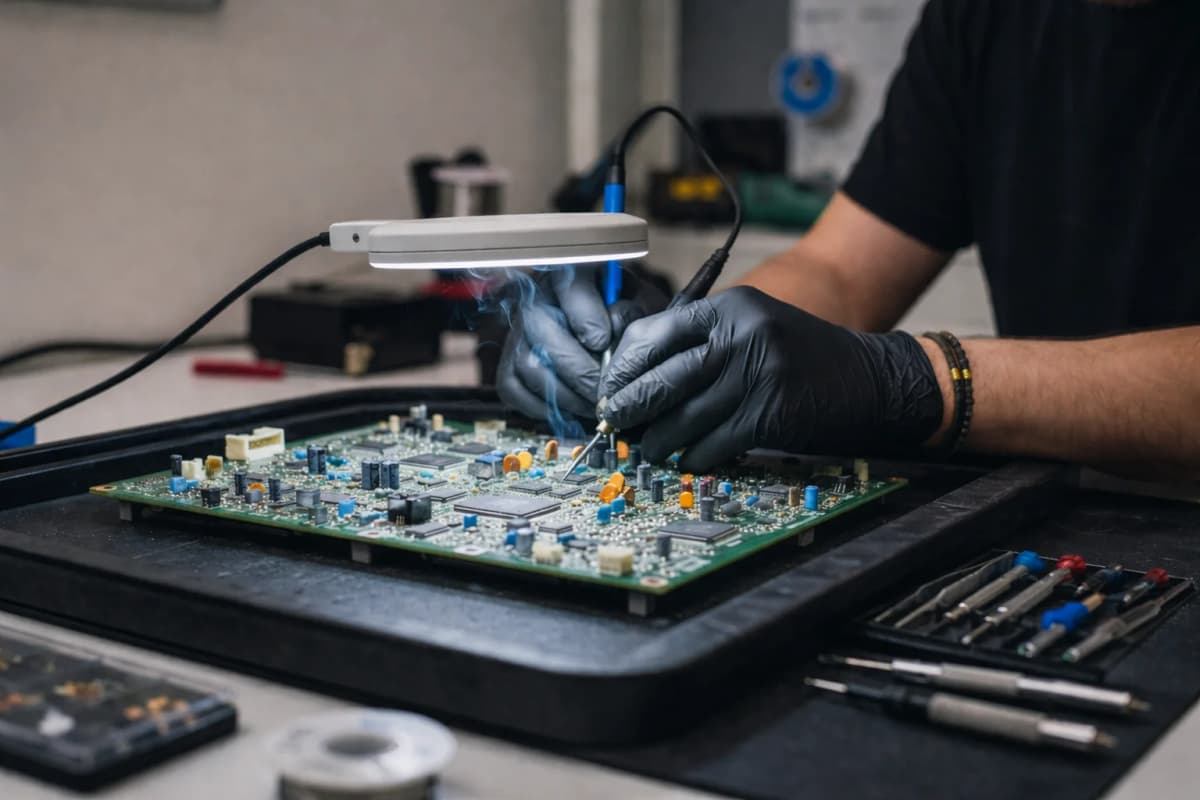
Bosch M7 Engine ECU: Repair, Cloning, and Workshop Testing
Bosch M7 ECU failure? Diagnosis, repair, and cloning to maintain original pairing. Request your personalized quote.
Please note: at Incarline, “repairing” a control unit means cloning. We transfer your original data — coding, immobiliser pairing and adaptations — onto a healthy unit with an identical reference. We do not carry out component-level repairs on your original unit.
The Bosch M7 engine ECU (ECM), including variants like the M7.9.8, is used in gasoline engines of a generation where management is done via a 16-bit microcontroller and dedicated calibration memory. These units often communicate via K-Line ISO 9141-2, with CAN sometimes depending on the revision. In the workshop, a Bosch M7 HS may exhibit generic symptoms such as difficult starting, random stalling, engine light on, limp mode, or power loss, accompanied by faults related to power supply, ignition, or injection. To secure the immobilizer and VIN, reading the EEPROM is one of the first steps before any hardware intervention. The goal is to isolate a common fault (injector drivers, ignition transistors, measurement shunt, worn capacitors, memory corruption), repair with equivalent or superior components, then bench test and validate with remapping if necessary.
Find your exact reference
Search by hardware reference, software reference or control unit name. Click a result to configure and order without leaving the page.
Identify Your Exact Reference
Each Bosch M7 has a manufacturer label showing the family (e.g., Bosch M7.9.8), Bosch reference, and vehicle manufacturer codings. This information guides the intervention strategy (EEPROM reading, test points, connectors, diagnostic protocol). In this family, there is typically a separate serial EEPROM from the program flash, facilitating the cloning of immobilizer data if the main board needs replacement. Here's how to ensure identification before sending:
- Locate the ECU label (aluminum cover) and note the mention "Bosch M7" followed by the variant.
- Clearly photograph the label(s) (Bosch reference, manufacturer codes, barcodes) and the connector.
- Note the vehicle's VIN and corresponding gasoline engine, useful for verifying software compatibility.
- Provide these elements when requesting a quote to prepare the appropriate EEPROM reading and bench test diagram.
- Common symptoms of a failing Bosch M7: engine light, unstable idle, ignition misfires, hot cutouts, inability to communicate via OBD on K-Line or CAN depending on version.
Your Options
Paired Used Unit
A used Bosch M7 ECU can be supplied and, if topology allows, paired by cloning immobilizer data from your EEPROM, avoiding vehicle relearning. This option is sometimes chosen when the original board is too corroded or burnt.
Workshop Repair
The intervention targets the root cause (drivers, power transistors, shunt resistors, capacitors, power lines, memory corruption). The return is with the original Bosch M7, already paired with your vehicle, thus no additional immobilizer procedure on the assembly workshop side.
Reprogramming / Cloning
Reading/writing the useful areas (EEPROM and calibration zones) allows either restoring a stable configuration or cloning a Bosch M7 to a unit of the same reference. The aim is to retain VIN, immobilizer, and codings for immediate restart.
What to Expect Technically
Upon receipt, a meticulous visual inspection of the Bosch M7 highlights typical defects of this generation: localized heating around injector and ignition drivers, dried electrolytic capacitors, oxidized tracks, or vibration residues having cracked solder joints. The diagnostic protocol starts with a full backup of non-volatile data: EEPROM reading (where immobilizer identifiers and sometimes specific parameters reside), then, if necessary, extraction of the program flash containing engine management maps. Depending on the variant, communication is via K-Line ISO 9141-2 or CAN, and service access may require a boot mode; we adapt the bench wiring to stabilize power supply, isolate the power stage, and verify sensor/actuator signal coherence.
After diagnosis, faulty components are desoldered: power transistors driving coils and injectors, shunt resistors for current measurement, linear or DC-DC regulators, clock quartz, or, in case of line breaks, straps/track repairs. End-of-life capacitors are replaced with low ESR and temperature-appropriate references. When the faulty component is encapsulated in a BGA package (possible cases on certain revisions or specific drivers), reballing and controlled resoldering may be necessary. Progressive electrical tests validate integrity: power supply, OBD communication, output activation, current monitoring via shunt, and verification of the absence of new generic faults.
If the memory has been corrupted, a software restoration is performed from a healthy dump of the same Bosch M7 family, with reinjection of your EEPROM data to preserve original pairing (VIN, immobilizer). A final bench test simulates start, idle, and basic solicitations; ignition and injection lines are controlled under dummy load to prevent any vehicle failure. The returned ECU remains yours, already recognized by the vehicle's immobilizer, avoiding additional learning procedures. Typical workshop lead time and warranty conditions are communicated at file opening, and a report of key measurements may accompany the return.
For searches like "Bosch M7 repair," "Bosch M7 cloning," or "Bosch M7 used," this approach focused on EEPROM backup, power stage refurbishment, and secure bench testing ensures long-term ECU reliability. In case of replacement, "Bosch M7 replacement" is considered only on an equivalent reference, to maintain coherent hardware and software compatibility.
Frequently asked questions
How do I know if my Bosch M7 ECU is faulty?
Which vehicles are equipped with the Bosch M7 ECU?
Can a Bosch M7 be cloned without going to the dealer?
What is the difference between repair and a paired used Bosch M7?
What memories are present in a Bosch M7 and why read them?
Does the Bosch M7 use K-Line or CAN for diagnostics?
Which internal components most often fail on a Bosch M7?
After repair, will the Bosch M7 immobilizer need relearning?
Your reference isn’t listed?
Contact us — we can source your control unit or handle your repair on a quote basis.
Contact us