
Bosch HV17 Remapping for Secure Engine Optimization
Bosch HV17: OBD/bench/boot reading, stages 1/2, torque/injection/boost maps, EGR/DPF/AdBlue off (dedicated use). Request your personalized quote.
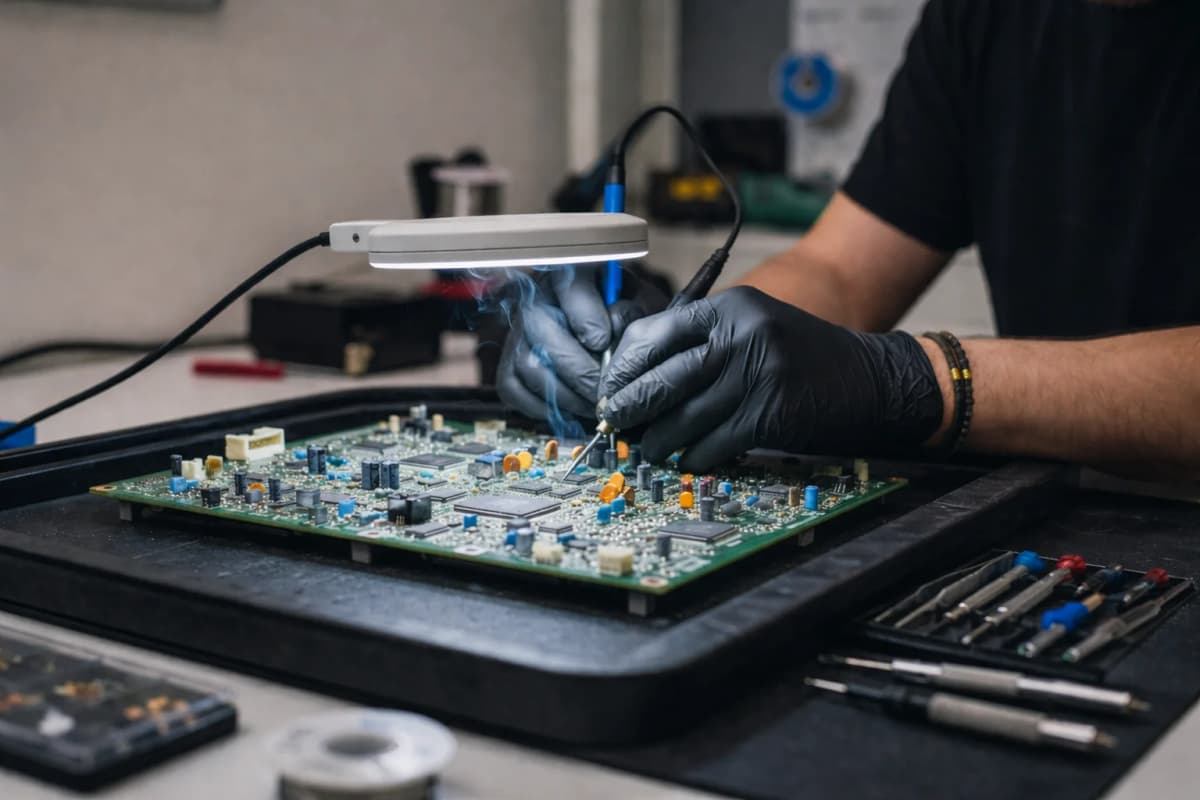
The Bosch HV17 is an engine control unit (ECM) from the Bosch brand. It manages injection, torque limits, and various actuators, and can be reprogrammed for measured gains (stage 1/2) or to disable certain systems depending on declared use (EGR/DPF/AdBlue). The designation "HV17" is not widely documented publicly, so exact identification is done via the unit's label (e.g., a variant noted HV17.4.1) and ID reading. In practice, access is via OBD when the protocol allows, or in bench/boot mode for full access. Incarline offers either a workshop remapping service or the provision of a calibrated file remotely, after verifying the reference and present securities.
Find your exact reference
Search by hardware reference, software reference or control unit name. Click a result to configure and order without leaving the page.
Technical Data Sheet of This Family
On units referenced as Bosch HV17, a modern ECU architecture is generally encountered with a 32-bit microcontroller and a memory organization combining internal flash/possible external flash and a serial EEPROM that notably retains vehicle identifiers and immobilizer parameters. Diagnostic exchanges are usually conducted via protocols used in automotive of this generation (for example, UDS or KWP2000 sessions over CAN bus), which determines the availability of OBD read/write. When the ECU only allows partial access, a "bench" mode (power supply and direct connection to the ECU pins outside the vehicle) or a boot-mode by opening the unit to activate a special microcontroller startup and access complete areas is chosen. On some revisions, BDM mode may exist, but it is less common than bench/boot on these generations.
In Bosch HV17 remapping, the mapping areas typically modified include: torque limits, load/airflow calculators, boost pressure and associated securities, injection durations and pressures (for diesel engines), as well as ignition timing and richness (for petrol engines). A stage 1 respects the original mechanics, with optimization of the main tables and correctors; a stage 2 assumes modified peripheral elements (intake/exhaust, turbo depending on configuration) and requires adjustment of more protection maps. System deactivations (EGR/DPF/AdBlue) are performed at the software level by disabling strategies and, if necessary, adapting fault management; this should remain reserved for off-road uses when regulations require.
On the tools side, reading/writing on a Bosch HV17 is typically done with professional solutions capable of covering OBD access, bench service mode, and boot-mode. In the practice of the trade, platforms like KESS/KESSv3, MPPS, CMD, or PCMflash are encountered, provided that the specific protocol corresponding to the identified reference is supported. Depending on the presence of write protections, bench/boot access is often preferred to secure a complete backup before modification. Prior to any intervention, it is recommended to perform a full ID, check the present software state, and record a full read when the protocol allows.
Technical Limits and Precautions: Some revisions of Bosch HV17 may integrate anti-write mechanisms or protected memory segments. An erasure or power cut during the programming phase can render the ECU inoperative (bricking). Hence the interest of a power stabilizer, a write protocol adapted to the exact revision, and checksum verification by the tool or external processing. Before delivery, a consistency check of the maps (aligned limiters, correctly recalibrated sensors, preserved security stratifications) is necessary to maintain reliability and avoid jerks, limp mode, or the recurrent appearance of faults not specific to the ECU.
Vehicles Concerned
The mention "Bosch HV17" is not standardized in public documentation, the precise installation depends on the reference engraved on the unit (e.g., HV17.4.1) and the manufacturer calibration. This type of ECU generation is found on moderate displacement petrol or diesel engines, distributed in Europe. Identification is reliably done from the Bosch label and ID reading via OBD/bench.
- Some compact sedans from European manufacturers equipped with 1.2L to 1.6L petrol engines (depending on versions)
- Segment C/D models with 1.6L to 2.0L diesel engines, depending on series and countries
- Some European light commercial vehicles with diesel engines close to 2.0L
- Versatile city cars from German and French brands, on specific series
- Some compact European SUVs in medium power petrol and diesel variants
To confirm the presence of a Bosch HV17 on a given vehicle, it is imperative to cross-reference the Bosch ECU reference, the manufacturer part number, and, if possible, the software ID read by diagnostic. Without these elements, any model list would remain indicative.
Points of Vigilance
Before any optimization of a Bosch HV17, back up all accessible data (at least the mapping and, if possible, the EEPROM) and check power stability during writing. In case of present protections, prefer bench or boot-mode to avoid interruption via OBD. Deactivations of pollution control systems (EGR/DPF/AdBlue) should only be considered in a legally authorized use context; also keep the original file for a return to stock configuration if necessary. Incarline can perform the remapping in the workshop or provide a modified file remotely after compatibility check, to limit the risk of software corruption and ensure a methodology adapted to the concerned revision.
Frequently asked questions
How do I know if my Bosch HV17 ECU is reprogrammable via OBD?
Which maps can be modified on a Bosch HV17 for a stage 1?
Is EGR/DPF/AdBlue removal possible on a Bosch HV17?
What tools and protocols are used to read/write a Bosch HV17?
Can a Bosch HV17 be cloned without dealership intervention?
What are the risks of bricking a Bosch HV17 during remapping?
What is the difference between remapping and paired replacement on Bosch HV17?
Can the original software be restored after Bosch HV17 remapping?
Your reference isn’t listed?
Contact us — we can source your control unit or handle your repair on a quote basis.
Contact us