
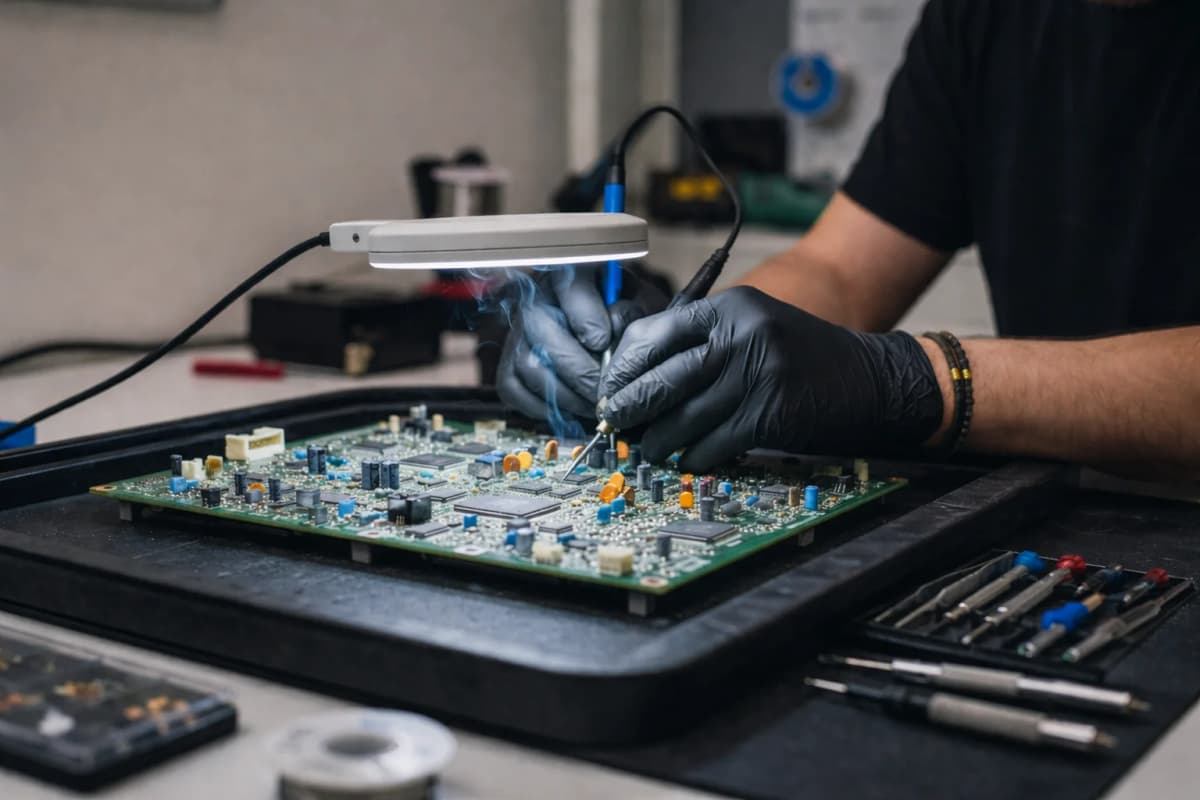
Bosch EDC7 — remapping, bench/BDM and Diesel optimization
Bosch EDC7 remapping via OBD, bench, boot/BDM. Torque/injection/turbo optimization, EGR/DPF depending on application. Workshop or file. Request your quote.
The Bosch EDC7 family is a Diesel engine ECU (ECM) commonly found on commercial vehicles and trucks where robustness is key, with sometimes limited OBD access and strict write protections. Depending on the application, we intervene via OBD when the protocol allows, otherwise in bench, boot-mode, or BDM to read and write calibration areas and, if necessary, the auxiliary memory that stores the identifier and immobilizer. Optimizations focus on injection, torque, and boost pressure maps, with potential management of EGR/DPF/AdBlue functions when controlled by the ECU. To avoid any risk of bricking, the procedure involves full backup and checksum controls. INCARLINE can perform Bosch EDC7 remapping in the workshop or provide a calibrated file remotely using protocols suited to this generation.
Find your exact reference
Search by hardware reference, software reference or control unit name. Click a result to configure and order without leaving the page.
A typical case
A garage receives an Iveco Daily Euro 4 utility vehicle equipped with a Bosch EDC7 that lacks torque under load, while the engine is healthy and the turbocharger reaches its target. The diagnosis shows a conservative torque limiter in the original calibration and unexploited injection margins, with active protections that react as soon as the demand exceeds a certain threshold. The strategy involves reading the Bosch EDC7 in bench to secure a complete backup, adapting the injection tables and torque ceilings in line with rail pressure and air management, then correcting the checksums before writing. On the road, the vehicle regains flexibility and maintains its speed better uphill without triggering limp mode, as the dynamic limiters and monitors remain aligned with the new demand.
Why this ECU has this fragility
The Bosch EDC7 relies on an architecture characteristic of its generation, with a 32-bit microcontroller and a low-level BDM interface frequently used for full access. The ECU separates calibration data and identification data (VIN, immo) into distinct memory spaces, often with a dedicated external serial EEPROM. This design, robust for everyday use, complicates partial writing via OBD: access windows are narrow, and internal supervision cuts any session at the slightest voltage, timing, or checksum discrepancy. This is why some EDC7 variants require bench/boot or BDM for reliable remapping.
Functionally, the Bosch EDC7 employs several stages of torque and smoke control, linked to admitted air, boost pressure, and rail pressure. Injection maps, smoke limiters, and torque ceilings are hierarchical, with monitors that track the gap between demand and the engine's actual capacity. An isolated modification of a single map can trigger limp mode, hence the importance of coherent adjustment of the whole (injection, torque, turbo) and associated timings. In utility and heavy-duty applications, EGR management and, depending on the version, interaction with emission systems like DPF or an external SCR device add additional dependencies that must be respected to maintain system stability.
What changes when you send it to us
Upon receiving a Bosch EDC7, the workshop process begins with a full read in bench, boot-mode, or via BDM to obtain a complete backup of the flash areas and identification memory, followed by an analysis of injection, torque, and boost maps to achieve a measured result without exceeding reasonable thermal and mechanical margins. Checksums are recalculated, identifiers are retained, then writing is validated on stabilized power with session monitoring. If a reliable OBD protocol is available for the concerned variant, the update can then be managed via the diagnostic port. This process aims for a reproducible optimization on Bosch EDC7, minimizing the risk of an interrupted session.
Access, tools, and limits specific to Bosch EDC7
In this family, OBD may suffice for some applications, but it is common to switch to bench, boot-mode, or BDM for proper reading/writing. Workshops generally rely on recognized professional platforms in the field, such as Alientech environments (including KESSv3 for supported protocols), CMD solutions for BDM/bench, or PCMflash software suites for low-level access when the dedicated module exists for the targeted EDC7; more rarely, MPPS configurations may be used if the appropriate protocol is available. The crucial point is not the brand of the tool, but the ability to communicate with the EDC7 via the correct protocol and secure a full read before any modification.
Typically reworked maps on Bosch EDC7 include injection quantity, torque limiters, and boost pressure, with, depending on the case, adjustment of EGR managers and emission functions when these are effectively controlled by the ECU. Technical limits are due to embedded protections, turbocharger tolerances, and thermal margins (EGT, cooling) specific to the vehicle. A responsible "stage 1" involves realigning the different control loops to exploit existing reserves, while a more advanced approach often requires mechanical preparation and more extensive validation. The main risk remains software bricking in case of power cut, unsuitable protocol, or non-compliant checksums; it is prevented by a full backup, stabilized power supply, and systematic file verification before writing.
In terms of the vehicle fleet, the Bosch EDC7 is found on utility vehicles and trucks like the Iveco Daily (Euro 4/Euro 5 generations), the MAN TGL (Euro 4/Euro 5 series), or the Iveco Eurocargo (Euro 4/Euro 5 families), with calibrations and access varying according to the engine and associated emission architecture. This diversity implies checking the access protocol and the extent of modifiable areas on a case-by-case basis to ensure a stable and traceable intervention on this EDC family.
Frequently asked questions
How to know if my Bosch EDC7 ECU is faulty or just poorly reprogrammed?
Which vehicles are equipped with the Bosch EDC7 ECU?
Can a Bosch EDC7 be cloned without going to the dealership?
Bosch EDC7 remapping via OBD or in BDM: which to prioritize?
Can EGR, DPF, or AdBlue be disabled on a Bosch EDC7?
What are the risks of bricking during a Bosch EDC7 remapping?
How to recover a bricked Bosch EDC7 after a failed OBD attempt?
How far can a stage 1 go on a Bosch EDC7 without mechanical modification?
Your reference isn’t listed?
Contact us — we can source your control unit or handle your repair on a quote basis.
Contact us