
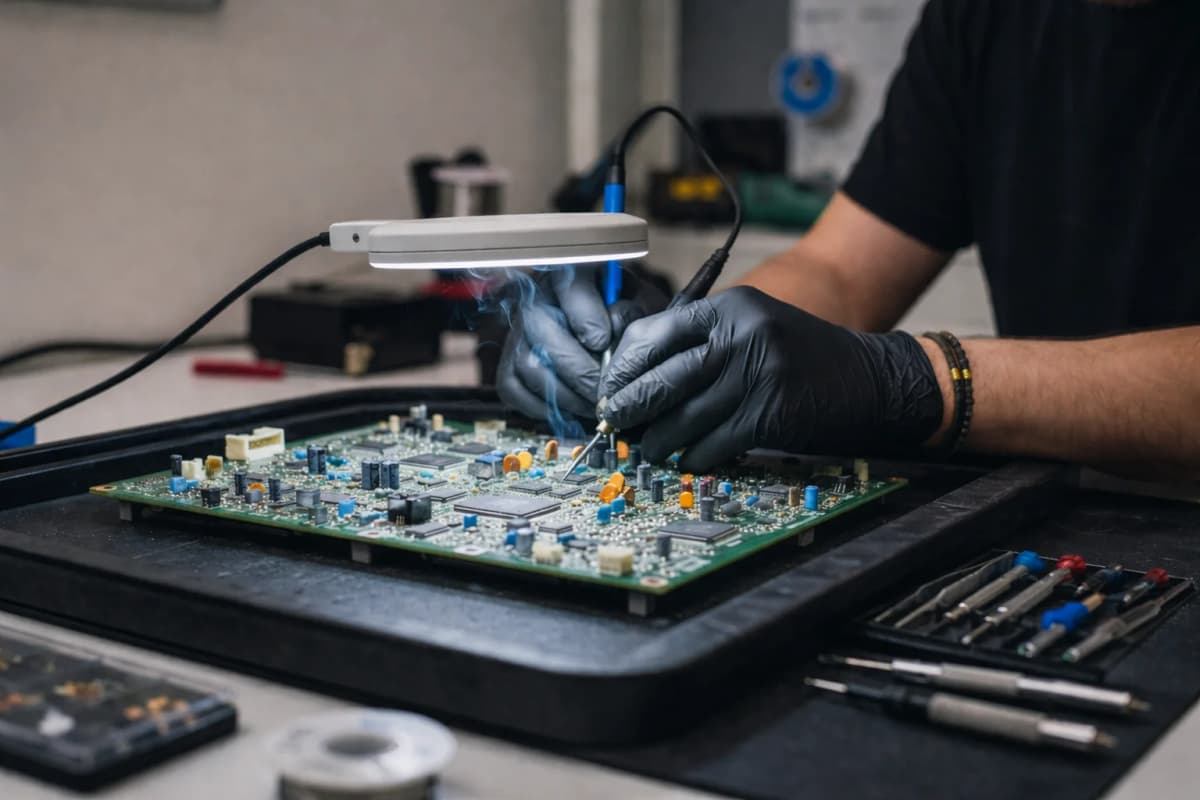
Bosch DQ500 TCM: identify the exact reference of your unit
HW/SW markings, manufacturer and Bosch number: quick guide for your Bosch DQ500. Check compatibility and start your search. Request your personalized quote.
Please note: at Incarline, “repairing” a control unit means cloning. We transfer your original data — coding, immobiliser pairing and adaptations — onto a healthy unit with an identical reference. We do not carry out component-level repairs on your original unit.
The Bosch DQ500 is the ECU for the 7-speed dual-clutch wet transmission mechatronics of the VAG group. Present notably on high-torque versions (e.g., Audi RS3 8V, Audi TT RS 8S, Audi Q3 RS Q3 8U), it manages solenoids, hydraulic pressure, and shift strategies. To order the correct part, the only reliable method is to note the exact reference on the unit's label (manufacturer reference, Bosch number, HW/SW indices, serial number) and, if necessary, confirm internal markings. A Bosch DQ500 is not interchangeable with another variant, even if it looks similar: the hardware index and software version must match. Use the configurator on this page for a search by HW/SW reference or by vehicle and validate compatibility before any intervention.
Find your exact reference
Search by hardware reference, software reference or control unit name. Click a result to configure and order without leaving the page.
Symptoms that bring you here
On transmissions equipped with a Bosch DQ500, warning signs are often clear: irregular gear shifts when hot, jerks during maneuvers, transmission warning lights on or flashing, abnormal PRNDS display, and limp mode with a single gear. There may also be a loss of reverse gear, difficult uphill starts, or a lock in third/limp to protect the system. When these symptoms appear, the ECU limits pressure and clutch strategy to prevent damage to the wet clutch and planetary gear set.
During diagnostics, faults related to 'transmission management' linked to the ECU or mechatronics are generally found (without needing to cite a specific code), and clutch adaptations out of range. The engine may run correctly, but the transmission remains disrupted, especially when hot. If you observe these behaviors, check the Bosch DQ500 TCM markings to identify the exact unit before deciding on a repair, replacement, or cloning. The page configurator allows you to confirm the correct match by hardware and software reference.
Technical causes in this family
The Bosch DQ500 combines the ECU with mechatronics (electronic board, pressure sensors, solenoids, and hydraulic block). Over time, heat, vibrations, and oil contamination can affect certain components. The TCM relies on a 32-bit microcontroller, communicates on the CAN bus with a UDS-type diagnostic protocol, and stores VIN/coding/adaptations in non-volatile memory (EEPROM/NVRAM and flash). A hardware/software mismatch between the installed unit and the sought one is enough to cause communication incompatibilities, solenoid index issues, or clutch adaptation problems.
- Aging components on the board (solenoid drivers, regulators) causing command losses under temperature.
- Internal pressure sensors drifting, distorting fill calculations and wet clutch adaptation values.
- Data corruption in memory (EEPROM/NVRAM) impacting VIN, immobilizer, coding, or learned values.
- Oil infiltration at the connector or micro-cracks in solder due to thermal cycles and mechatronics vibrations.
- Unstable 12 V supply or oxidized grounds causing TCM restarts and safety mode activation.
- Hydraulic wear of the block (excluding electronics) forcing the ECU to compensate and eventually saturating strategies.
What Incarline offers
First of all, we help you precisely identify the Bosch DQ500 unit by reading the useful markings: manufacturer reference (VAG format), Bosch number, 'HW' hardware index, and 'SW' version, as well as the serial number. On the outer label, you will typically see the manufacturer's part number, a manufacturer number, and the 'HW/SW' blocks. Internal markings (on the electronic board) may specify a hardware revision or sub-referencing; their reading is reserved for professionals and serves to confirm the index's accuracy. Use the configurator on this page to search by HW/SW or by vehicle, then upload clear photos of the labels to lock compatibility.
If your unit is faulty and its reference is confirmed, targeted repair of the Bosch DQ500 ECU can be considered when the electronics show typical and reproducible faults. When the electronics are too damaged, a paired used solution is possible provided the same hardware reference and documented software compatibility are strictly respected. Depending on the case, cloning/virginization allows transferring useful areas (VIN, immobilizer, coding, adaptations) from the old TCM to the replacement unit to avoid dealership reprogramming. In all scenarios, do not use a 'close' variant: on DQ500, the exact HW/SW index, solenoid mapping, and internal sensor set must match to restore nominal operation.
Frequently asked questions
How do I know if my Bosch DQ500 ECU is faulty?
Which vehicles are equipped with the Bosch DQ500 ECU?
Can a Bosch DQ500 be cloned without going to the dealership?
Where to find the exact reference on a Bosch DQ500?
Is the Bosch DQ500 interchangeable with another variant with a close reference?
What is the difference between a repair and a paired used unit for a Bosch DQ500?
What to do in case of a Bosch DQ500 failure on the road?
Your reference isn’t listed?
Contact us — we can source your control unit or handle your repair on a quote basis.
Contact us