
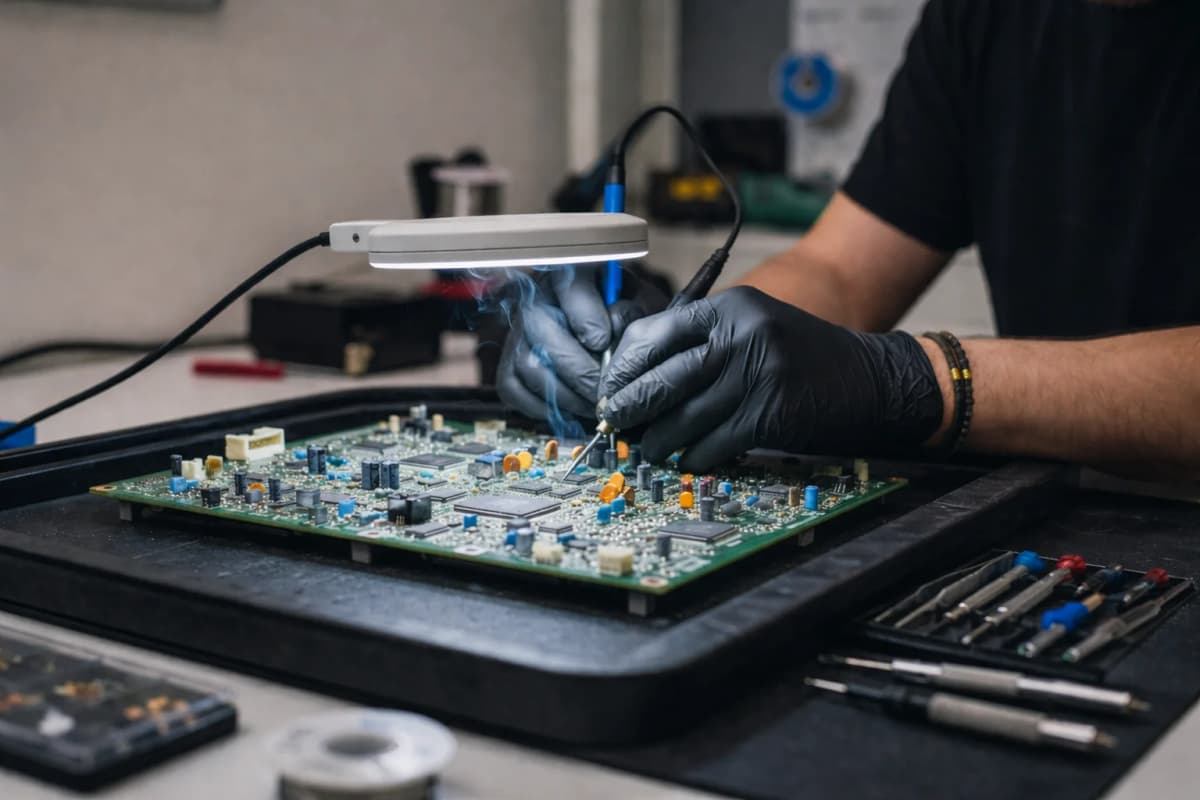
Bosch DCU17: diagnostics, repair and engine ECU bench tests
Bosch DCU17 ECU failure? Workshop diagnostics, repair, and bench testing, with pairing preservation. Request your personalized quote.
Please note: at Incarline, “repairing” a control unit means cloning. We transfer your original data — coding, immobiliser pairing and adaptations — onto a healthy unit with an identical reference. We do not carry out component-level repairs on your original unit.
The Bosch DCU17 engine ECU is a recent generation control unit, identifiable by a label mentioning "DCU17" followed by a suffix (e.g., DCU17HD01 or DCU17PC43). When a DCU17 fails, the symptoms remain typical of an ECM: engine light on, random starts, limp mode or power loss, or even lack of diagnostic communication. In the workshop, the approach is to preserve the vehicle's electronic identity (VIN, immobilizer, codings) while restoring hardware integrity: reading memories (notably EEPROM), locating faulty components (power transistors, shunt measurement resistors, capacitors, corrupted memory areas), re-soldering and replacing parts, then bench validation. The goal is to return a fully functional Bosch DCU17 already paired with the car, without needing to redo the immobilizer procedure on the vehicle side.
Find your exact reference
Search by hardware reference, software reference or control unit name. Click a result to configure and order without leaving the page.
Identify your exact reference
Before any intervention on a Bosch DCU17, it is essential to precisely identify the variant to guide diagnostics, data reading, and bench tests. Labels in this family clearly mention DCU17, followed by an alphanumeric code specific to the sub-variation (e.g., DCU17HD01 or DCU17PC43), allowing for the appropriate procedure choice.
- Cut the vehicle's power and disconnect the battery to safely remove the ECU.
- Locate the manufacturer's label on the case cover: the mention "Bosch DCU17…" appears with a suffix; note it in full.
- Also record any additional numbers present on the label to facilitate map and coding identification.
- Send a clear photo of the label with the request: this avoids any ambiguity about the Bosch DCU17 variant concerned.
The options available to you
Paired used unit
One option is to provide a compatible used Bosch DCU17 unit paired by cloning essential data, to avoid any immobilizer relearning.
Repair by cloning
The repair of your Bosch DCU17 focuses on restoring hardware condition and saving/restoring memories, to retain the original electronic identity.
Remapping/calibrations
Depending on the diagnosis, remapping or recalibration of the Bosch DCU17 may complete the intervention after bench validation.
What to expect technically
Intervention on a Bosch DCU17 begins with a meticulous visual inspection: looking for signs of overheating near power stages, checking solder joints on connectors, verifying areas sensitive to vibrations and moisture. Common failures include worn power transistors (actuator control), degraded shunt measurement resistors (current reading), dried or short-circuited capacitors, and data corruptions in memory.
The first critical step is data backup: reading the serial EEPROM (where information like VIN, immobilizer parameters, and various codings reside) and extracting relevant flash segments. Depending on the Bosch DCU17 sub-variation, access is either through a "boot" mode of the typical 32-bit microcontroller of this generation or via the CAN bus with a standard industry diagnostic protocol; in all cases, the priority is the integrity of identifiers and calibrations.
Next comes the hardware part. Components identified as faulty with a multimeter and oscilloscope are cleanly desoldered (hot air, infrared, or suitable station), tracks are checked and cleaned, then replaced identically. On some Bosch DCU17 units, the microcontroller and/or certain memories are in BGA package; reballing or careful BGA resoldering may be necessary in case of solder microcracks. After replacement, a flatness, alignment, and isolation check is performed, and the internal thermal paste is reapplied if the cover design requires it.
Once the hardware part is secured, the Bosch DCU17 ECU is bench validated. The ECU is powered on a test harness, with simulation of sensor and actuator signals, and exchanges on the CAN network to verify diagnostic communication and key function behavior. If a software inconsistency is detected (altered map, damaged flash sectors), targeted remapping is performed to realign the firmware and calibrations with the saved identification data.
At the end of the tests, the ECU is closed, seal integrity checked, then marked as ready. The Bosch DCU17 is returned to you paired with the original vehicle: no immobilizer relearning is generally required on the vehicle side, as the VIN, immobilizer, and codings are retained. The typical workshop turnaround time depends on the nature of the failure and the complexity of the variant, and it is communicated during the quote; a workshop warranty applies according to the prevailing conditions. This approach limits immobilization time and avoids additional adaptations during installation.
Specific points to keep in mind for the Bosch DCU17 family: the sub-variant nomenclature (e.g., DCU17HD01 and DCU17PC43) guides the choice of memory access procedure; the architecture relies on a common 32-bit microcontroller in this segment with dedicated SPI serial EEPROM for identifiers, and diagnostic exchange occurs via the vehicle's CAN network with a widely used aftermarket protocol. These characteristics guide both the backup/cloning strategy and integrity checks after cloning.
Frequently asked questions
How do I know if my Bosch DCU17 ECU is faulty?
Which vehicles are equipped with the Bosch DCU17 ECU?
Can a Bosch DCU17 be cloned without going to the dealer?
What is the difference between a repair and a paired used unit for a Bosch DCU17?
What should I do in case of a Bosch DCU17 failure?
What critical data is found in a Bosch DCU17's EEPROM?
Does a repaired Bosch DCU17 require immobilizer relearning?
Your reference isn’t listed?
Contact us — we can source your control unit or handle your repair on a quote basis.
Contact us