
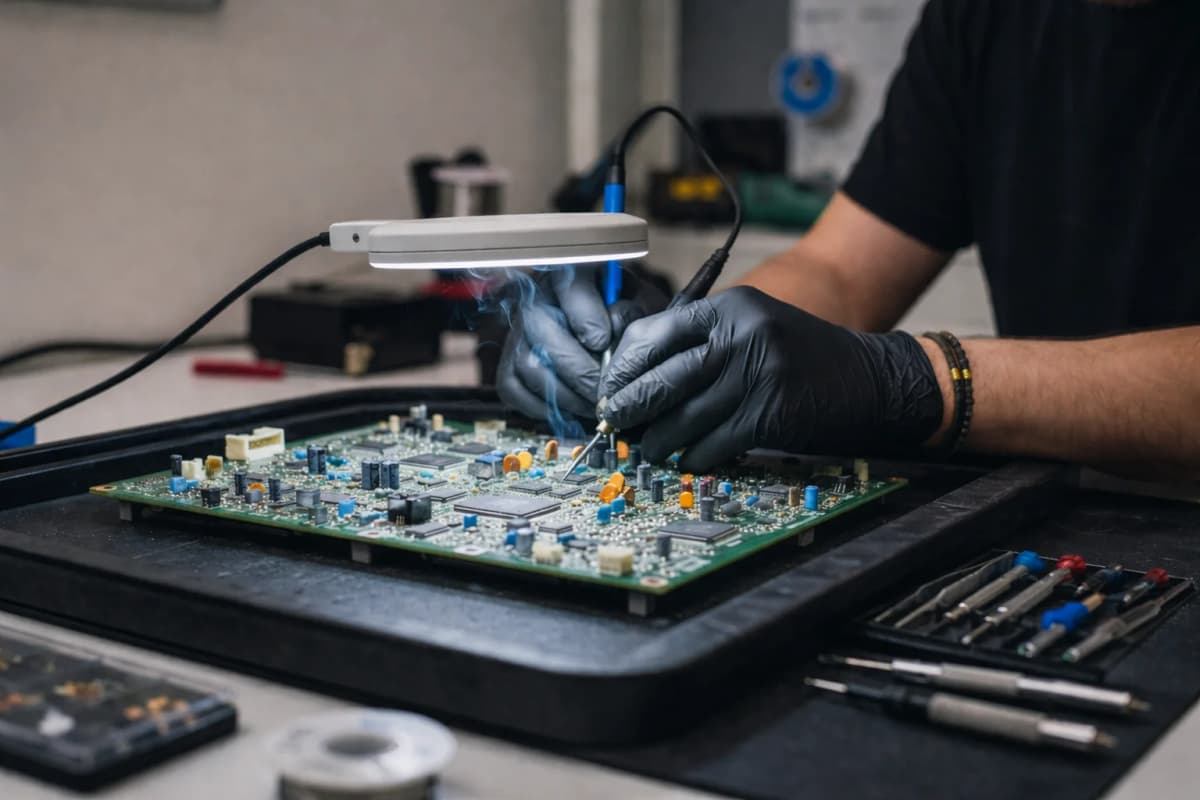
Bosch BMS: diagnosis of a faulty engine ECU, solutions
Bosch BMS ECU failure? Warning light, limp mode, difficult starting: diagnosis and options (repair, cloning, replacement). Request your personalized quote.
You have just run the diagnostic tool and everything points to the Bosch BMS ECU: engine warning light on, limp mode, power loss, sometimes impossible starting. In this family of Bosch BMS ECMs, we encounter internal faults (power supply, injector or ignition drivers), communication losses, or memory errors that disrupt injection and timing. The diagnosis must distinguish between ECU failure and peripheral sensor (mass air flow sensor, EGR, lambda sensor, injector). When the sensor measurement seems plausible but the command is not executed or 'internal ECU' faults reappear, the Bosch BMS is at fault. INCARLINE can confirm the diagnosis on the bench and propose the appropriate follow-up.
Find your exact reference
Search by hardware reference, software reference or control unit name. Click a result to configure and order without leaving the page.
In brief
The Bosch BMS is an engine ECU (ECM) managing injection, ignition, and immobilizer. Typical symptoms of a faulty BMS include a persistent engine warning light, limp mode, misfires, power loss, or random starting. Diagnostic tools often report internal module errors, power supply issues, injector/coil command failures, or CAN/K-line communication problems. Depending on the condition, targeted repair, Bosch BMS cloning, or paired replacement are possible.
Frequently asked technical questions
Why does this Bosch BMS ECU fail?
With age, thermal and vibrational stresses wear out the power electronics and internal soldering. In the Bosch BMS range, we typically observe weaknesses in the power stage, certain drivers (coils/injectors), and memory area corruptions after electrical shocks. The ECM integrates a 32-bit microcontroller, parallel flash memory for maps, and a serial EEPROM for learning/immobilizer data; alterations of these elements cause recurring faults and erratic behavior.
What indicators point to the Bosch BMS rather than a peripheral sensor?
A faulty sensor results in an inconsistent measurement but a coherent ECU reaction (targeted fallback strategy). Conversely, a faulty Bosch BMS often accumulates multiple symptoms without simple logic: starting only when cold, sharp cuts at stable RPM, missing injector commands on several cylinders while power supplies and grounds are good. Fault logs display internal ECU errors, intermittent communication losses on CAN/K-line, or checksum inconsistencies. When, after replacing a sensor (mass air flow/EGR/sensor), the fault persists identically, the ECM is the suspect.
What DTC codes are typical on a Bosch BMS?
Without listing specific references, this family encounters faults related to the internal processor/controller, ECU power supply (voltage out of range), command outputs (injectors, coils, idle actuators), and communication (missing CAN frames or impossible K-line session). Immobilizer or VIN pairing errors may also appear after a battery drop or electrical intervention, as the Bosch BMS stores these data in EEPROM.
Which vehicles are affected by the Bosch BMS and are there any communication peculiarities?
The Bosch BMS is found on certain BMW petrol models of a certain generation and on BMW Motorrad using units from the same family (e.g., BMW R1200GS K25, BMW R1200RT K26, BMW K1200S K40). Depending on the variants, diagnostics use CAN for fast exchanges and often retain a K-line for certain legacy functions. This dual communication stack explains why a diagnostic tool can partially read the ECUs while other functions refuse connection when one of the buses is unstable.
Possible remedies
After taking measurements (power supplies, grounds, continuity, command signals) and running the diagnostic tool, the logical step is to send the Bosch BMS for professional bench diagnosis; depending on the verdict, INCARLINE can offer targeted repair, replacement with a pre-paired used Bosch BMS, or Bosch BMS cloning to retain the immobilizer and vehicle settings without going through the network.
Frequently asked questions
How do I know if my Bosch BMS ECU is really faulty and not a sensor?
Which vehicles are equipped with the Bosch BMS ECU?
Can a Bosch BMS be cloned without going to the dealer?
What are the typical symptoms of a Bosch BMS failure while driving?
What technical peculiarities of the Bosch BMS complicate diagnosis?
What is the difference between repair and paired used Bosch BMS?
What to do if my Bosch BMS no longer opens the diagnostic session?
Your reference isn’t listed?
Contact us — we can source your control unit or handle your repair on a quote basis.
Contact us