
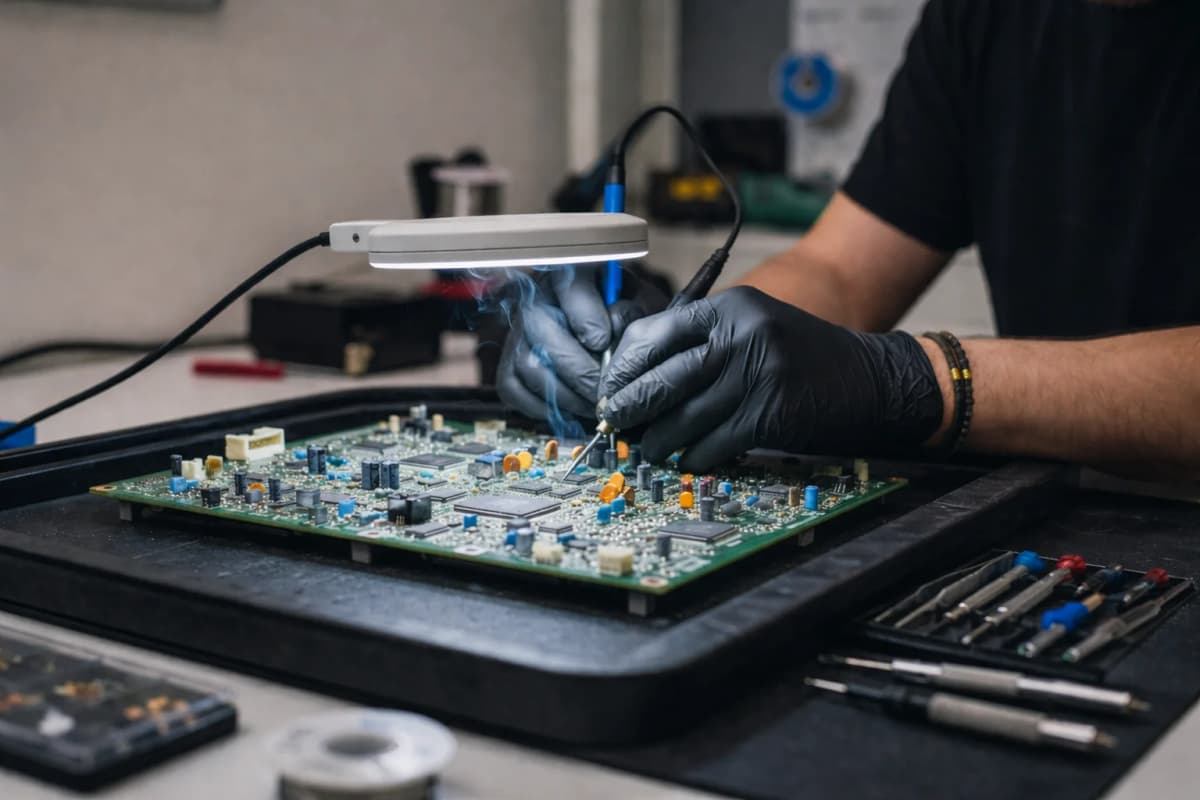
Bosch AS: paired used engine ECU ready to install
Bosch AS engine ECU tested and paired (same HW/SW), ready to install as an exchange unit. Ideal for older ranges. Request your personalized quote.
Please note: at Incarline, “repairing” a control unit means cloning. We transfer your original data — coding, immobiliser pairing and adaptations — onto a healthy unit with an identical reference. We do not carry out component-level repairs on your original unit.
The Bosch AS engine ECU belongs to an older generation of petrol/diesel ECUs where the architecture generally relies on an 8 or 16-bit microcontroller, an external EEPROM for identification data, and diagnostic exchanges via K-Line on ISO 9141/14230 protocol, sometimes with limited CAN network presence depending on the variants. As these units age, faults related to soldering, memories, and thermal environment become recurrent: random starts, limp mode, persistent engine light, communication losses, or non-specific fault codes. On these Bosch AS units, component-level repair is often hindered by the scarcity of parts and variable effectiveness. This is why Incarline offers, for this family, a paired used solution: a Bosch AS ECU tested on the bench, with the same hardware reference and software version, then prepared to take over your vehicle's identification (VIN, immobilizer, learning parameters) when applicable.
Find your exact reference
Search by hardware reference, software reference or control unit name. Click a result to configure and order without leaving the page.
A typical case
A workshop receives a European compact car equipped with a Bosch AS ECU exhibiting erratic starting, the engine light on, and intermittent communication with the diagnostic tool. After checking power supplies, grounds, and wiring, the diagnosis points to the ECU: uncertain EEPROM reading, sporadic frame loss on the K-line, and inconsistent behavior when hot. Instead of immobilizing the vehicle for a long time to attempt component-level repair with parts that have become difficult to find, the chosen solution is a rigorously identical used Bosch AS (same HW/SW reference) from a compatible donor. The unit is prepared so that the immobilizer and vehicle identifier are recognized, then installed. After a short engine adaptation relearning authorized by the manufacturer, the car regains stable operation.
Why this ECU has this fragility
The Bosch AS is situated in a transitional period of engine electronics where one frequently encounters an 8-pin serial EEPROM dedicated to identifiers (VIN, immobilizer, codings) and, depending on the references, a program memory in parallel flash or EPROM. The board topology and solder alloys of this era poorly withstand long-term thermal cycles and vibrations: micro-cracks at the memory units or main connector then cause random cut-offs, especially when hot. It is also a generation where diagnostic communication is very often carried out on K-Line ISO 9141/14230, sensitive to imperfect grounds and even slight oxidation on the wiring, complicating investigation when the unit starts to fail. In this context, simply 'reprogramming' does not correct a latent hardware weakness, and localized solder rework is not always sufficient if the substrate or pads have aged.
Another point specific to this technological niche: the architecture around an 8/16-bit microcontroller imposes well-defined memory areas for maps and identification. When the EEPROM deteriorates (unstable cells, corruption after under-voltage), symptoms range from immobilizer refusal to the inability to connect the diagnostic tool without displaying a specific code. Moreover, some Bosch AS variants poorly tolerate starter overvoltages or prolonged voltage drops, accelerating the electrical wear of memories and linear regulators. This is why, on these older Bosch AS units, replacement with a paired used unit with the same hardware and software reference often proves more reliable than the hunt for rare components and partial restoration: starting from a sound bench-tested base while preserving the vehicle's electronic identity.
What changes when you send it to us
Upon receiving your faulty Bosch AS, the unit is identified by its label and electronic reading, then the necessary data (EEPROM, identifiers, immobilizer parameters when possible) is extracted. A stock Bosch AS ECU, with the same HW/SW reference, is then selected and verified on the bench with cold/hot sequences and K-Line and, if applicable, CAN communication tests. The information from your old unit is transferred or readied for pairing; depending on the case, direct starting is possible, or a brief relearning (idle, fuel adaptation) is performed after installation. Incarline thus provides a paired used unit ready to install as an exchange unit, and you return yours to complete the operation.
Frequently asked questions
How do I know if my Bosch AS ECU is really the cause?
Can a Bosch AS be cloned to retain the immobilizer and VIN?
Which vehicles are equipped with the Bosch AS ECU?
Does the Bosch AS use K-Line or CAN for diagnostics?
Where are the data to be retained located in a Bosch AS?
Is relearning necessary after replacement with a paired used Bosch AS?
Can the maps of a Bosch AS be reprogrammed after replacement?
Your reference isn’t listed?
Contact us — we can source your control unit or handle your repair on a quote basis.
Contact us