
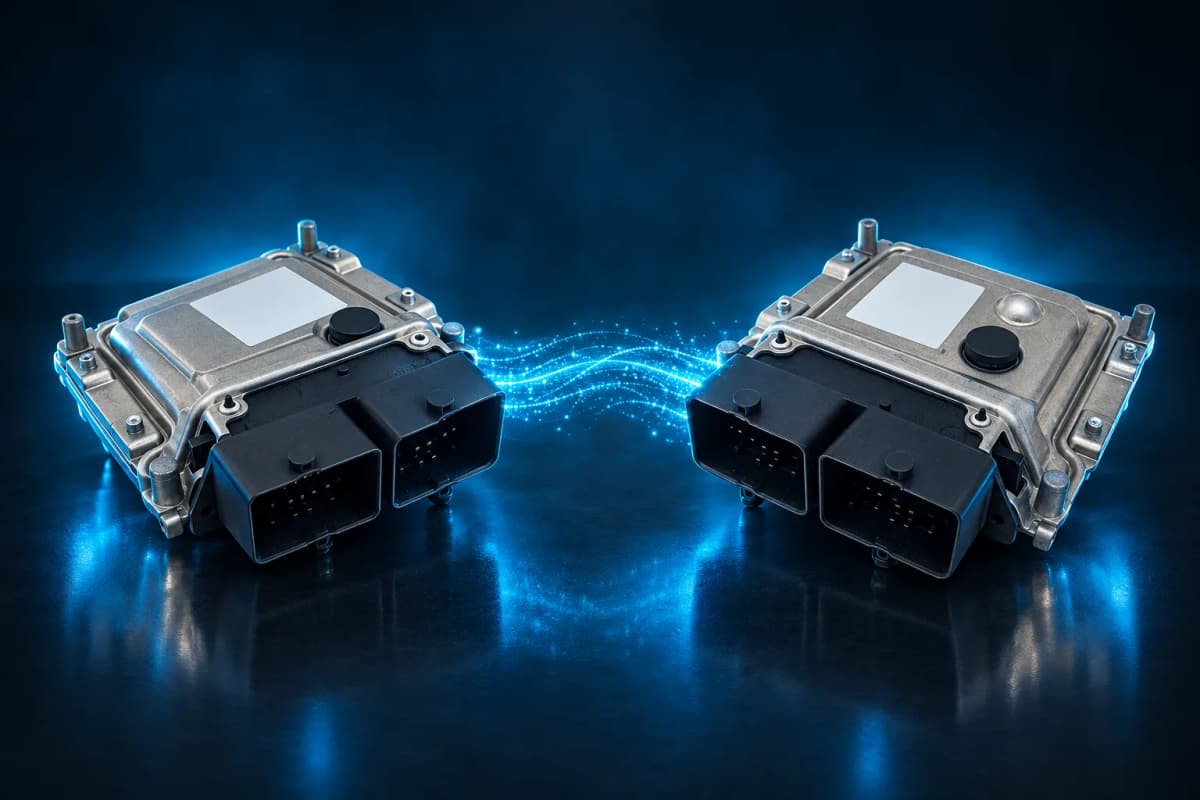
Repairing an engine ECU is possible, but its reliability entirely depends on diagnosis and validation. Why cloning to a healthy ECU is a safer answer.
When an engine ECU fails, the first question that almost always arises is the same: can it be repaired? The honest answer is that repairing an ECU is technically possible in many cases — but it does not offer the same guarantees as replacing it with a healthy ECU reprogrammed with your data. Here's why, at Incarline, we prioritize cloning.
What does repairing an ECU actually mean?
An engine ECU is an electronic board enclosed in a sealed casing. Repairing means identifying the faulty component — a power transistor, a swollen capacitor, a track corroded by moisture, a solder cracked by vibrations — and then replacing it with a soldering iron or hot air.
On paper, it's appealing: you keep the original casing, so the registration, immobilizer code, and mapping remain in place. No remapping, no adaptation. This is why repair is still commonly offered.
The problem is not the act of repair. It lies elsewhere, and it boils down to two words: diagnosis and validation.
The real obstacle: proving the fault is what you think it is
An ECU almost never fails as a whole. An injector fault can destroy a power stage; water ingress can damage three tracks, only one of which is visible; a startup overvoltage can weaken a component that will last another six months before failing.
In other words: repairing what is visible does not guarantee that what is broken has been addressed. And that's where the problem lies, because an ECU cannot be seriously tested on a workbench. It must be tested on the vehicle, under real conditions — hot engine, full electrical load, all sensors connected.
Verifying that a repaired ECU really works requires having a bench capable of simulating the exact electrical architecture of the vehicle concerned. These benches exist, but each ECU family requires its own. Without this validation, a repair goes to the client with an unknown: the residual fault that will only manifest after a few hundred kilometers.
Cloning: starting from a base whose condition is known
Cloning involves retrieving all the data from your original ECU — engine mapping, immobilizer code, serial number, adaptations learned over the miles — and transferring them to an ECU of the same type, whose operation is certain.
You thus receive a casing that behaves exactly like yours, without dealership remapping and without relearning. The difference lies in one point: the electronics executing these data are healthy, not repaired and assumed healthy.
This eliminates the risk that concerns us most, that of a latent malfunction invisible at the workshop. On a functional base, there is nothing to discover later.
When repair still makes sense
It would be dishonest to claim that an ECU should never be repaired. Two situations fully justify it.
The first case is that of the unavailable ECU. On some older or less common vehicles, no compatible casing is available; repair then becomes the only possible way.
The second is that of a perfectly circumscribed fault, with a known and documented failure mode on this specific model — a component that always fails in the same way, on an identified series. The diagnosis is no longer a hypothesis.
Outside of these cases, the price-risk ratio leans towards cloning.
What this concretely changes for you
An ECU cloning at Incarline starts at €130 excluding VAT. You send us your original ECU, we extract the data, transfer them to a healthy casing, and return it to you ready to install. No dealership visit, no car key reprogramming, no loss of engine adaptations.
If your ECU is not the cause — it's more common than you think, a damaged harness or a faulty sensor produce the same symptoms — we will tell you rather than sell you an unnecessary service.
In summary
Repairing an engine ECU is not a bad practice: it is a practice whose reliability entirely depends on the quality of diagnosis and validation. Cloning shifts the problem to where it is manageable — on an electronic base whose condition is known — while retaining everything that makes up your vehicle's identity.
This is why we have made it our default response to faulty ECUs, and why we reserve repair for cases where it is truly the best option.
Questions fréquentes
Un calculateur cloné est-il un calculateur d'occasion ?
C'est un calculateur du même type que le vôtre, vérifié fonctionnel, sur lequel vos données ont été transférées. Il porte votre configuration et votre code antidémarrage : pour le véhicule, c'est le vôtre.
Faut-il repasser en concession après un clonage ?
Non. Les données transférées incluent le code antidémarrage et les adaptations. Le calculateur se monte et le véhicule démarre, sans intervention supplémentaire.
Combien de temps faut-il compter ?
Comptez 3 à 5 jours ouvrés après réception du calculateur dans notre atelier, retour compris.
Et si mon calculateur est trop endommagé pour être lu ?
C'est le cas limite. Si la mémoire est illisible, les données ne peuvent pas être extraites : il faut alors passer par un calculateur vierge à adapter au véhicule. Nous vous le dirons dès le diagnostic.
Clonage Calculateur ECU
Our technicians carry out this operation in our workshop.